Šimšir

PrirodnaDRVAgreen · catty · woody
Gornje notePiramida
—Jačina
—Trajnost
3Poreklo
Uzorak
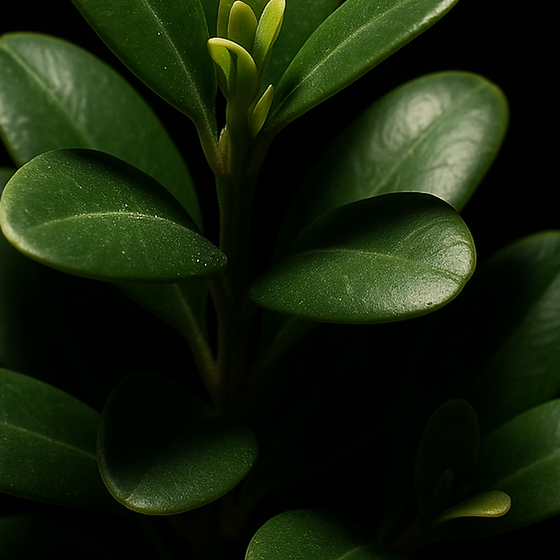
Šimšir kao sirovina za parfeme
Gornje note
Buxus sempervirens
Definicija

Buxus is the genus of box, or boxwood, a group of evergreen shrubs and small trees. The genus has about seventy species, and the name box refers especially to Buxus sempervirens, the common box.

ZELEN MAČJI SUMPORAST DRVENAST
Boxwood, box, common box, European box
Type
Sirovina
Olfactive family
Drvenasti
Instrumenti
Piramida
GGornje note
SSrednje note
BBazne note
Zemlje proizvođači
Western and southern Europe northwest Africa southwest Asia

Miris

The scent of common box is most pungent on warm summer days. It has been likened to cat urine. Some people find it to be malodorous. Not everyone finds the scent disagreeable.

Detaljno

The genus Buxus has about seventy species in the family Buxaceae. The majority of species are tropical or subtropical, and only the European and some Asian species are frost-tolerant.

Buxus sempervirens, the common box, is an evergreen shrub or small tree growing 1 to 9 m tall. It is native to western and southern Europe, northwest Africa and southwest Asia, from southern England south to northern Morocco and east through the northern Mediterranean region to Turkey. The leaves are arranged in opposite pairs, green to yellow-green and oval, 1.5-3 cm long and 0.5-1.3 cm broad. The flowers are inconspicuous but highly scented, greenish-yellow, with no petals. The species typically grows on soils derived from chalk and limestone, usually as an understorey in forests of larger trees. Box Hill, Surrey is named after its notable box population, which comprises the largest area of native box woodland in England.

In gardens, box is a very popular ornamental, especially for topiary and hedges, thanks to its small leaves, its evergreen habit, its tolerance of close shearing and its scented foliage. The scent is not to everyone's liking: the herbalist John Gerard found it "evil and lothsome". Daniel Defoe recounts that Queen Anne had the box hedging at Hampton Court Palace removed because she found its odour offensive.

Slow growth makes boxwood very hard, possibly the hardest in Europe along with Cornus mas, and heavy. The wood is used for cabinet-making, flutes and oboes, engraving, marquetry, woodturning, tool handles and mallet heads, and as a substitute for ivory. The extremely fine endgrain suits woodblock printing and woodcut blocks, and box was the usual material for them in Europe. Boxwood is often used for chess pieces because of its relatively high density. Before the development of plastics, its density and stability made it one of the best available materials for measurement scales and technical drawing rulers. Boxwood has been used since antiquity to make parts for various stringed instruments, mostly tailpieces, chin rests and tuning pegs. It was a common material for making recorders in the eighteenth century.

Buxus sempervirens contains steroidal alkaloids such as cyclobuxine, and it also contains flavonoids. The toxic principle in the leaves is steroidal alkaloids, and the poison severity is low. Contact with the cell sap may cause skin irritation. The leaves were formerly used in place of quinine and as a fever reducer. They were also used as an auburn hair dye.

Zanimljivosti

Digging sticks made by Neanderthals more than 170,000 years ago in Italy were made from boxwood. Catholic households in climates where palms are scarce often use boxwood twigs instead to adorn their crosses on Palm Sunday.

Dobijanje i hemija

Formula
Complex natural mixture (key constituents: cyclobuxine C₂₅H₄₂N₂O)
Botanički naziv
Buxus sempervirens
Izgled
Heartwood basically yellow to white or grey
Sinonimi
Boxwood, box, common box, European box
Status prema standardima IFRA
Pogledajte napomenu

No IFRA Standard for the material itself (51st Amendment)

Fizička svojstva
Relativna gustina
0.79-0.92-0.97 g/cm3

Pogledajte i

5 nota