Cipriol

PrirodnaDRVAzemljan · drvenast · bogat
Bazne notePiramida
4/5Jačina
—Trajnost
1Poreklo
Uzorak
Cipriol kao sirovina za parfeme
Bazne note
Cyperus scariosus
Definicija

Cypriol, also called nagarmotha oil, is an essential oil distilled from the roots of Cyperus scariosus. Its aroma is described as woody, earthy, dry, spicy, patchouli and vetiver.

DRVENAST ZEMLJAN DIMNI BIBERAST
cypriol, nagarmotha oil
Type
Sirovina
Olfactive family
Drvenasti
Source
roots (rhizomes)
Chemical class
complex natural (essential oil)
Instrumenti
Piramida
GGornje note
SSrednje note
BBazne note
4/5Jačina
Visoka
jačina mirisa
Zemlje proizvođači
Indija

Miris

The scent is woody-earthy, dry-amber and slightly peppery. It has an earthy, leathery undertone, and it evokes nuances of vetiver, cedarwood and olibanum. The initial impression is fresh and diffusive, resembling an Oriental cinnamon-olibanum complex that is dry, woody and slightly spicy. The body note moves towards the woody-earthy depth of Virginia cedarwood and vetiver oils. The drydown is sweet-woody and rich, with strong vetiver-like undertones, smoky leather facets and a subtle peppery warmth.

Teroar i zrelost

Detaljno

Cyperus scariosus is a perennial herbaceous plant from Australia and New Guinea. The species was first formally described by the botanist Robert Brown in 1810. It is very similar to Cyperus pertenuis, and Georg Kükenthal thought it was a variety of Cyperus corymbosus.

Explore all seven extraits in the Discovery Set.

Distribution

It occurs in Papua New Guinea and Australia. In Australia it occurs in northern, eastern and central Queensland, northern Northern Territory and Western Australia. It is not known from the Indian subcontinent. In parts of India, the name is commonly misapplied to Cyperus pertenuis.

Chemistry

The major compounds in the essential oil of nagarmotha rhizomes are cyperene, longifolin, caryophyllene oxide and longiverbenone. The amount of cyperene varied from 5.77% to 24.17% across 13 locations in India. Longifolin ranged from 5.95% to 20.43%, caryophyllene oxide from 2.42% to 10.38%, and longiverbenone from 3.96% to 12.71%.

Rotundone has the highest odor-activity value of the compounds measured in cypriol oil and, together with the other ketones, contributes to its woody-amber character. A new ketone, cyperen-8-one, has a significant woody, ambery odor. A novel lactone, cyperolactone, and an alcohol were also identified in the oil. A total of 21 nitrogenous components have been reported, of which epi-guaipyridine, cananodine and guaia-9,11-dienpyridine were the most abundant.

Composition in more detail

The 13 Indian oils differed considerably in chemical composition. Among the nitrogen-containing molecules, epi-guaipyridine was found at 32 mg/kg, cananodine at 10 mg/kg and guaia-9,11-dienpyridine at 9 mg/kg.

Rotundone is a bicyclic sesquiterpene with the formula C₁₅H₂₂O and a molecular weight of 218.33.

Taxonomy

The species belongs to the family Cyperaceae in the order Poales, and its name is accepted.

Dobijanje i hemija

Način dobijanja

The essential oil is distilled from the roots. Hydro-distillation of rhizomes collected from 13 locations in India gave oil yields from 0.20% at Padampur (Orissa) to 0.58% at Tilakgram (M.P.).

Formula
Complex natural mixture (key constituents: cyperene; longifolin; caryophyllene oxide; longiverbenone; rotundone C₁₅H₂₂O; cyperen-8-one)
CAS
68916-60-9
Botanički naziv
Cyperus scariosus
Izgled
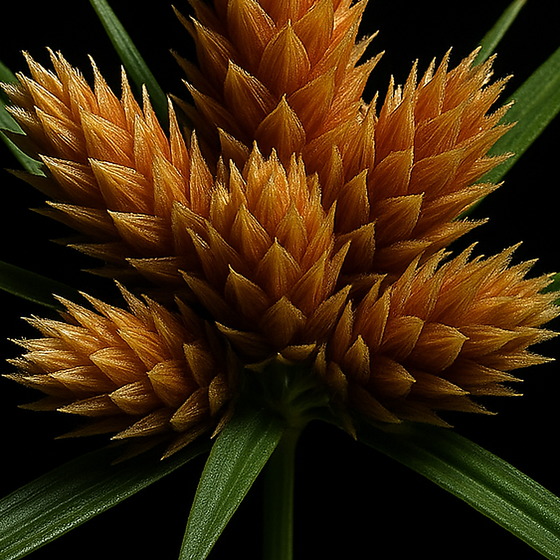
amber to light brown viscous liquid
Jačina mirisa
Jak
Sinonimi
cypriol, nagarmotha oil
Status prema standardima IFRA
Pogledajte napomenu

No IFRA Standard for the material itself (51st Amendment)

U parfemima

Cypriol is used in perfumery as a fixative. It is used in woody and Oriental bases, dry-amber accords and heavy fougères. In fine fragrance, typical usage ranges from 0.5% to 3% when it is used as a fixative and blender. In heavy fougères it supplies earthy-woody depth, strength and tenacity to the classic lavender, coumarin and oakmoss structure. It is also applied in forest notes and, combined with galbanum resinoid, in hyacinth compositions. Typical partners are bergamot (particularly in dry-amber structures), labdanum, patchouli, clary sage, vetiver, sandalwood, cedarwood derivatives, oakmoss products, frankincense, cistus and galbanum. The oil also blends well with methylionones, isoeugenol and woody-amber synthetics. At 0.5-2% it acts as a fixative and modifier that strengthens woody-earthy depth without dominating. Above 2% its soft-woody note and top-note diffusivity become noticeable, and at 3-10% its character is meant to stand out. In soap perfumery and functional fragrance, its low cost, tenacity and stability make it economically attractive.

Uloga u formuli
01fiksativ
02naturalizator
03graditelj volumena
04modifikator
Oblici na tržištu
eterično ulje apsolut

Pogledajte i

6 nota