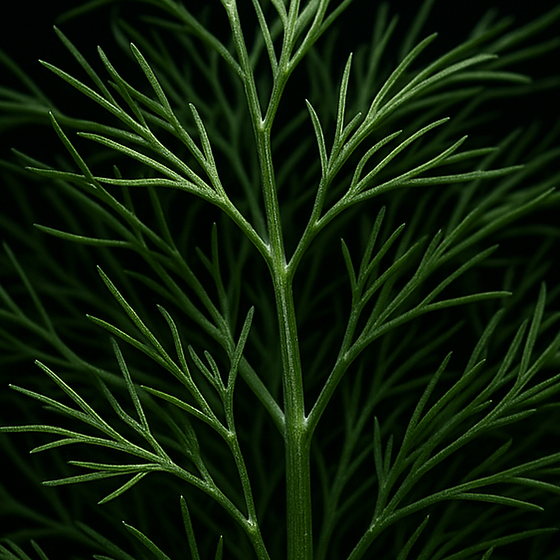
Mirođija

PrirodnaZAČINIzelen · svež · sladak
Srednje notePiramida
4/5Jačina
—Trajnost
5Poreklo
Uzorak
Mirođija kao sirovina za parfeme
Srednje note
Anethum graveolens
Definicija

Dill (Anethum graveolens) is an annual herb of the celery family Apiaceae, and its oil is extracted from the leaves, stems and seeds. The oil from dill seed has a caraway-like odor.

ZAČINSKI BILJNI CITRUSNI SVEŽ AROMATIČAN
Dillweed oil, Dill herb oil
Type
Sirovina
Olfactive family
Začinski
Source
leaves, stems and seeds
Chemical class
essential oil
Instrumenti
Piramida
GGornje note
SSrednje note
BBazne note
4/5Jačina
Visoka
jačina mirisa
Zemlje proizvođači
Sjedinjene Američke Države Kanada Bugarska Mađarska Ukrajina

Miris

American dill weed oil has a strong, fresh, somewhat spicy, aromatic odor. Dill's odor type is herbal. The seeds have a pleasant aromatic odor, and the aroma of dill seeds comes from carvone, which is spicy and caraway-like, and limonene, which is fresh and citrus-like.

Detaljno

Dill (Anethum graveolens) is the sole species of the genus Anethum, though some botanists classify it in the related genus Peucedanum as Peucedanum graveolens. It grows from a taproot up to 0.5-1.5 metres tall, with slender, hollow stems and finely divided leaves. The seeds are not true seeds but the halves of very small, dry fruits called schizocarps. Dill is grown widely in Eurasia, where its leaves and seeds are used as a herb or spice for flavouring food.

In North America two forms of dill oil are encountered: dill weed oil, from Anethum graveolens, and dill seed oil, which is usually of Indian origin and comes from A. sowa. Carvone and limonene are the main constituents of the oil from the fruits. The S-(+) enantiomer of carvone occurs to the extent of about 40-60% in dill seed oil. In one analysis of dill seed oil, carvone made up 46.1% and limonene 43.8% in oil from non-shaded plants, against 49.8% and 37.8% in oil from shaded plants. The carvone content of dill seed oil differs by origin, with the highest values reported for Romania (75.2%), Uzbekistan (73.61%) and Egypt (62.48%) and the lowest for Algeria (34.3%).

Dill weed oil is the most important of the two oils. In a reported composition of dill weed oil, the major constituents are carvone (35%), limonene (25%) and α-phellandrene (29%). The (+)-dill ether of dill weed oil, present at up to 10%, is responsible for the typical organoleptic properties of the dill plant and of dill weed oil. Dill ether is 3,9-epoxy-1-p-menthene. Carvone is the predominant odorant of dill seed, while α-phellandrene, limonene, dill ether and myristicin are the most important odorants of dill herb. As the plant progresses from flowering to fruit ripeness, the carvone content of the oil increases and α-phellandrene decreases. Carvone is higher in oil from widely spaced plants, while phellandrene, α-pinene and dill ether are lower.

Successful cultivation of dill requires warm to hot summers with high sunshine levels, and even partial shade reduces the yield substantially. The seed is harvested by cutting the flower heads off the stalks when the seed is beginning to ripen. Dill is best when used fresh, as it loses its flavor rapidly if dried.

The fern-like leaves of dill are aromatic and flavour foods such as gravlax (cured salmon) and other fish dishes. Dill seeds are used whole or ground in the food industry to flavour meats, stews, pastries, bakery products and vinegars. Carvone, the compound most responsible for the flavour of caraway, dill and spearmint, has been used in food for millennia.

Explore all seven extraits in the Discovery Set.

—

Related: Allspice · Anethole · Anise · Asafoetida · Baking Spices · Bay Leaf · Biryani · Caraway

Zanimljivosti

S-(+)-carvone, the form found in dill seed oil, has a spicy aroma with notes of rye and gives caraway seeds their smell, while its mirror image R-(-)-carvone has the sweetish minty smell of spearmint leaves. That the two are perceived as smelling different is evidence that olfactory receptors must respond more strongly to one enantiomer than to the other.

Dobijanje i hemija

Način dobijanja

Dill seed oil is obtained by steam distillation of the fruits (seeds). Dill weed oil is obtained by steam distillation of the dill weed (herb) before the fruits mature. Oil yield and composition vary with the relative amount of vegetative and reproductive tissue and the maturity of the plant material distilled. The oil content is lowest in leaves (0.08%), rises to 1.10% in flowers and reaches its maximum (3.20%) in the full ripening stage with seeds. The highest oil yields with maximum carvone levels were obtained when most of the fruits on primary umbels were pigmented but had not become dry and fully mature. The fruit yields about 3.5% of the oil.

Formula
Complex natural mixture (key constituents: carvone C₁₀H₁₄O; limonene; α-phellandrene; dill ether)
CAS
8006-75-5
Botanički naziv
Anethum graveolens
Izgled
Pale-yellow to yellow liquid
Jačina mirisa
Jak
Sinonimi
Dillweed oil, Dill herb oil
Status prema standardima IFRA
Pogledajte napomenu

No IFRA Standard for the material itself (51st Amendment)

Fizička svojstva
Tačka ključanja
189 °C
Tačka paljenja
147 °F
Relativna gustina
0.895 to 0.915
Indeks prelamanja
1.483 (n20/D)

U parfemima

The oil from the seeds is distilled and used in the manufacturing of soaps. Dill oil serves in flavors and fragrances, and its cosmetic function is perfuming. Dill is not featured in any current PREMIEREPEAU fragrance.

Uloga u formuli
01modifikator
02nota potpisa
03sredstvo za podizanje
04sirovina za stapanje
05graditelj volumena
06svežina
Oblici na tržištu
eterično ulje

Pogledajte i

7 nota