


Zelena čili papričica
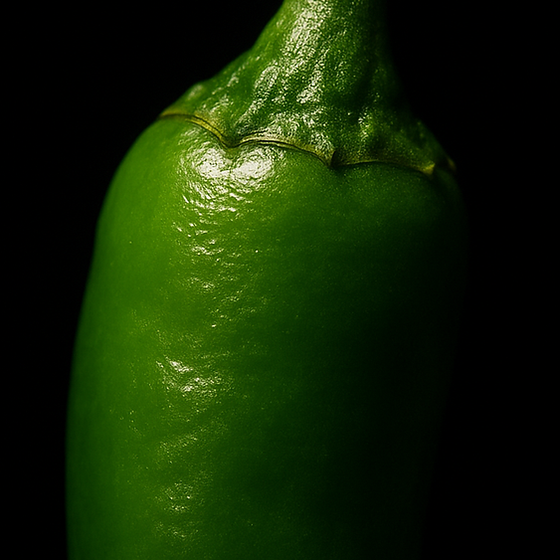
In 2024, world production of green chillies and peppers, counted as any Capsicum or Pimenta fruits, was 45 million tonnes. The smell of peppers comes from 3-isobutyl-2-methoxypyrazine, which is mainly contained in the flesh of the pepper.
- Type
- Akord
- Olfactive family
- Aromatični
- Chemical class
- Methoxypyrazine
Miris
Detaljno
Zanimljivosti
TRPV1, the capsaicin receptor, is an ion channel activated by capsaicin and by temperatures greater than 43 °C, and its activation leads to a painful, burning sensation. Birds do not feel pungency because they lack TRP channels, and pepper seeds are not destroyed when birds eat and digest them.
Dobijanje i hemija
Način dobijanja
The volatile oil of green bell peppers is recovered by chopping the fruit and distilling it with steam under vacuum, which yields about 1 part of oil per 1,000,000 parts of peppers. The oil is then fractionated by gas chromatography, and its major component is identical to synthetic 2-methoxy-3-isobutylpyrazine. In the laboratory, leucine amide is reacted with glyoxal to give 2-hydroxy-3-isobutylpyrazine, and this intermediate is methylated to give 2-methoxy-3-isobutylpyrazine. An essential oil extract of capsicum that holds capsaicinoids and terpenes is made from capsicum powder with the seeds and stems removed.
- Formula
- Complex natural mixture (key constituents: 2-isobutyl-3-methoxypyrazine C₉H₁₄N₂O)
- Botanički naziv
- Capsicum annuum
- Jačina mirisa
- Very strong (methoxypyrazine detectable below one part per trillion)
No IFRA Standard for the material itself (51st Amendment)
- Tačka paljenja
- 80 °C
U parfemima
3-Isobutyl-2-methoxypyrazine has such a powerful scent that it is often used in fragrances and cleaners. Although it is not very volatile, it is often considered a top note in perfumery because the fragrance can be detected at such low levels. Chemically it behaves like a base note, since it has a low volatility. Its pungency allows it to be identified with the other top notes in the fragrance even if its relative concentration in the air is much lower. It poses little threat to children or pets, and it is used in detergents, candles, deodorants, gums and candies.
Pogledajte i
8 nota