


Čuga
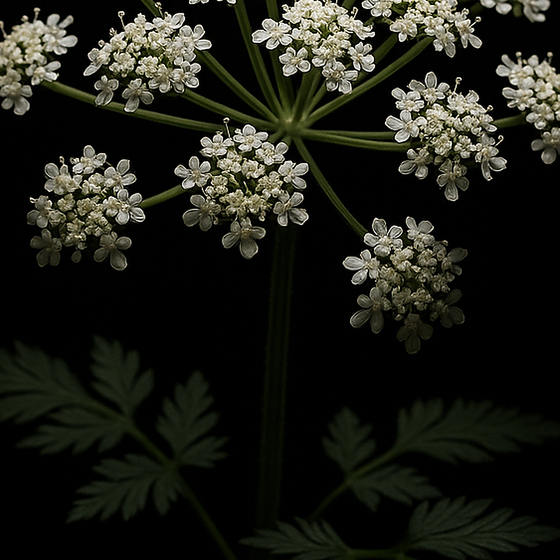
Quiet, shaded, forest-floor green. Hemlock oil smells like the understory of an old-growth Appalachian forest — cooler and darker than spruce, less sweet than fir, with a mossy, almost damp quality underneath the bornyl acetate warmth. The conifer that stays in shadow.
- Type
- Sirovina
- Olfactive family
- Drvenasti
- Source
- needles and twigs
- Chemical class
- complex natural
Miris
Detaljno
Zanimljivosti
The hemlock woolly adelgid (Adelges tsugae), a 1.5 mm insect from Japan, has killed tens of millions of Eastern hemlock trees since it was first detected in Richmond, Virginia in 1951. The adelgid feeds on parenchyma cells at the base of needles, draining the tree's nutrient reserves. A mature hemlock can die within 4–10 years of infestation. By the 2020s the pest had spread across nearly the entire native range of Tsuga canadensis. The ecological collapse is reshaping forest canopy composition across the Appalachians — hemlock's role as a shade-provider for cool-water streams makes its loss particularly damaging to aquatic ecosystems.
Dobijanje i hemija
Način dobijanja
Steam distillation of fresh needles and terminal twigs of Tsuga canadensis. The oil is a pale yellow to colorless liquid with a characteristic fresh-balsamic, slightly camphoraceous odor. Distillation is typically performed in small batches by artisanal distillers in the northeastern United States and eastern Canada. Yield is approximately 0.5–1.0% by weight of fresh plant material — modest but consistent with other conifer needle oils. The oil's composition varies with harvest season: winter needles tend to produce higher bornyl acetate percentages, while summer harvests show strengthens monoterpene fractions. Whole-branch distillation (needles plus bark and wood) shifts the profile toward more terpenoid-rich, less ester-dominated compositions.
- Formula
- complex mixture (bornyl acetate C₁₂H₂₀O₂ ~40-60%, key component)
- Botanički naziv
- Tsuga canadensis (Eastern hemlock — conifer)
- Izgled
- pale yellow to yellow clear liquid
- Jačina mirisa
- Srednji
- Trajnost
- 5 hours at 100.00%
- Sinonimi
- HEMLOCK SPRUCE OIL TSUGA OIL EASTERN HEMLOCK OIL
No IFRA Standard for the material itself (51st Amendment)
- Tačka paljenja
- 143.00 °F. TCC ( 61.67 °C. )
U parfemima
Hemlock oil (Tsuga canadensis) functions as a heart-to-base note modifier in coniferous, forest, and green compositions. Its high bornyl acetate content (40–60%) gives it better tenacity than pine oils and makes it useful as a soft fixative in woody accords. It bridges well with vetiver, oakmoss, cedarwood, and labdanum — anywhere a dark, forested dimension is needed without brightness or sweetness. In fougere frameworks, it provides a more somber coniferous axis than spruce or fir. In chypre structures, it reinforces the mossy-woody base. The oil is FEMA GRAS (No. 3034) and has no current IFRA restrictions, making it straightforward to formulate with. Its relative obscurity in contemporary use owes more to supply constraints — hemlock woolly adelgid has devastated Eastern hemlock populations since the 1980s — than to any olfactory limitation.
Pogledajte i
6 nota