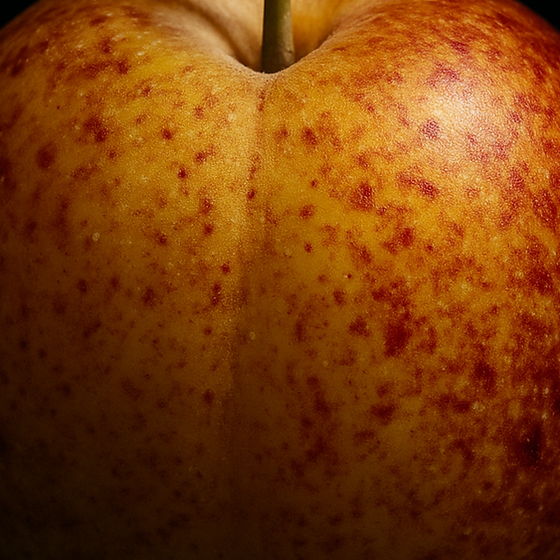
The mirabelle plum, Prunus domestica subsp. syriaca, is a cultivar group of plum trees of the genus Prunus. The fruit is small and oval, with smooth-textured flesh and a red or dark yellow colour that becomes flecked. Mirabelles are described as sweet and full of flavour. Two main cultivars are grown for fruit production, derived from cherry plums grown in Nancy and Metz. The Metz type is smaller, less hard and less sweet, and has no small red spots on the skin. The Metz type is very good for jam, while the Nancy type is sweeter and better as fresh fruit.
Lorraine has an ideal climate and soil composition for the cultivation of this fruit. The orchards are planted on clay-limestone soils. The tree suits the Lorraine climate because of its cool summer nights and the rarity of hot days, conditions that favour ripening and an optimal sugar level in the fruit. Lorraine accounts for about 70% of world mirabelle production, from nearly 700 hectares of orchards and about 200,000 trees. Since the mid-2010s the harvest has begun up to two weeks earlier than in the historical calendar, because of global warming. In the hottest summers, drought and water deficit lower the fruit size and raise the sugar content.
Since 1996 the Mirabelle de Lorraine has been recognised by the EU as a high-quality regional product with a Protected Geographical Indication. The label guarantees a minimum fruit size of 22 mm and a minimum sugar content, and can be used only in a specific geographical zone of production. To bear the name, the fruit must be picked and packed in Lorraine and have a minimum sugar level of 16° Brix. The production zone is exactly the regional territory of Lorraine, made up of the four departments of Meurthe-et-Moselle, Meuse, Moselle and Vosges. The fruit must also have a colour of at least 4 on an 8-point scale, which corresponds to a slightly greenish yellow. The Mirabelle de Lorraine is grown from clones of the Mirabelle de Nancy and Mirabelle de Metz varieties.
The fruit is used mainly in fruit preserves and dessert pies. Its juice is commonly fermented into wine or distilled into plum brandy. The eau-de-vie de mirabelle de Lorraine has held a regulated designation of origin since 1953 and an AOC since 2015. The mirabelle is also an ingredient of a liqueur. About 25% of production is eaten as fresh fruit, and 65% is processed into frozen halves, jams, coulis, pure-fruit purées, fruit in syrup and dried mirabelles.
Harvest and orchards
Early varieties are generally harvested between late June and early August, and late varieties can be harvested until the end of September. Clay soils that hold water, a hilly relief and an alternation of warm days with cooler nights are said to help the aromas develop and the sugars concentrate. Up to 3,000 seasonal workers take part in the harvest each year. About 250 growers and three fruit cooperatives may use the name commercially, and more than 200 producers work in the Lorraine territory today. About one third of the orchards are now run by young producers. The Mirabelle de Lorraine also carries a Label rouge.
Botany and varieties
The mirabelle belongs to the rose family, Rosaceae, in the genus Prunus. The old French free-stone varieties, among them the mirabelle, are called noble varieties. Mirabelles and some greengages grow fairly easily from seed. The Mirabelle de Nancy is partly self-compatible: only 2 to 10% of its flowers set fruit by self-pollination.
Uses and festivals
Mirabelles are eaten as mirabelle tart, and a flavoured wine called perlé de mirabelle is made from them. Plum fruits are also made into jam and liqueur. A Maison de la mirabelle stands at Rozelieures, and the Jardins de Lorraine cooperative offers visits of its fruit packing during the season. Bayon elects a Miss Mirabelle, and Metz has held its festival and the election of the Mirabelle Queen since 1947.
—
Related: Acerola · Akebia Fruit · Allyl Amyl Glycolate · Arctic Bramble · Argan · Berries · Black Sapote · Buriti