


Borova smola
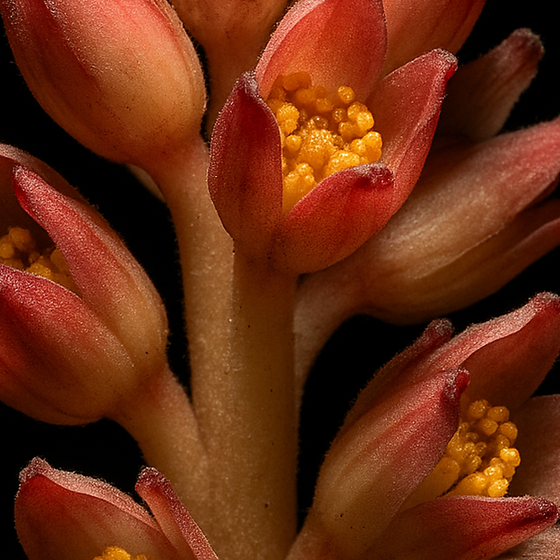
Sticky, resinous, and golden. Pinesap smells like a fresh wound on a pine trunk — warm, amber-tinted resin with a sharp terpenic bite and a slow, balsamic sweetness as it hardens.
- Type
- Akord
- Olfactive family
- Aromatični
- Source
- Fantasy/Concept
- Chemical class
- reconstructed accord
Miris
Detaljno
Dobijanje i hemija
Način dobijanja
Pine oleoresin is collected by tapping living trees (scoring the bark to induce resin flow). The crude resin is then steam-distilled to separate turpentine (volatile fraction, rich in pinenes) from rosin (the non-volatile resin acids). For perfumery, both fractions may be used — turpentine for top-note brightness, rosin for base-note warmth.
- Formula
- Complex resin — key components: alpha-Pinene (C₁₀H₁₆), beta-Pinene (C₁₀H₁₆), Abietic acid (C₂₀H₃₀O₂)
- CAS
- 8002-09-3 (pine oil, general)
- Botanički naziv
- Pinus spp. (pine resin / oleoresin)
- Izgled
- Pale yellow to amber liquid
- Jačina mirisa
- Srednji
- Sinonimi
- Pinesap Orchid, Monotropa uniflora
Not subject to an IFRA Standard (51st Amendment)
- Tačka paljenja
- ~78°C
- Relativna gustina
- 0.850–0.870 @ 25°C
- Indeks prelamanja
- 1.472–1.480 @ 20°C
U parfemima
Pinesap is a heart-to-base resinous note bridging bright conifer top notes and warm amber bases. It provides a sense of living forest — trees that are actively exuding, not dried lumber. Useful in forest, conifer, and amber compositions. The note is built from combinations of alpha-pinene, balsam fir or copaiba resin, and amber-type molecules (ambroxide, ambroxan). Natural pine resin or turpentine can be used directly in small quantities.
Pogledajte i
7 nota