Tamaris

PrirodnaCVETOVIcvetni · svež · drvenast
Srednje notePiramida
—Jačina
—Trajnost
—Poreklo
Uzorak
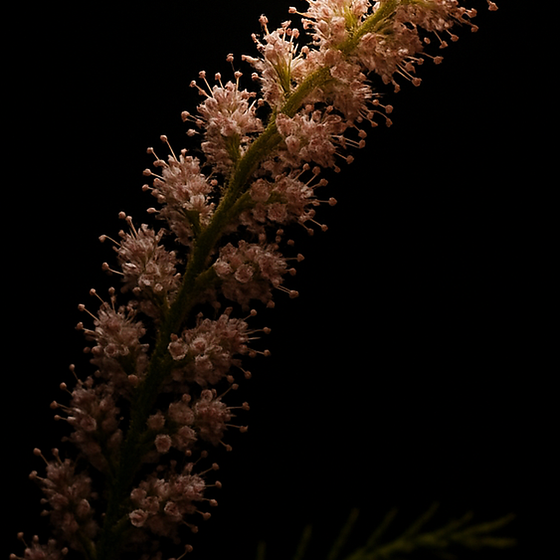
Tamaris kao sirovina za parfeme
Srednje note
Tamarix spp.
Definicija

Tamarisk is the common name of Tamarix, a genus of about 50-60 species of flowering plants in the family Tamaricaceae, native to drier areas of Eurasia and Africa.

Floral
96
Vert
69
Doux
63
Poudré
52
Fruité
41
Boisé
55
Salt cedar, taray
Type
Sirovina
Olfactive family
Cvetni
Instrumenti
Piramida
GGornje note
SSrednje note
BBazne note

Teroar i poreklo

Detaljno

Tamarisks are evergreen or deciduous shrubs or trees growing to 1-18 m in height. The largest species, Tamarix aphylla, is an evergreen tree that can grow to 18 m tall. Tamarisks have slender branches and grey-green foliage. Leaves in the family are generally scale-like and 1-5 mm long, and in some species they are encrusted with salt secretions. The pink to white flowers appear in dense masses on spikes 5-10 cm long at branch tips from March to September.

Habitat and Range

Tamarisks usually grow on saline soils, tolerating up to 15,000 ppm soluble salt. Tamarix aphylla is found along watercourses in arid areas. Tamarix gallica, also known as the French tamarisk, is indigenous to Saudi Arabia and the Sinai Peninsula and is very common around the Mediterranean region.

Salt Secretion

Tamarix aphylla excretes concentrated salty water from glands on its leaf surfaces, and the water evaporates to leave a crust of crystals containing more than ten salts. Soil salinities increase as a result of inputs of salt from glands on saltcedar leaves.

Uses

Tamarisk species, notably T. ramosissima and T. tetrandra, are used as ornamental shrubs, windbreaks, and shade trees. In the Southwest United States, tamarisk was introduced to help erosion control. The wood may be used for carpentry or firewood. The nectar from the blossoms of Tamarix aphylla produces high-quality honey with a unique taste.

Ecology

Saltcedar can reproduce both vegetatively and by seed. Individual saltcedar plants can produce 500,000 tiny seeds per year. Tamarix gallica is present in many other areas as an invasive introduced species.

Chemistry

Well-known phenolic acids such as ferulic acid, gallic acid and p-coumaric acid are commonly found in Tamarix species. In extracts of Tamarix smyrnensis flowers, p-coumaric acid, catechin and gallic acid were the most abundant phenolics and flavonoids.

Explore all seven extraits in the Discovery Set.

Zanimljivosti

The leaves of Tamarix aphylla excrete salty water, and the crystals of at least one salt, lithium sulphate, stay stuck on the leaves. These crystals swell with the small amount of humidity in the air at night, and the leaves absorb the moisture.

Dobijanje i hemija

Način dobijanja

Flower extracts of Tamarix smyrnensis were prepared in one study with methanol, ethanol and ethyl acetate.

Botanički naziv
Tamarix spp.
Sinonimi
Salt cedar, taray
Status prema standardima IFRA
Pogledajte napomenu

No IFRA Standard for the material itself (51st Amendment)

Pogledajte i

7 nota