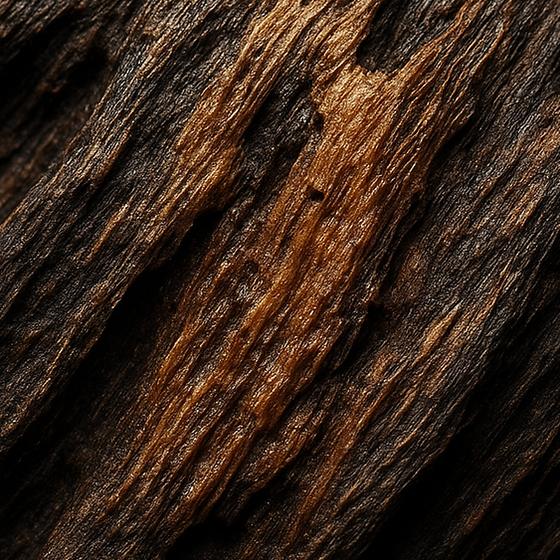
Агарове дерево

НатуральнийДЕРЕВИНА Й МОХИдеревний · насичений · бальзамічний
Базові нотиПіраміда
—Сила
—Стійкість
8Походження
Зразок
Агарове дерево як парфумерна сировина
Базові ноти
Aquilaria malaccensis Lam.
Визначення

Agarwood, a resinous heartwood used for perfume and incense, is produced by trees of the genera Aquilaria and Gyrinops. In perfume the scent is mainly a combination of oriental-woody and very soft fruity-floral notes.

Boisé
99
Terreux
96
Vert
63
Fumé
57
Résineux
34
Doux
20
oud, agar wood, aloes
Type
Складник
Olfactive family
Деревні
Source
heartwood
Chemical class
complex natural mixture (sesquiterpenes and chromones)
Інструменти
Піраміда
ВВерхні ноти
СНоти серця
ББазові ноти
Країни-виробники
Камбоджа Індія Індонезія Лаос Малайзія М’янма Таїланд В’єтнам

Запах

The odour of agarwood is complex and pleasing, with few or no similar natural analogues. The incense smoke is characterised by a sweet-balsamic note and by shades of vanilla and musk and amber. The best agarwood fragrance is mellow and sweet, full of penetration and persistence. The higher the grade of agarwood, the richer the layers of aroma. The odour of the oil is sweet, woody, balsam and sandalwood.

Теруар і зрілість

Докладно

Aquilaria is a genus of trees, called lign aloes trees, in the family Thymelaeaceae. Aquilaria trees grow to 6-20 m (20-66 ft) tall. Aquilaria malaccensis is the major source of agarwood. Aquilaria crassna and Aquilaria sinensis are the other two species of the genus that are commonly harvested. Some Aquilaria species produce agarwood after being attacked by physical force, insects, or infection by bacteria or fungi.

The tree may be infected by a mould, and in response it produces a self-defence material to conceal damages or infections. In Aquilaria malaccensis, the resin is produced in response to infection by a parasitic mould, Phaeoacremonium parasitica, formerly Phialophora parasitica. The unaffected wood of the tree is relatively light in colour. The resin dramatically increases the mass and density of the affected wood, changing its colour from a pale beige to yellow, orange, red, dark brown or black.

The composition of agarwood oil is exceedingly complex, with more than 150 chemical compounds identified. At least 70 of these are terpenoids, which come in the form of sesquiterpenes and chromones, and no monoterpenes have been detected at all. Other common classes of compounds include agarofurans, cadinanes, eudesmanes, valencanes and eremophilanes, guaianes, prezizanes and vetispiranes. 2-(2-Phenylethyl)chromone derivatives and sesquiterpenes are the two predominant constituents of agarwood. The exact balance of these materials varies with the age and species of the tree and with the details of the oil extraction process. The aromatic qualities of agarwood vary with the species, the geographic location, the branch, trunk or root of origin, the time since infection, and the methods of harvesting and processing.

One of the main reasons for the relative rarity and high cost of agarwood is the depletion of wild sources. Aquilaria malaccensis has been listed in CITES Appendix II since 1995, and in 2004 all agarwood-producing Aquilaria and Gyrinops species were listed too. A number of countries have outstanding reservations about the 2004 listing of all Aquilaria species. Aquilaria malaccensis is on the brink of extinction in the wild and is now considered critically endangered on the IUCN Red List. Agarwood plantations have been established in a number of countries such as India, Bangladesh and Bhutan, and reintroduced into Malaysia and Sri Lanka as commercial plantation crops.

Agarwood is used for incense, perfume, traditional medicine and other products in the world market. It has been used for centuries as incense in Buddhist, Hindu and Islamic ceremonies. Over 3,000 years ago, the ancient Egyptians used agarwood incense in their funeral rites. It was described as a fragrant product as early as 1400 BCE in the Vedas of India.

Further reading. Agarwood: the $100,000/kg tree poached to extinction — a long-form investigation into the supply chain, CITES regulation, and plantation economics of oud. Explore the PREMIEREPEAU collection.

Explore all seven extraits in the Discovery Set.

Отримання й хімія

Спосіб отримання

Oud oil can be distilled from agarwood using steam. The total yield of oil for 70 kg of wood will not exceed 20 ml. A common method in planted forestry is to inoculate trees with the fungus. Numerous inoculation techniques have been developed, with varying degrees of success. Traditional artificial agarwood formation techniques are based on physical methods such as cutting and digging holes. Modern artificial techniques are mainly biochemical methods, such as chemical reagent invasion and bacteria inoculation.

Формула
Complex natural mixture (key constituents: agarospirol; α-guaiene; α-agarofuran)
CAS
94350-09-1
Ботанічна назва
Aquilaria malaccensis Lam.
Синоніми
oud, agar wood, aloes
Статус IFRA
Див. примітку

No IFRA Standard for the material itself (51st Amendment)

Фізичні властивості
Температура спалаху
141.00 °F

У парфумерії

Agarwood is used in the perfume industry, especially among Arabic brands. Oud has become a popular component in perfumery. Most brands have a creation based on or dedicated to oud, or on an oud accord made with certain chemical scent components. Few perfume houses use real oud in their creations, because oud is very expensive and potent. Oud is generally used as a base note and is traditionally paired with rose.

Роль у формулі
01фіксатор
02модифікатор
03сполучний компонент
04формувач об’єму
Форми випуску
ефірна олія абсолют CO₂-екстракт настоянка

Див. також

7 ноти