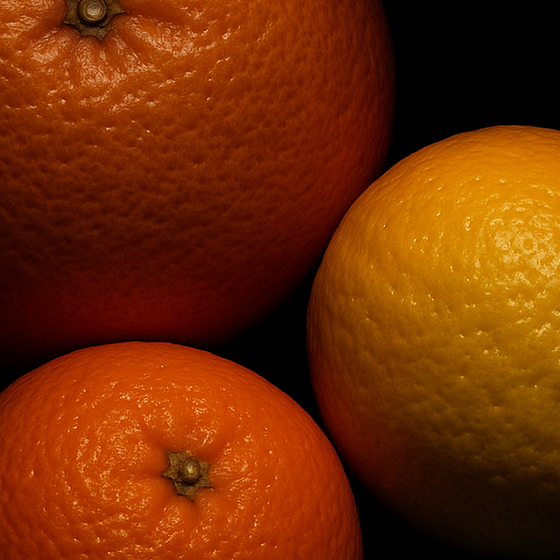
Цитрусові

ЦИТРУСОВІ ЗАПАХИцитрусовий · свіжий · цедровий
Верхні нотиПіраміда
4/5Сила
—Стійкість
·Походження
Зразок
Цитрусові як парфумерна сировина
Верхні ноти
Citrus spp. and allied genera (Rutaceae); the modern Citrus genus also includes the former Fortunella (kumquats) and Microcitrus following 2010s phylogenetic reclassification.
Визначення

Cold-pressed peel oils from the Citrus genus and its kin — bergamot, lemon, orange, lime, mandarin, grapefruit, yuzu, citron. Bright, terpenic, photophobic, often the first thing a perfume says when it opens.

ЦИТРУСОВИЙ ЦЕДРОВИЙ СВІЖИЙ СОЛОДКИЙ ГІРКИЙ АРОМАТИЧНИЙ
CITRUS CITRUS FRUITS CITRUS NOTES AGRUMES
Type
Група
Olfactive family
Цитрусові
Source
Cold-pressed peel oils, distilled oils, FCF derivatives, CO₂ extracts
Chemical class
Terpene-rich expressed oils (limonene, citrals, linalool, γ-terpinene)
Інструменти
Піраміда
ВВерхні ноти
СНоти серця
ББазові ноти
4/5Сила
Висока
інтенсивність запаху
Країни-виробники
Італія (Калабрія, бергамот; Сицилія, лимон, цитрон), Бразилія (солодкий апельсин, найбільший виробник у світі), США (Флорида, Каліфорнія), Іспанія (Валенсія), Аргентина, Китай, Мексика, Японія (юдзу, Коті), Південно-Східна Азія.

Запах

Citruses open sharp and terpenic — peel oil at its most volatile, the rind cracked open. Within minutes the lighter terpenes burn off; what remains is what each species carries underneath. Lemon and lime leave their citral signature, a metallic-aldehydic crispness. Bergamot sheds its terpenes to expose linalool and linalyl acetate, drifting into floral. Mandarin softens into a grape-skin and orange-blossom tail. By the heart's arrival the citrus is largely gone — its work, by design, is the opening.

Докладно

Citruses are the perfume's opening syllable: short-lived, volatile, bright, often the first thing a fragrance says before the heart arrives. They are cold-pressed peel oils from the Citrus genus and its allied genera (now consolidated under Citrus following 2010s phylogenetic reclassification), members of the Rutaceae family [E]. Bergamot, lemon, sweet and bitter orange, lime, mandarin, grapefruit, yuzu, citron, kumquat, finger lime: each carries a slightly different terpene ratio over the same underlying chemistry.

Explore all seven extraits in the Discovery Set.

Chemistry

Every cold-pressed citrus oil is built on d-limonene (CAS 5989-27-5, C₁₀H₁₆), often at 60 to 95% of the oil [A]. On top of that backbone, each species adds a signature: citral, the mixed isomers geranial and neral (CAS 5392-40-5) [B], gives lemon and lemongrass their characteristic profile. Linalool and linalyl acetate carry bergamot into its floral register. γ-Terpinene runs through lemon and lime. Methyl anthranilate threads grape and orange-blossom into mandarin. The composite is hesperidic: the perfumer's term for this terpene-and-citral envelope.

Extraction

Cold pressing (mechanical expression) is the dominant method. The peel oil glands are broken open and the emulsion is centrifuged. Yield is generous by floral standards: 0.3 to 1% of peel weight, sometimes higher in lemon. Distilled versions exist, principally for bergamot, where the distillation step removes phototoxic furocoumarins to produce a bergapten-free (FCF) oil. CO₂ extraction is increasingly used for premium grades because it captures more of the living-peel character without the heat of steam distillation.

Phototoxicity and IFRA

Most expressed citrus peel oils contain furocoumarins, bergapten (5-methoxypsoralen, CAS 484-20-8) and psoralen (CAS 66-97-7) most prominent [C]. These compounds intercalate with skin DNA and amplify UV damage; the practical result is severe phototoxic burns on UV exposure. IFRA's 51st Amendment caps the bergapten level at approximately 0.4% in leave-on products [D]. Distilled and FCF versions are unrestricted, which is why most modern colognes use FCF bergamot.

In a fragrance

Citrus oils are the classic top notes: they lift florals, sharpen aromatics, anchor colognes and hesperidic structures, and bridge into aldehydic openings. They rarely persist past the first half-hour: what remains is what the perfumer placed beneath.

Sources & Notes

[A] PubChem CID 439250, d-limonene, CAS 5989-27-5, formula C₁₀H₁₆. pubchem.ncbi.nlm.nih.gov/compound/439250.

[B] PubChem CID 638011, citral (mixed geranial + neral), CAS 5392-40-5, formula C₁₀H₁₆O. pubchem.ncbi.nlm.nih.gov/compound/638011.

[C] PubChem CID 2355 (bergapten / 5-methoxypsoralen, CAS 484-20-8) and CID 6199 (psoralen, CAS 66-97-7). The principal furocoumarins responsible for citrus phototoxicity.

[D] IFRA Standards, 51st Amendment (2024). Furocoumarin restriction limits for leave-on products. ifrafragrance.org/safe-use/library.

[E] Kew, Plants of the World Online: Citrus genus consolidated to include the former Fortunella and Microcitrus on the basis of molecular phylogeny. powo.science.kew.org.

Цікавий факт

The word 'cologne' began as a literal place name — Köln, the German city where Giovanni Maria Farina assembled the first hesperidic structure (bergamot, lemon, orange, neroli, herbs) in 1709. 'Eau de Cologne' was originally his recipe; the term broadened only later. The citrus opening therefore predates the modern concentration system by two centuries.

Отримання й хімія

Спосіб отримання

Cold pressing (mechanical expression) is the dominant method for citrus peel oils. The peels are abraded or pressed to rupture the oil glands; the resulting emulsion is centrifuged to separate the essential oil. Yield is generous compared to floral extraction — roughly 0.3–1% of peel weight depending on species and ripeness. Distilled versions exist (notably for bergapten-free bergamot) and shift the profile toward lighter, less waxy character. CO₂ extraction is increasingly used for premium grades.

Формула
Composite. d-Limonene C₁₀H₁₆ is the structural backbone of the family; citrals C₁₀H₁₆O dominate lemon and lime aromatic; linalool C₁₀H₁₈O carries bergamot and mandarin into floral territory.
CAS
Not a single material. Key constituents: d-limonene (CAS 5989-27-5, C₁₀H₁₆) — dominant terpene in nearly every cold-pressed citrus peel oil; citral (CAS 5392-40-5, C₁₀H₁₆O); linalool (CAS 78-70-6); γ-terpinene (CAS 99-85-4).
Ботанічна назва
Citrus spp. and allied genera (Rutaceae); the modern Citrus genus also includes the former Fortunella (kumquats) and Microcitrus following 2010s phylogenetic reclassification.
Сила запаху
Висока
Синоніми
CITRUS CITRUS FRUITS CITRUS NOTES AGRUMES
Статус IFRA
Обмежено

Restricted. Most expressed citrus peel oils (bergamot, lemon, lime, grapefruit, bitter orange) carry IFRA limits in leave-on products due to the phototoxic furocoumarins they contain (bergapten / 5-methoxypsoralen, psoralen). Under the 51st Amendment, the limit is 5-MOP (bergapten) at 0.0015% (15 ppm) in the finished leave-on product. Distilled and bergapten-free (FCF) versions escape the furocoumarin phototoxicity limit but remain fragrance materials under IFRA category use levels; this is why most modern colognes use FCF bergamot.

Фізичні властивості
Нота
Umbrella term covering bergamot, lemon, orange (sweet and bitter), lime, mandarin, tangerine, grapefruit, yuzu, citron, kumquat, finger lime, calamondin and others.

У парфумерії

Citrus oils are the classical top notes of perfumery — short-lived, bright, volatile, the opening syllable before the heart arrives. They lift florals, sharpen aromatics, anchor colognes and hesperidic structures, and bridge into aldehydic openings. Their phototoxic furocoumarins force the perfumer to choose between expressed (full character, restricted) and distilled or bergapten-free (FCF) versions (unrestricted, slightly thinner).

Роль у формулі
01верхня нота
02компонент піднесення
03модифікатор
04якір свіжості
Форми випуску
ефірна олія холодного пресування перегнана олія олія FCF (без бергаптену) CO₂-екстракт конкрет

Див. також

5 ноти