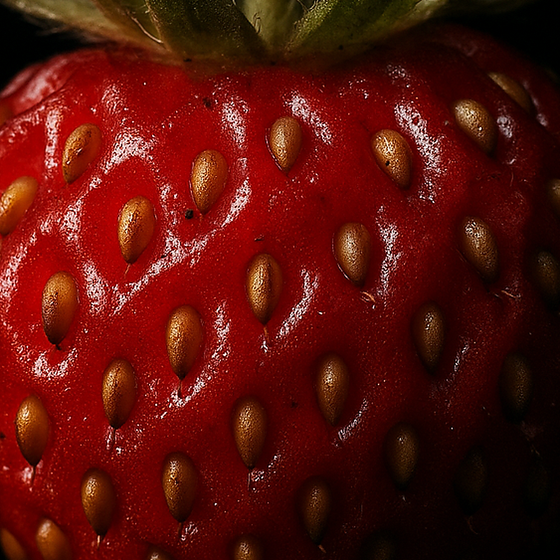
Суниця

АкордФРУКТИ, ОВОЧІ Й ГОРІХИфруктовий · солодкий · свіжий
Ноти серцяПіраміда
—Сила
—Стійкість
3Походження
Зразок
Суниця як парфумерна сировина
Ноти серця
Fragaria vesca
Фантазійний/концептуальний
Визначення

Wild strawberry is the fruit of Fragaria vesca, a perennial herbaceous plant in the rose family. Its scent has more floral nuances than that of traditional strawberries.

ЗЕЛЕНИЙ СОЛОДКИЙ ГУРМАНСЬКИЙ ТЕПЛИЙ СВІЖИЙ ВЕРШКОВИЙ
woodland strawberry, Alpine strawberry, Carpathian strawberry, European strawberry
Type
Акорд
Olfactive family
Фруктові
Source
fruit
Інструменти
Піраміда
ВВерхні ноти
СНоти серця
ББазові ноти
Країни-виробники
Азія Європа Північна Америка

Запах

The aroma of wild strawberries is sweet and floral. The fruit's scent has flowery accents, like a cross between violet and white flowers. Wild strawberries, often in fact a specific variety that can also be cultivated, have a more refined, fruity-floral fragrance. The strawberry note is described as red berry, juicy and green floral. Methyl anthranilate, on which the fragrance of wild strawberries largely depends, gives an intensive sweetish-flowery impression.

Докладно

Wild strawberry is the fruit of Fragaria vesca, a perennial herbaceous plant in the rose family that grows naturally throughout much of the Northern Hemisphere. The plant is also called the woodland strawberry, Alpine strawberry, Carpathian strawberry or European strawberry. The Latin epithet vesca literally means thin or feeble, but it likely carries the sense of edible in this context.

Botany

Five to eleven soft, hairy white flowers are borne on a 3-15 centimetre stalk that usually lifts them above the leaves. The leaves are light green and trifoliate, with toothed margins. The plant spreads mostly by runners, but its seeds are viable and establish new populations. Fruits average 84.0% water, and their dry weight includes 21.0% carbohydrates and 5.5% lipids. The wild strawberry is used as a genetic model plant for the garden strawberry and for the family Rosaceae in general. Its genome was sequenced in 2010, and again with greater detail and accuracy in 2017.

Origin and Production

The typical habitat of Fragaria vesca is along trails and roadsides, embankments, hillsides, meadows, young woodlands, sparse forest, woodland edges and clearings. The fruit is eaten by a variety of mammals and birds that also help to distribute the seeds in their droppings. Woodland strawberry fruit is strongly flavored and is still collected and grown for domestic use, and on a small scale commercially for gourmets and as an ingredient for commercial jam, sauces, liqueurs, cosmetics and alternative medicine. In Turkey, hundreds of tons of wild fruit are harvested each year, mainly for export. Most of the cultivated varieties have a long flowering period, and they are usually called alpine strawberries. Some cultivars have fruit that are white or yellow when fully ripe, instead of the normal red.

Chemistry

Esters, terpenes and furans are the chemical compounds with the strongest relationships to strawberry flavour, sweetness and fragrance. More than 970 volatile compounds have been reported in strawberry fruits in total. Over 130 different ester molecules have been identified in strawberries. The fragrance of wild strawberries depends largely on relatively high amounts of methyl anthranilate. Methyl anthranilate is an ester of anthranilic acid. Methyl anthranilate and gamma-decalactone are prominent in aromatic wild strawberries. Strawberry aroma types are essentially divided into those containing methyl anthranilate and those free of it. Methyl anthranilate appears to be absent in most modern strawberry cultivars. Modern strawberry cultivars show a pronounced depletion of volatile compounds and poor aroma quality compared with older cultivars and wild strawberry species. Fragaria vesca contains the ellagitannin agrimoniin, an isomer of sanguiin H-6.

Furaneol, also called strawberry furanone, is found in strawberries. It has a caramel-like odor at high concentrations and a sweet strawberry aroma when dilute. Ethyl methylphenylglycidate, the so-called strawberry aldehyde, contains ester and epoxide functional groups and has no aldehyde group. Its aroma is described as sweet, fruity, strawberry, floral, honey, fatty.

Цікавий факт

Its fruit persists for an average of 1.2 days, which is possibly the shortest persistence of any fleshy fruit in Europe. It bears an average of 46.8 seeds per fruit, which is possibly the highest per fruit of any in Europe.

Отримання й хімія

Спосіб отримання

Perfumers recreate strawberry fragrance in the laboratory by combining different molecules. Ethyl methylphenylglycidate is usually prepared by the condensation of acetophenone and the ethyl ester of monochloroacetic acid in the presence of a base, in a reaction known as the Darzens condensation.

Формула
Complex natural mixture (key constituents: methyl anthranilate C₈H₉NO₂; gamma-decalactone)
CAS
84929-78-2 (Fragaria vesca extract)
Ботанічна назва
Fragaria vesca
Синоніми
woodland strawberry, Alpine strawberry, Carpathian strawberry, European strawberry
Статус IFRA
Див. примітку

No IFRA Standard for the material itself (51st Amendment)

У парфумерії

The strawberry note has many workaday uses and makes an occasional appearance in fine fragrance, although it is not often flaunted. Strawberry flavour and fragrance are used widely in manufacturing, including foods, beverages, perfumes and cosmetics. Ethyl methylphenylglycidate is used in the fragrance industry, in artificial flavors and in cosmetics. The acetate ester of furaneol, also known as strawberry acetate, is used in traces in perfumery to add a sweet gourmand note.

Роль у формулі
01фірмова нота
02компонент піднесення
03сполучний компонент
04свіжість
Форми випуску
абсолют

Див. також

7 ноти