


Phenylacetonitrile
Mots-clés : floral · green · herbal
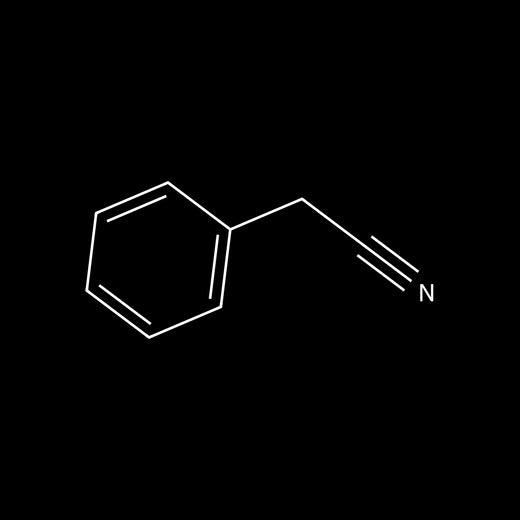
Phenylacetonitrile is a nitrile, acetonitrile with one of the methyl hydrogens substituted by a phenyl group. It smells herbaceous-green yet very sweet, with heavy-floral undertones.
- Famille olfactive
- Floraux · 779 entrées du glossaire dans cette famille Sous-famille : Fleurs classiques · 313 entrées de cette sous-famille
- Matière
- Naturel et synthétique
- Pyramide
- Tête · Volatilité: Note de tête
- Aussi appelé
- Benzeneacetonitrile, Benzyl cyanide, Benzyl nitrile, Phenyl acetyl nitrile
Famille, sous‑famille et cluster : PREMIEREPEAU house classification, version 2026‑11.
Phenylacetonitrile · Facettes
Entrées du glossaire portant chaque facette, sur 3 979 :
- floral 1 546
- green 1 442
- herbal 757
Phenylacetonitrile · Sentir
It smells herbaceous-green yet very sweet, with heavy-floral undertones.
Phenylacetonitrile · En parfumerie
It brings a herbaceous-green, very sweet and heavy-floral odour, and it serves as an intermediate for esters used in perfumery.
Pyramide
Phenylacetonitrile : Tête. Entrées du glossaire classées à chaque étage de la pyramide, sur 4 006 (42 n'en classent aucun) :
- Tête 718
- Tête · Cœur 497
- Cœur 1 641
- Cœur · Fond 514
- Fond 594
Phenylacetonitrile · Extraction et chimie
It is made by the reaction of benzyl chloride with potassium cyanide, or with sodium cyanide. It is produced from benzyl chloride and alkali cyanide in alcohol or aqueous solution under phase transfer catalysis with N,N-dialkylbenzylammonium chloride. It is used in organic synthesis, as an intermediate for pharmaceutical drugs, in the synthesis of optical bleaches for fibres and in the production of insecticides.
- Apparence
- Colourless oily liquid
Phenylacetonitrile · En profondeur
Identity
Phenylacetonitrile has the CAS number 140-29-4, the molecular formula C₈H₇N and a molecular weight of 117.15 g/mol. Its systematic name is 2-phenylacetonitrile. It is a nitrile and a benzene derivative, and it is also a pheromone and an animal metabolite.
Odour
It smells floral, green and herbal. Its odour is peculiar, herbaceous-green yet very sweet, with heavy-floral undertones, and it is reminiscent of orange leaf water absolute and orange flower water absolute. Its odour is also aromatic.
Occurrence in nature
It is found in Alliaria petiolata, Beta vulgaris, Botrytis cinerea, Brassica rapa, Camellia sinensis, Carica papaya, Citrus deliciosa, Citrus paradisi, Citrus reticulata, Fallopia sachalinensis, Hesperis matronalis and Inula racemosa.
Production
It is made by the reaction of benzyl chloride with potassium cyanide, or with sodium cyanide. It is produced from benzyl chloride and alkali cyanide in alcohol or aqueous solution under phase transfer catalysis with N,N-dialkylbenzylammonium chloride. It is used in organic synthesis, as an intermediate for pharmaceutical drugs, in the synthesis of optical bleaches for fibres and in the production of insecticides.
Use in perfumery
It is a chemical intermediate for esters used in perfumery. In cosmetics it serves as a fragrance ingredient.
Use in flavours
It is a chemical intermediate for esters used in flavours.
Properties
It is a colourless oily liquid. It boils at 233.5 °C and melts at -23.8 °C. Its flash point is 102 °C in a closed cup. Its density is 1.0205, so it is denser than water. Its solubility in water is 100 mg/L at 25 °C, and it is soluble in alcohol, ether and acetone.
Safety and IFRA
The IFRA Standard « Benzyl cyanide » (Amendment 38) covers this material. Its INCI name is PHENYLACETONITRILE and its function is fragrance. It appears in Annex II, entry 424, of the EU Cosmetics Regulation, which lists prohibited substances. Its EC number is 205-410-5 and it is registered under REACH. It is toxic in contact with skin.
Phenylacetonitrile · Fiche technique
Masse moléculaire
117.15 g/mol Plus lourd que 343 des 536 autres entrées au même niveau de la pyramide pour lesquelles un poids est enregistré; 2 pèsent le même poids
2 515 entrées enregistrent un poids moléculaire. Par place dans la pyramide : Tête 537, Tête · Cœur 403, Cœur 861, Cœur · Fond 452, Fond 262.
Identité
- Type
- Ingrédient
- Catégorie
- Molécules aromatiques
Classification
- Cluster
- Fleurs classiques · 245 entrées de ce groupe
- Classe chimique
- Nitrile
Données chimiques
- Formule
- C8H7N
- Numéro CAS
- 140-29-4
- PubChem CID
- 8794, fiche de composé sur PubChem
- InChIKey
- SUSQOBVLVYHIEX-UHFFFAOYSA-N
- Wikidata · Wikipedia
- Phenylacetonitrile: Q425620, élément sur Wikidata · Wikipedia, Article anglais
Étiquetage
- Annexes cosmétiques de l'UE
Propriétés physiques
- Point d'ébullition
- 233.5 °C
- Point de fusion
- -23.8 °C
- Point d'éclair
- 102 °C (closed cup)
- Densité
- 1.0205
Performances et règles
- Disponible en
- synthetic
- Statut IFRA
- IFRA Standard « Benzyl cyanide » (Amendment 38)
Phenylacetonitrile · Voir aussi
Entrées liées à Phenylacetonitrile, selon leur place dans la pyramide. « partagé » signale un mot olfactif que Phenylacetonitrile possède aussi.
Notes de tête

Cinnamonitrile
épicé · floral (partagé) · huileux Épicé / Tête · Cœur / 129.16 g/mol

Notes de cœur

Phénylacétate de méthyle
miel · floral (partagé) · sucré Floraux / Synthétique / 150.17 g/mol
Capucine
épicé · poivré Épicé / Naturel
Phénylacétate d'éthyle
miel · abricot · sucré Fruité / Synthétique / 164.2 g/mol
2-Phénylhexanenitrile
balsamique · trèfle · orchidée Résineux / Cœur · Fond / Synthetic / 173.25 g/mol


Notes de fond

Acétate d'anisyle et de phényle
miel · balsamique · fruité Floraux / Même sous-famille / 256.3 g/mol

Phenylacetonitrile · Sources
- PubChem Phenylacetonitrile
- ChEBI Phenylacetonitrile: chemical classification record
- Pyrfume Arctander, Perfume and Flavor Chemicals: odour descriptions (Pyrfume archive)
- Wikidata (LOTUS natural products data) Phenylacetonitrile: organisms it is reported in, with the papers
- European Commission, CosIng Phenylacetonitrile: cosmetic ingredient record
- IFRA Standards, 51st Amendment
- European Chemicals Agency Phenylacetonitrile: substance record
Citer comme Glossaire PREMIEREPEAU, « Phenylacetonitrile », https://premierepeau.com/
