


Armoise
Keywords: herbaceous · fresh · camphoraceous
Armoise is an essential oil from Artemisia herba-alba (Asteraceae), the white wormwood. It has a light herbaceous odour characteristic of thujone.
- Olfactive family
- Aromatic · 495 entries of the glossary in this family Subfamily: Herbal aromatics · 225 entries in this subfamily Cluster: Camphoraceous aromatics · 116 entries in this cluster
- Material
- Natural Aerial parts of Artemisia herba-alba
- Pyramid
- Top-Heart Note
- Also called
- Artemisia oil, armoise oil, armoise blanche, white wormwood
Armoise · Facets
Entries of the glossary that carry each facet, of 3,979:
- herbaceous 51
- fresh 1,392
- camphoraceous 142
- minty 107
- sweet 1,990
- mineral 72
Armoise · Scent
The oil offers sweet, fresh, slightly mentholated top notes. Its natural camphor gives mineral effects that reinforce the citrus character, until it typifies chamomile in the base note.
Evolution over time
Armoise: scent over time.
- Immediately
Sweet, fresh, slightly mentholated top notes.
Scent words: fresh · sweet - After a few hours
Natural camphor gives mineral effects that reinforce the citrus character.
Scent words: citrus · mineral - After a few days
The character typifies chamomile in the base note.
The overall odour is light and herbaceous, characteristic of thujone.
Armoise · In Perfumery
The oil is particularly adapted to fougère and cologne fragrances. Artemisia oil is used in fairly large amounts in fine fragrances, for example for chypre notes. It is rarely used in cosmetics.
Pyramid
Armoise: Top · Heart. Entries of the glossary stored at each place of the pyramid, of 4,000 (35 store no place):
- Top 718
- Top · Heart 501
- Heart 1,646
- Heart · Base 512
- Base 588
Role in the formula
Armoise: roles in the formula. Entries of the glossary that share each role, of 4,000:
- Modifier 1,168
- Freshness 720
- Blender 1,041
- Top note fewer than 40 entries
Armoise · Terroir & Origins
- Producing countries
- Morocco
Armoise · Extraction & Chemistry
The oil is obtained by steam distillation of the herb Artemisia herba-alba, which grows wild in Northern Africa. In a study of subcultured plants from the sub-arid to Saharan domains of Tunisia, the aerial parts were shade dried for 15 days, cut into small pieces and hydrodistilled in a Clevenger-type apparatus for 4 hours. The oil yield varied between 0.68% v/w and 1.93% v/w, based on dried weight of samples.
- Appearance
- Light yellow to yellow liquid
Armoise · Did You Know?
Morocco produces about 30 tonnes a year, which is 70% of worldwide demand.
Armoise · In Depth
The plant
Artemisia herba-alba is a perennial shrub that grows commonly on the dry steppes of the Mediterranean regions in Northern Africa, Western Asia and Southwestern Europe. Its specific epithet means "white herb" in Latin, as its stems and leaves are white and woolly. In French the plant is called armoise herbe-blanche or armoise blanche. Its leaves are strongly aromatic and covered with fine glandular hairs. Artemisia is a large genus of almost 500 species in the daisy family, Asteraceae.
Origin
In Tunisia the shrub grows in areas with between 400 mm and 90 mm of annual precipitation. It tolerates drought, mainly thanks to the polymorphism of its leaves and its root architecture. The plant flowers from September to December.
Composition
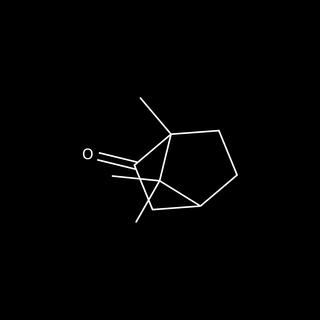
Camphor makes up 15 to 40% of the oil, and α- and β-thujone together make up between 25 and 70%. Because A. herba-alba exists as various chemotypes, the composition of the oil may vary widely. In Morocco, the market leader in exports of the essential oil, 16 chemotypes were found, twelve with monoterpenes as major components and four with sesquiterpene skeletons as the major fraction. Davanone, chrysanthenone and cis-chrysanthenol have been described as major constituents in some Moroccan and Spanish populations.
A study of 18 plants from southern Tunisia identified one hundred components in the oil. Ten of these, among them cineole, camphor, thujones and davanone, exceeded 10% of the total oil. Camphor is one of the most encountered components in the oil.
Armoise · History
Artemisia herba-alba is thought to be the plant translated as "wormwood" in English-language versions of the Bible. The English word wormwood also names the dark green oil of the plant, which was used to kill intestinal worms. The genus Artemisia was erected by Carl Linnaeus in 1753. Its name derives from the Greek goddess Artemis.
Armoise · Technical Sheet
Identity
- Botanical
- Artemisia herba-alba
- IPNI
- Artemisia herba-alba Asso, Syn. Stirp. Aragon. 117 (1779) — Ignacio Jordán de Asso y del Rio (1742-1814)
- Type
- Ingredient
- Category
- Greens, herbs and fougeres
In Nature
- Recorded altitude
- 150–950 m · median 350 m · 1,337 records with an altitude · GBIF
- Wild or cultivated
- 923 native · 4 introduced · 3 cultivated among 6,437 records (the rest carry no such mark) · GBIF
- Recorded in
- 15 of 512 squares of the world grid; a brighter dot holds more records · GBIF
- Also from this genus
- Artemisia: Absinthe · Artemisia · Davana · Davana Oil · Desert Sagebrush · Génépi · Mugwort · Sweet Annie · 2 more entries
- Also from this botanical family
- Asteraceae: African Marigold · Arnica · Artichoke · Blue Tansy · Burdock · Calendula · 42 more entries
In Print
- Timeline
- first described 1779 · earliest aroma paper in Europe PMC, 2001
Classification
- Chemical class
- Essential oil whose main components are ketones (camphor, thujone)
Chemical data
- CAS
- 8022-37-5, 84775-75-7
Labelling
- EU allergens reported
- Limonene · Linalool · Pinene · Terpineol · Alpha-Terpinene · Terpinolene · Beta-Caryophyllene · Camphor · Carvone
Physical properties
- Specific gravity
- 0.917-0.935
- Refractive index
- 1.4600-1.4720
Performance and rules
- Available as
- essential oil
- IFRA status
- No IFRA Standard for the material itself (51st Amendment)
Armoise · See Also
Entries related to Armoise, by their place in the pyramid. « shared » marks a scent word Armoise has too.
Top notes


Heart notes
-
Camphor Bush
herbal · camphoraceous (shared) · minty (shared) Aromatic / Same cluster / Natural 
Génépi
herbal · aromatic Aromatic / Same subfamily / Natural-
Sweet Annie
aromatic · herbal · green Aromatic / Same subfamily / Natural

Armoise · Sources
- Molecules (Basel, Switzerland) Essential oil composition of Artemisia herba-alba from southern Tunisia
- Molecules Essential Oil Composition of Artemisia herba-alba from Southern Tunisia
- AFRICAN JOURNAL OF BIOTECHNOLOGY Chemical constituents and antioxidant activity of the essential oil from aerial parts of Artemisia herba-alba grown in Tunisian semi-arid region (2011)
- JOURNAL of QASSIM UNIVERSITY FOR SCIENCE Phytochemical constituents and biological activities of Artemisia herba-alba: An updated review (2025)
- Horst Surburg, Johannes Panten Common Fragrance and Flavor Materials (2006)
- Horst Surburg, Johannes Panten Common Fragrance and Flavor Materials
- IFRA Standards, 51st Amendment
- Wikipedia Artemisia herba-alba
- Wikipedia Artemisia (genus)
- PubChem substance 135293547: Armoise
- PubChem substance 135289312: Artemisia herba-alba, ext.
Cite as PREMIEREPEAU Glossary, “Armoise”, https://premierepeau.com/pages/glossary-terms/armoise Updated 2026-11-17
