


Sweet Annie
Keywords: aromatic · herbal · green
Sweet Annie is a common name for Artemisia annua, a wormwood native to temperate Asia.
- Olfactive family
- Aromatic · 510 entries of the glossary in this family Subfamily: Herbal aromatics · 230 entries in this subfamily
- Material
- Natural Flowering tops of Artemisia annua
- Pyramid
- Heart · Volatility: Heart Note
- Also called
- sweet wormwood, annual wormwood, annual mugwort, sweet sagewort, annual sagewort, Chinese wormwood
Family, subfamily and cluster: PREMIEREPEAU house classification, version 2026‑11.
Sweet Annie · Facets
Entries of the glossary that carry each facet, of 3,979:
- aromatic 102
- herbal 757
- green 1,442
- fresh 1,387
- floral 1,546
Sweet Annie · Scent
The odour is characteristic and aromatic. The intensive aromatic scent of the leaves is characteristic. The small pale yellow flowers have a pleasant odour.
Sweet Annie · In Perfumery
The essential oil obtained from the flowering tops is used in the flavouring of vermouth.
Pyramid
Sweet Annie: Heart. Entries of the glossary stored at each place of the pyramid, of 4,006 (42 store no place):
- Top 718
- Top · Heart 497
- Heart 1,641
- Heart · Base 514
- Base 594
Role in the formula
Sweet Annie: roles in the formula. Entries of the glossary that share each role, of 4,006:
- Flavouring fewer than 40 entries
- Green note fewer than 40 entries
- Modifier 1,167
Sweet Annie · Extraction & Chemistry
The essential oil is generally obtained by hydrodistillation of the flowering tops. The yield of the oil generally ranges between 0.3 and 0.4%, but it can reach 4.0% (V/W) from selected genotypes. The crop must be allowed to attain maturity to obtain high yields of the essential oil.
Sweet Annie · Did You Know?
The discovery of artemisinin and its antimalarial properties made the Chinese scientist Tu Youyou recipient of the 2011 Lasker Prize and the 2015 Nobel Prize in Physiology or Medicine.
Sweet Annie · In Depth
The plant
Artemisia annua belongs to the plant family Asteraceae and is an annual short-day plant. The plant is hairless and naturally grows from 30 to 100 cm tall, although in cultivation it can reach 200 cm. Capitate glands, which contain the terpenoidic volatile constituents, are reported to cover 35% of the mature leaf surface.
Composition of the oil
The essential oil is rich in mono- and sesquiterpenes. Its three main characteristic components are artemisia ketone, 1,8-cineole and camphor, and their proportions differ greatly with the geographic origin. Chinese oil has a high content of artemisia ketone (64%), while Iranian oil has 48% camphor and 9.4% 1,8-cineole. Artemisia ketone has the formula C₁₀H₁₆O.
Artemisinin
The chemical compound artemisinin, which is isolated from A. annua, is a medication used to treat malaria.
Sweet Annie · History
In the USA, the plant became known as sweet Annie after its introduction in the nineteenth century, when it was used as a preservative and flavouring.
Sweet Annie · Technical Sheet
Identity
- Botanical
- Artemisia annua
- Taxonomy
- Asterales order › Asteraceae family › Artemisia genus · GBIF
- Botanical records
- Artemisia annua: POWO, Artemisia annua · IPNI, Artemisia annua · GBIF, Artemisia annua · Wikidata, Artemisia annua · Wikipedia, Artemisia annua
- IPNI
- Artemisia annua L., Sp. Pl. 2: 847 (1753) — Carl Linnaeus (1707–1778)
- Type
- Ingredient
- Category
- Greens, herbs and fougeres
In Nature
- Flowering
- peak in September–October · north of the equator · iNaturalist
- Sample origins in GC-MS studies
- Iran (2 papers; one: Nat Prod Res 2013, Iran) · India (2 papers; one: Journal of essential oil research 2003, India) · China (1 paper; one: Nat Prod Res 2024, China) · Korea (1 paper; one: Molecules 2023, Korea) · Serbia (1 paper; one: Chem Biodivers 2022, Serbia)
- Recorded altitude
- 0–450 m · median 150 m · 8,265 records with an altitude · GBIF
- Wild or cultivated
- 38 native · 354 introduced · 24 cultivated among 25,254 records (the rest carry no such mark) · GBIF
- Recorded in
- 76 of 512 squares of the world grid; a brighter dot holds more records · GBIF
- Also from this genus
- Artemisia: Absinthe · Armoise · Artemisia · Davana · Davana Oil · Desert Sagebrush · Génépi · Mugwort · 2 more entries
- Also from this botanical family
- Asteraceae: African Marigold · Arnica · Artichoke · Blue Tansy · Burdock · Calendula · 42 more entries
In Print
- Timeline
- first described 1753 · earliest aroma paper in Europe PMC, 1962
- In English books
- most mentioned in the 2010s · Google Books Ngram
Classification
- Cluster
- Herbal aromatics · 79 entries in this cluster
- Chemical class
- Monoterpenoids and sesquiterpenes
Chemical data
- Formula
- Complex natural mixture (key constituents: artemisia ketone C₁₀H₁₆O; camphor; 1,8-cineole)
- Most reported compounds
- Artemisinin (62 papers; one: Planta Med 1994, Artemisinin) · Arteannuin B (19 papers; one: Planta Med 1994, Arteannuin B) · Beta-Caryophyllene (10 papers; one: Planta Med 1994, Beta-Caryophyllene) · Artemisia ketone (9 papers; one: Planta Med 1994, Artemisia ketone) · LOTUS
- Structure
- Camphor, Eucalyptol (1,8-Cineole):
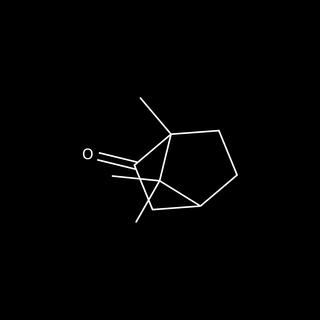
Camphor
PubChem, Camphor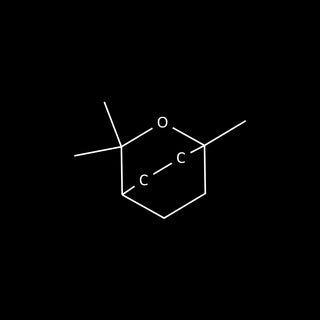
Eucalyptol (1,8-Cineole)
PubChem, Eucalyptol (1,8-Cineole) - Compound classes reported
- Monoterpenoids 17 % · Sesquiterpenoids 42 % · Flavonoids 16 % · of 274 compounds reported, 9 % of them esters · LOTUS
Labelling
- Forms in the EU cosmetic inventory
- Sweet Annie: ARTEMISIA ANNUA FLOWER/LEAF/STEM EXTRACT · ARTEMISIA ANNUA EXTRACT · ARTEMISIA ANNUA HERB OIL · ARTEMISIA ANNUA LEAF EXTRACT · ARTEMISIA ANNUA LEAF/STEM EXTRACT · ARTEMISIA ANNUA OIL · ARTEMISIA ANNUA POWDER · ARTEMISIA ANNUA SEED EXTRACT
- EU allergens reported
- Limonene · Linalool · Geraniol · Citral · Eugenol · Coumarin · Farnesol · Benzyl Benzoate · Pinene · Terpineol · Alpha-Terpinene · Terpinolene · Beta-Caryophyllene · Camphor · Carvone · Anethole · Methyl Salicylate · Vanillin · Santalol
Performance and rules
- Available as
- essential oil
- IFRA status
- No IFRA Standard for the material itself (51st Amendment)
Sweet Annie · See Also
Entries related to Sweet Annie, by their place in the pyramid. “shared” marks a scent word Sweet Annie has too.
Top notes

Artemisia
green (shared) · fresh (shared) · woody Aromatic / Top · Heart / Same subfamily / Natural-
Armoise
herbaceous · fresh (shared) · camphoraceous Aromatic / Top · Heart / Same subfamily / Natural 
Tarragon
green (shared) · fresh (shared) · sweet Aromatic / Top · Heart / Natural
Davana
woody · fruity · sweet Fruity / Top · Heart / Natural


Heart notes

Génépi
herbal (shared) · aromatic (shared) Aromatic / Same cluster / Natural

Sweet Annie · Sources
- GBIF Artemisia annua
- International Plant Names Index (IPNI) Artemisia annua L.
- Evidence-Based Complementary and Alternative Medicine Essential Oil of Artemisia annua L.: An Extraordinary Component with Numerous Antimicrobial Properties
- IFRA Standards, 51st Amendment
- Wikipedia Artemisia annua
- NIST Chemistry WebBook 1,5-Heptadien-4-one, 3,3,6-trimethyl- (Artemisia ketone)
- PubChem Artemisia ketone
Cite as PREMIEREPEAU Glossary, “Sweet Annie”, https://premierepeau.com/
