


Carvyl acetate
Keywords: green · herbal · minty
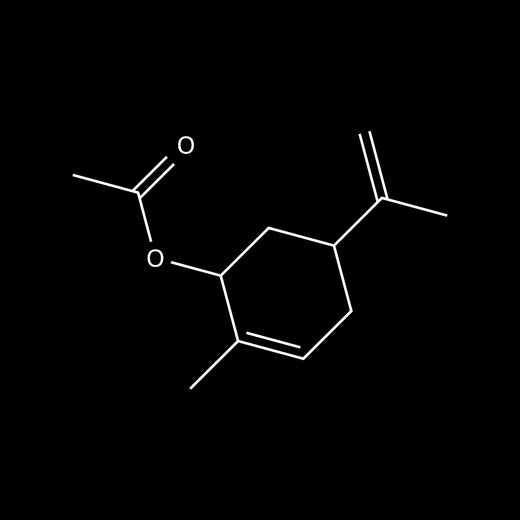
Carvyl acetate is an acetate ester with a spearminty, green and herbal odour.
- Olfactive family
- Aromatic · 511 entries of the glossary in this family Subfamily: Classic aromatics · 169 entries in this subfamily Cluster: Minty aromatics · 78 entries in this cluster
- IFRA status
- Restricted
- Pyramid
- Heart · Volatility: Heart Note
- Strength
- Medium Step 3 of 5 · shared by 1,462 of 2,149 graded entries Graded entries at each step, from 1 to 5: 4, 118, 1,462, 501, 40. 24 more sit between two steps.
- Also called
- Carveol acetate, (1R,5R)-carvyl acetate, (1S,5R)-carvyl acetate, 6-Acetoxy-p-mentha-1,8-diene
Carvyl acetate · Facets
Entries of the glossary that carry each facet, of 3,979:
- green 1,444
- herbal 757
- minty 104
- fruity 1,299
- sweet 1,988
- sour 45
Carvyl acetate · Scent
A green, herbal and spearminty odour with fruity, sweet, rummy and spicy facets.
Carvyl acetate · In Perfumery
It is a fragrance ingredient with a green, minty character of medium strength.
Pyramid
Carvyl acetate: Heart. Entries of the glossary stored at each place of the pyramid, of 4,000 (35 store no place):
- Top 718
- Top · Heart 496
- Heart 1,644
- Heart · Base 513
- Base 594
Carvyl acetate · In Depth
Identity
Its systematic name is (2-methyl-5-prop-1-en-2-ylcyclohex-2-en-1-yl) acetate. Its CAS number is 1205-42-1, its formula is C₁₂H₁₈O₂ and its molecular weight is 194.27 g/mol. It is a clear, colourless to pale yellow liquid.
Odour
It smells green and herbal, with minty, fruity, sweet and spicy touches. The minty side is spearmint, joined by nasturtium, rummy, grape and pear nuances. Its substantivity is 163 hours at 100 %.
Use in perfumery
It is a fragrance ingredient.
Use in flavours
It is a flavouring agent with a green, spearmint profile. Its taste is green, minty and spearmint, with vegetable, herbal, wasabi and ripe fruity notes. An expert committee on food additives found no safety concern at current levels of intake when it is used as a flavouring agent.
Properties
It boils at 229 °C, or at 115 to 116 °C at 10 mmHg. Its flash point is 97.78 °C and its estimated logP is 3.359. Its density is 0.964 to 0.970 and its refractive index is 1.473 to 1.479. It is slightly soluble in water and soluble in alcohol and most fixed oils. Its vapour pressure is an estimated 0.001 mmHg at 25 °C.
Safety and IFRA
An IFRA Standard named Carvyl acetate exists under the 51st Amendment, and the material is restricted under it. Its INCI name is LAEVO-CARVYL ACETATE and its function is perfuming. Its EC number is 214-883-7. All hazard notifications (1551 of 1551) find that it does not meet the criteria for a GHS hazard class.
Carvyl acetate · Technical Sheet
Molecular weight
194.27 g/mol Heavier than 816 of the 862 other entries at the same place of the pyramid that store a weight; 10 weigh the same.
2,518 entries store a molecular weight. By place in the pyramid: Top 537, Top · Heart 403, Heart 863, Heart · Base 452, Base 263.
Identity
- Type
- Ingredient
- Category
- Aroma chemicals
Classification
- Chemical class
- Ester
Chemical data
- Formula
- C12H18O2
- CAS
- 1205-42-1
- PubChem CID
- 7335, compound record on PubChem
- InChIKey
- YTHRBOFHFYZBRJ-UHFFFAOYSA-N
- Wikidata
- Carvyl acetate: Q4686651, item on Wikidata
Physical properties
- Appearance
- Colourless to pale yellow clear liquid
- Boiling point
- 115 to 116 °C at 10 mmHg
- Flash point
- 97.78 °C (208 °F)
- Density
- 0.964–0.970
- Refractive index
- 1.473–1.479
- Vapour pressure
- 0.001 mmHg at 25 °C (estimated)
- Log P
- 3.359 (estimated)
- Tenacity
- 163 hours at 100 %
Performance and rules
- IFRA status
- Restricted — IFRA Standard “Carvyl acetate” (Amendment 51)
Carvyl acetate · See Also
Entries related to Carvyl acetate, by their place in the pyramid. “shared” marks a scent word Carvyl acetate has too.
Top notes

Citron Leaf
fresh · green (shared) · citrus Green / Natural

Heart notes

Isopulegyl acetate
sweet (shared) · peppermint · fruity (shared) Aromatic / Heart · Base / Same cluster / 196.29 g/mol
(1R,5R)-2-methyl-5-prop-1-en-2-ylcyclohex-2-en-1-ol
minty (shared) · sweet (shared) · spicy Aromatic / Same cluster / 152.23 g/mol
Dihydrocarvyl acetate
floral · rose · sweet (shared) Aromatic / Heart · Base / Same cluster / 196.29 g/mol
(2-methyl-5-prop-1-en-2-ylcyclohex-2-en-1-yl) propanoate
fruity (shared) · herbal (shared) · minty (shared) Aromatic / Heart · Base / Same cluster / 208.3 g/mol
Perillyl acetate
floral · fruity (shared) · herbal (shared) Florals / 194.27 g/mol


Carvyl acetate · Sources
- PubChem Carvyl acetate
- Pyrfume Good Scents odour data (Pyrfume archive)
- Pyrfume Leffingwell odour data (Pyrfume archive)
- The Good Scents Company Information System Carvyl acetate: data sheet
- IFRA Standards, 51st Amendment
- European Commission, CosIng Carvyl acetate: cosmetic ingredient record
Cite as PREMIEREPEAU Glossary, “Carvyl acetate”, https://premierepeau.com/
