Delonix

AccordFLOWERSfloral · tropical

Seven perfumesOne of them is looking at you

HeartPyramid
—Strength
—Tenacity
1Origins

Editorial noteWe own no rights to this material, its name or its trademark. This entry is independent editorial journalism, published under freedom of expression.
Specimen
Delonix perfume ingredient
Heart
Delonix regia
Fantasy/Concept
Definition

Delonix is a genus of flowering plants in the bean family, Fabaceae. The flowers of its best-known species, the royal poinciana (Delonix regia), have a subtle fragrance.

FLORAL
Flame tree, royal poinciana, flamboyant, peacock flower, phoenix tree, flame of the forest
Type
Accord
Olfactive family
Florals
Subfamily
Classic florals
Cluster
Classic florals
Instruments
Pyramid
TTop
HHeart
BBase
—Strength
Subtle
Subtle
Producing countries
Madagascar

Scent

The flowers of Delonix regia have a subtle fragrance.

The Full Story

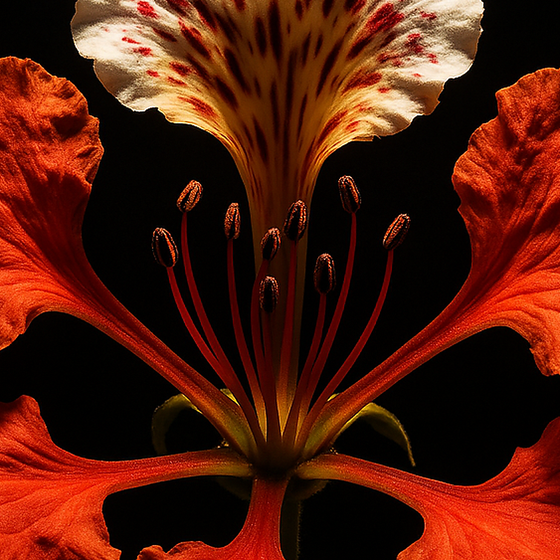
Delonix regia, the flamboyant tree or flame tree, is a legume native to Madagascar that has been introduced into tropical and sub-tropical regions worldwide. Its flowers are bright red and orange, 10 to 13 cm in diameter, and they have a subtle fragrance. It is a medium-sized deciduous tree that grows to about 10 m. In the wild it is now rare, but it is widely cultivated and may be seen adorning avenues, parks and estates in tropical areas throughout the world.

The royal poinciana requires a tropical or near-tropical climate, but can tolerate drought and salty conditions. The tree does poorly in heavy or clay soils, and flowers more profusely when kept slightly dry.

Delonix is a genus of flowering plants in the family Fabaceae, subfamily Caesalpinioideae. It contains trees native to Madagascar and East Africa. The royal poinciana is by far its best known species. The name of the genus comes from the Greek words for "evident" and "claw", referring to the petals. The common name poinciana comes from a former genus of the same name, in which the members of Delonix were once classified.

Plants of the genus, collectively known as fengoky or fengoka, release brown resin lumps that can be dissolved to make glue or sucked as edible sweets among the Malagasy. Their seeds are roasted and eaten as a snack in the south.

The leaves of the royal poinciana are doubly pinnate and 30 to 50 cm long, with 20 to 40 pairs of primary leaflets, each divided into 10 to 20 pairs of secondary leaflets. Each flower has four spreading scarlet or orange-red petals and one upright petal marked with yellow and white. The pods are flat and woody, up to 70 cm long, and hold between 18 and 45 seeds about 2 cm long.

Twelve species of Delonix are accepted. One of them, Delonix velutina, is an endangered tree of the far north of Madagascar, and its main threat is the use of its wood to build fishing canoes.

—

Related: Accord Eudora · African Marigold · Alpha Amylcinnamaldehyde · Alyssum · Angels Trumpet · Aquaflora · Ashoka Flower · Aurantiol

Did You Know?

Delonix regia is light sensitive: trees beside street lamps stay evergreen and do not bloom, or may flower only on the side away from the light. In the Caribbean Islands the pods are used for fuel and are called woman's tongue because of the rattling noise they make when the wind blows them.

Extraction & Chemistry

Extraction method

The volatile oil of the leaves of Delonix regia has been obtained by three methods: hydrodistillation, steam distillation, and cold maceration of air-dried leaves in n-hexane. These gave yields of 0.32%, 0.54% and 1.25% respectively.

Botanical
Delonix regia
Appearance
Bright red and orange flowers
Odour strength
Subtle
Synonyms
Flame tree, royal poinciana, flamboyant, peacock flower, phoenix tree, flame of the forest
IFRA status
See note

No IFRA Standard for the material itself (51st Amendment)

In Perfumery

The flowers of its best-known species, the royal poinciana, have only a subtle fragrance.

Role in the formula
01modifier
Available as
synthetic accord fantasy note

See Also

7 notes