


Gorse
Keywords: floral · creamy · fresh
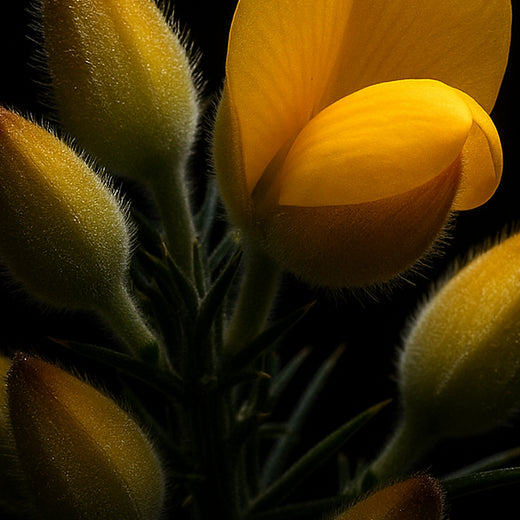
Gorse (Ulex europaeus), also called furze or whin, is a spiny evergreen shrub of the pea family, native to Western Europe. Its yellow flowers have a distinctive coconut-like scent, which some people notice very strongly and others only weakly.
- Olfactive family
- Florals · 779 entries of the glossary in this family Subfamily: Green florals · 143 entries in this subfamily Cluster: Classic florals · 245 entries in this cluster
- Material
- Natural Flowers
- Pyramid
- Heart · Volatility: Heart Note
- Strength
- Medium Step 3 of 5 · shared by 1,473 of 2,156 graded entries Graded entries at each step, from 1 to 5: 4, 119, 1,473, 498, 39. 23 more sit between two steps.
- Producing countries
- Western Europe (native range)
- Also called
- Common gorse, furze, whin
Family, subfamily and cluster: PREMIEREPEAU house classification, version 2026‑11.
Gorse · Facets
Entries of the glossary that carry each facet, of 3,979:
- floral 1,546
- green 1,442
- sweet 1,988
- warm 1,108
- creamy 401
Gorse · Scent
On the bush, the flowers have a smell reminiscent of coconut or ground almonds. When a bunch of flowers is gathered in a container, a number of more complex, fruity aromas become noticeable. The volatile extract of fresh flowering gorse and Scotch broom has a fresh, light liquorice odour.
Evolution over time
Gorse: scent over time.
- Immediately
Fresh, light liquorice odour
Scent words: fresh - After a few hours
More complex, fruity aromas
Scent words: fruity - After a few days
Coconut or ground almonds
Gorse · In Perfumery
Pyramid
Gorse: Heart. Entries of the glossary stored at each place of the pyramid, of 4,006 (42 store no place):
- Top 718
- Top · Heart 497
- Heart 1,641
- Heart · Base 514
- Base 594
Role in the formula
Gorse: roles in the formula. Entries of the glossary that share each role, of 4,006:
- Modifier 1,167
- Signature note 897
- Lifting agent 567
- Blender 1,040
- Volume builder 780
- Freshness 720
PREMIEREPEAU collection: Extrait de parfum
Gorse · Extraction & Chemistry
Volatile compounds were extracted from fresh flowering branches and flowers of gorse and Scotch broom at a mean yield of 0.06% on a fresh mass basis. The gorse came from north-west Spain and was gathered over the spring blossom, in April and May. The extracts were then analysed by GC and GC/MS.
Available as
Gorse: available as.
- synthetic accord
- fantasy note
- volatile extract
- flowers
- Appearance
- Yellowish liquid (volatile extract of fresh flowering plant material)
Gorse · Did You Know?
The old country saying “When gorse is out of blossom, kissing’s out of fashion” exists because, between the different species, some gorse is nearly always in flower. Gorse readily catches fire because of the high levels of natural oils found in the spines.
Gorse · In Depth
Botany
Gorse commonly grows 1–2.5 m in height, and plants can live for up to 30 years. The young stems are green, with the shoots and leaves modified into green spines 1–3 centimetres long. Young seedlings produce normal leaves for the first few months, and these are trifoliate, resembling a small clover leaf.
The solitary flowers are yellow and 1–2 cm long, with the pea-flower structure typical of the Fabaceae. The fruit is a legume pod that contains 2–3 small blackish, shiny, hard seeds, which are ejected when the pod splits open in hot weather.
The Genus Ulex
Ulex is a genus of about twenty species of thorny evergreen shrubs. Its species are native to parts of western Europe and northwest Africa, with the majority in Iberia. Common gorse is the only species native to much of western Europe, where it grows in sunny sites and usually on dry, sandy soils. The western gorse (Ulex gallii) is characteristic of highly exposed Atlantic coastal heathland and montane habitats.
Common gorse flowers a little in late autumn and through the winter, coming into flower most strongly in spring. Western gorse and dwarf furze flower in late summer.
Chemistry
GC and GC/MS analysis of the volatile extracts identified 20 compounds from the flowering biomass of gorse. Phytol, E-nerolidol and 6,10,14-trimethylpentadecanone are the main terpenoid constituents of the volatile extract of the flowers. Aliphatic compounds make up 61.12 percent of that extract.
Ecology
Like other legumes, gorse fixes nitrogen into the soil. Seeds remain viable for 30 years. Outside its native range it is often considered a weed and is a serious invasive problem in some areas, notably the western United States, Chile and New Zealand.
Several bird species take shelter in gorse bushes, as they are so dense and provide great protection during harsh weather. Gorse flowers are a good source of nectar for bees and butterflies.
Uses
Bruised gorse was used in some areas for feeding to horses and other livestock. In many areas, bundles of gorse were used to fire traditional bread ovens. Gorse wood has been used to make small objects, and reference sources describe it as non-toxic and especially suited for cutlery.
Gorse is one of the 38 plants used to prepare Bach flower remedies. A lectin extracted from the seeds is the standard method for identification of H substance on human red blood cells.
Related: Wisteria · Sweet Pea · Yellow Flowers
Gorse · History
The flower, known as chorima in the Galician language, is the national flower of Galicia in northwest Spain. Sprigs of gorse, usually called furze in the West Country, were a traditional gift between young lovers on May Day, when the blossom is at its peak.
The furze is the badge of the Sinclair and MacLennan clans of Scotland. The gorse is also the emblem of Brittany.
Gorse was brought to Australia during the early 1800s as a hedge and ornamental plant. It was introduced to New Zealand from Britain as a type of hedge.
Gorse · Technical Sheet
Identity
- Botanical
- Ulex europaeus
- Taxonomy
- Fabales order › Fabaceae family › Ulex genus · GBIF
- Botanical records
- Ulex europaeus: POWO, Ulex europaeus · IPNI, Ulex europaeus · GBIF, Ulex europaeus · Wikidata, Ulex europaeus · Wikipedia, Ulex europaeus · IUCN Least concern (LC), Ulex europaeus
- IPNI
- Ulex europaeus L., Sp. Pl. 2: 741 (1753) — Carl Linnaeus (1707–1778)
- Type
- Ingredient
- Category
- Flowers
- Note
- Ulex europaeus; absolute extracted from flowers. Coconut-like, warm, sweet aroma. Very limited commercial production.
In Nature
- Growth form
- Shrub · POWO
- Native range
- Northern Europe · Middle Europe · Southwestern Europe · Southeastern Europe · Macaronesia · POWO
- Introduced to
- 54 regions · Southern America 11 · Africa 10 · Australasia 10 · Europe 9 · Tropical Asia 7 · Northern America 3 · Temperate Asia 2 · Pacific 1 · Antarctic 1
- Flowering
- peak in February–April · December · north of the equator · iNaturalist
- Recorded altitude
- 0–2,800 m · median 150 m · 19,763 records with an altitude · GBIF
- Wild or cultivated
- 102,792 native · 23,493 introduced · 3,248 cultivated among 438,648 records (the rest carry no such mark) · GBIF
- Recorded in
- 67 of 512 squares of the world grid; a brighter dot holds more records · GBIF
- Also from this botanical family
- Fabaceae: Acacia · Albizia · Amburana Bark · Amburana Wood · Ashoka Flower · Astragalus · 50 more entries
In Print
- Timeline
- first described 1753 · earliest aroma paper in Europe PMC, 2018
- In English books
- most mentioned in the 1980s · Google Books Ngram
Classification
- Chemical class
- Fantasy note
Chemical data
- Formula
- Complex natural mixture (key constituents: phytol; E-nerolidol; 6,10,14-trimethylpentadecanone)
- GC-MS study
- PLoS One 2018, On the bioherbicide potential of Ulex europaeus and Cytisus scoparius: Profiles of volatile organic compounds and their phytotoxic effects
- Structure
- Phytol:
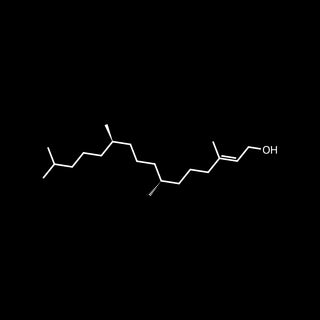
Phytol
PubChem, Phytol - INCI names (CosIng)
- ULEX EUROPAEUS FLOWER EXTRACT (SKIN CONDITIONING)
- Compound classes reported
- Isoflavonoids 57 % · Lysine alkaloids 30 % · of 30 compounds reported · LOTUS
Labelling
- Forms in the EU cosmetic inventory
- Gorse: ULEX EUROPAEUS LEAF/ROOT/STEM EXTRACT
Physical properties
- Specific gravity
- 0.85 g/mL (mean density of the volatile extract of fresh flowering gorse and Scotch broom)
Performance and rules
- IFRA status
- No IFRA Standard for the material itself (51st Amendment)
Gorse · See Also
Entries related to Gorse, by their place in the pyramid. “shared” marks a scent word Gorse has too.
Heart notes
-
Hina
floral (shared) · sweet (shared) · tropical Florals / Same cluster / Natural 
Rangoon Creeper
floral (shared) · tropical Florals / Same cluster / Natural
Jujube Blossom
floral (shared) · fruity · sweet (shared) Florals / Same cluster / Natural-
Lydia Broom
floral (shared) · green (shared) Florals / Same subfamily / Natural 
Spanish Broom
floral (shared) · sweet (shared) · green (shared) Florals / Same subfamily / Natural
Kudzu
floral (shared) · green (shared) · fruity Florals / Same subfamily / Natural
Laburnum
floral (shared) · sweet (shared) · green (shared) Florals / Same subfamily / Fantasy/Concept
Jasmine
floral (shared) Florals / Natural
Orange Blossom
floral (shared) · honeyed · citrus Florals / Natural
Tuberose
floral (shared) · narcotic · creamy (shared) Florals / Natural
Violet
floral (shared) · violet Florals / Natural & Synthetic-
Genet
honeyed · warm (shared) · hay-like Florals / Heart · Base / Natural


Other entries · Place in the pyramid not stored

Carnation
floral (shared) · spicy · clove Florals / Same cluster / Natural

Gorse · Sources
Read the science
- PLoS One (2018) On the bioherbicide potential of Ulex europaeus and Cytisus scoparius: Profiles of volatile organic compounds and their phytotoxic effects
- Molecules (2019) Cytisus scoparius and Ulex europaeus Produce Volatile Organic Compounds with Powerful Synergistic Herbicidal Effects
- GBIF Ulex europaeus
- International Plant Names Index (IPNI) Ulex europaeus L.
- PLOS ONE (2018) On the bioherbicide potential of Ulex europaeus and Cytisus scoparius: Profiles of volatile organic compounds and their phytotoxic effects
- NSW Department of Primary Industries Gorse (Ulex europaeus)
- IFRA Standards, 51st Amendment
- Wikipedia Ulex europaeus
- Wikipedia Ulex
- IUCN Global Invasive Species Database Ulex europaeus, full account
Cite as PREMIEREPEAU Glossary, “Gorse”, https://premierepeau.com/
