


Guava Blossom
Keywords: floral · fruity · sweet
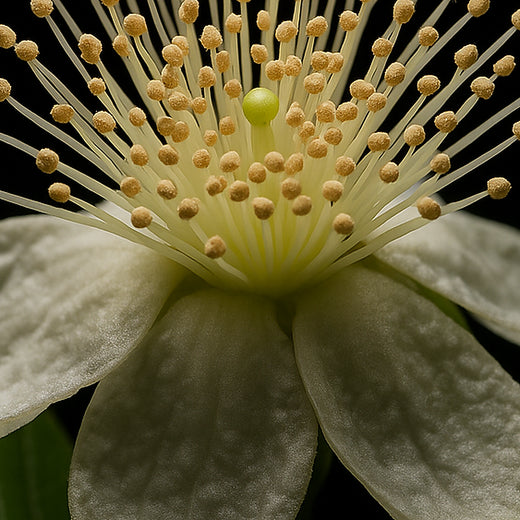
Guava blossom is the flower of the common guava, Psidium guajava, a small tree of the myrtle family. Its flowers are white, with five petals and numerous stamens.
- Olfactive family
- Florals · 779 entries of the glossary in this family Subfamily: Fresh florals · 104 entries in this subfamily Cluster: Classic florals · 245 entries in this cluster
- Material
- Fantasy/Concept Flower
- Pyramid
- Heart · Volatility: Heart Note
- Strength
- Medium Step 3 of 5 · shared by 1,473 of 2,156 graded entries Graded entries at each step, from 1 to 5: 4, 119, 1,473, 498, 39. 23 more sit between two steps.
- Also called
- Guava Flower, Guava
Family, subfamily and cluster: PREMIEREPEAU house classification, version 2026‑11.
Guava Blossom · Facets
Entries of the glossary that carry each facet, of 3,979:
- floral 1,546
- sweet 1,988
- fruity 1,301
- warm 1,108
- fresh 1,387
- tropical 189
Guava Blossom · Scent
Evolution over time
Guava Blossom: scent over time.
- Immediately
Sweet tropical-green softness, faint musk
Scent words: green · tropical · sweet · musky - After a few hours
Delicate fruity-floral warmth
Scent words: floral · fruity - After a few days
Gentle fading, barely perceptible
Guava Blossom · In Perfumery
The plant is used in many different shampoo products for its scent.
Pyramid
Guava Blossom: Heart. Entries of the glossary stored at each place of the pyramid, of 4,006 (42 store no place):
- Top 718
- Top · Heart 497
- Heart 1,641
- Heart · Base 514
- Base 594
Role in the formula
Guava Blossom: roles in the formula. Entries of the glossary that share each role, of 4,006:
- Diffusion enhancer 248
- Modifier 1,167
- Signature note 897
- Lifting agent 567
- Blender 1,040
- Volume builder 780
Available as
Guava Blossom: available as.
- essential oil
- accord
Guava Blossom · Terroir & Origins
- Producing countries
- Central America, India, Mexico, South America
- Other countries of origin
- Brazil
No origin card: India, Mexico.
Brazilian Guava Blossom
São Paulo & Bahia — Brazil
Facet scores, out of 100
- Floral 95 (also a facet of the entry)
- Green 82
- Sweet 78 (also a facet of the entry)
- Fruity 60 (also a facet of the entry)
- Powdery 44
- Woody 37
It is in Brazil that Guava Blossom finds its finest expression. The Brazilian terroir imprints a distinctive opulent profile.
Brazil’s terra roxa, a red laterite soil of exceptional fertility, is the result of volcanic basalt decomposition.
- Species
- Psidium guajava
- Harvest
- Hand-picking of flowers, often at dawn
- Extraction
- Steam distillation of the flowers
- Climate
- Subtropical to tropical, distinct seasons
- Soil
- Red lateritic (terra roxa)
- Altitude
- 0 – 800 m
Guava Blossom · Did You Know?
Traditional medicine uses Psidium guajava in 44 countries. In ethnobotanical surveys of its use against diarrhea, leaves were the most frequently used plant part.
Guava Blossom · In Depth
Psidium guajava is an evergreen shrub or small tree native to South America. Some sources list it as also native to Mexico, Central America, the Caribbean, and the rest of South America. It is now distributed in tropical and subtropical regions worldwide.
It is pollinated by insects. When cultivated, it is pollinated mainly by the common honey bee, Apis mellifera. From seed, common guavas may bloom and set fruit in as few as two years or as many as eight. The fruits are many-seeded berries. Oil hydrodistilled from guava flowers collected in Goiás, Brazil contained α-cadinol (37.8%) and β-caryophyllene (12.2%).
Tree and leaves
The tree can grow up to 12 m and has a smooth, brown bark. Its tough, dark leaves are opposite, simple and elliptic to ovate, and measure 5–15 centimetres in length. The name guava comes from the Taíno guayabo, by way of the Spanish guayaba.
Leaf oil
The essential oil of fresh guava leaves, obtained by hydro-distillation, was analysed by GC-MS, which identified 54 compounds making up 98.172% of the oil. The major constituents of that leaf oil were iso-caryophyllene (33.53%), veridiflorene (13.00%), farnesene (11.65%) and dl-limonene (9.84%).
Production
In 2024 world production of guavas, counted together with mangoes and mangosteens, was 62 million tonnes, led by India with 45% of the total.
Explore all seven extraits in the Discovery Set.
Related: Bottlebrush · Acerola Blossom · Carambola Blossom
Guava Blossom · History
Archaeological sites in Peru yielded evidence of guava cultivation as early as 2500 BC.
Guava Blossom · Technical Sheet
Identity
- Botanical
- Psidium guajava
- Taxonomy
- Myrtales order › Myrtaceae family › Psidium genus · GBIF
- Botanical records
- Psidium guajava: POWO, Psidium guajava · IPNI, Psidium guajava · GBIF, Psidium guajava · Wikidata, Psidium guajava · Wikipedia, Psidium guajava · IUCN Least concern (LC), Psidium guajava
- IPNI
- Psidium guajava L., Sp. Pl. 1: 470 (1753) — Carl Linnaeus (1707–1778)
- Type
- Concept
- Category
- Flowers
- Note
- Guava blossom (Psidium guajava) essential oil. Key aroma compounds: beta-caryophyllene, 1,8-cineole, (E)-cinnamyl alcohol. Specific gravity ~0.870–0.920 at 25 °C (est).
In Nature
- Native range
- Western South America · POWO
- Introduced to
- 116 regions · Southern America 37 · Africa 32 · Pacific 19 · Tropical Asia 12 · Northern America 8 · Temperate Asia 6 · Australasia 2
- Flowering
- peak in April–June · north of the equator · iNaturalist
- Sample origins in GC-MS studies
- China (1 paper; one: Chem Biodivers 2017, China) · Tunisia (1 paper; one: Industrial crops and products 2014, Tunisia) · French Polynesia (1 paper; one: Journal of essential oil research 2011, French Polynesia) · South Korea (1 paper; one: Journal of essential oil research 2011, South Korea) · Taiwan (1 paper; one: Journal of essential oil research 2007, Taiwan)
- Recorded altitude
- 0–1,600 m · median 600 m · 12,419 records with an altitude · GBIF
- Wild or cultivated
- 89 native · 3,212 introduced · 185 cultivated among 63,970 records (the rest carry no such mark) · GBIF
- Recorded in
- 140 of 512 squares of the world grid; a brighter dot holds more records · GBIF
- Also from this genus
- Psidium: Guava
- Also from this botanical family
- Myrtaceae: Allspice · Anise Myrtle · Blue Mallee · Cajeput · Clove · Clove Leaf · 26 more entries
In Print
- Timeline
- first described 1753 · earliest aroma paper in Europe PMC, 1985
- In English books
- most mentioned in the 1980s · Google Books Ngram
Classification
- Chemical class
- Complex natural (essential oil)
Chemical data
- Formula
- Complex mixture (essential oil)
- Most reported compounds
- Quercetin (6 papers; one: Biosci Biotechnol Biochem 2010, Quercetin) · Reynoutrin (5 papers; one: Biosci Biotechnol Biochem 2010, Reynoutrin) · Avicularine (4 papers; one: Biosci Biotechnol Biochem 2010, Avicularine) · Beta-Caryophyllene (3 papers; one: Flavour & Fragrance J 1991, Beta-Caryophyllene) · Catechin (3 papers; one: Chem Nat Compd 2011, Catechin) · LOTUS
- CAS
- 92456-53-6 (not found in a public registry)
- INCI names (CosIng)
- PSIDIUM GUAJAVA LEAF OIL (FRAGRANCE)PSIDIUM GUAJAVA SEED OIL (SKIN CONDITIONING – EMOLLIENT)PSIDIUM GUAJAVA FRUIT EXTRACT (ASTRINGENT, SKIN CONDITIONING)PSIDIUM GUAJAVA LEAF EXTRACT (ASTRINGENT, SKIN CONDITIONING)PSIDIUM GUAJAVA LEAF WATER (ANTIMICROBIAL, ANTIOXIDANT, SKIN PROTECTING)PSIDIUM GUAJAVA FRUIT (SKIN CONDITIONING)PSIDIUM GUAJAVA FRUIT JUICE (ASTRINGENT, SKIN CONDITIONING)
- Compound classes reported
- Monoterpenoids 4 % · Sesquiterpenoids 11 % · Phenolic acids (C6-C1) 19 % · Flavonoids 14 % · of 161 compounds reported, 25 % of them esters · LOTUS
Labelling
- EU allergens reported
- Limonene · Geraniol · Citral · Isoeugenol · Farnesol · Pinene · Terpineol · Alpha-Terpinene · Terpinolene · Beta-Caryophyllene · Benzaldehyde · Santalol
Physical properties
- Appearance
- Colorless to pale yellow liquid
Performance and rules
- IFRA status
- No IFRA Standard for the material itself (51st Amendment)
Guava Blossom · See Also
Entries related to Guava Blossom, by their place in the pyramid. “shared” marks a scent word Guava Blossom has too.
Heart notes

Canna flower
floral (shared) · rich · tropical (shared) Florals / Same cluster / Synthetic
Mango Blossom
floral (shared) · tropical (shared) · fruity (shared) Florals / Same cluster / Natural
Michelia
floral (shared) · fruity (shared) · sweet (shared) Florals / Same cluster / Natural
Blue Lilies
floral (shared) · fruity (shared) · sweet (shared) Florals / Same cluster / Natural
Litchi Blossom
floral (shared) · fruity (shared) · sweet (shared) Florals / Same cluster / Natural
Violet
floral (shared) · violet Florals / Natural & Synthetic
Rose
floral (shared) · honeyed · waxy Florals / Natural
Lily
floral (shared) · green · waxy Florals / Synthetic
Tuberose
floral (shared) · narcotic · creamy Florals / Natural
Pitanga
fruity (shared) · sweet (shared) · fresh (shared) Fruity / Natural
Rose Apple
fruity (shared) · floral (shared) · fresh (shared) Fruity / Natural


Base notes

Iris
powdery · earthy · violet Florals / Natural

Guava Blossom · Sources
Read the science
- Molecules (2020) Comparative Chemical Profiles of the Essential Oils from Different Varieties of Psidium guajava L
- J Sci Food Agric (2013) Odour-active compounds in guava (Psidium guajava L. cv. Red Suprema)
- Braz J Biol (2021) Chemical composition and biological activities of essential oil from flowers of Psidium guajava (Myrtaceae)
- International Plant Names Index (IPNI) Psidium guajava L.
- Frontiers in Pharmacology (2024) Ethnobotany, phytochemistry, and biological activities of Psidium guajava in the treatment of diarrhea: a review
- Brazilian Journal of Biology (2021) Chemical composition and biological activities of essential oil from flowers of Psidium guajava (Myrtaceae)
- IFRA Standards, 51st Amendment
- Wikipedia Guava
- Wikipedia Psidium guajava
Cite as PREMIEREPEAU Glossary, “Guava Blossom”, https://premierepeau.com/

