


Hoary Basil
Keywords: citrus · lime · basil
Hoary basil is a common name for Ocimum americanum, an annual herb of the family Lamiaceae, also called American basil or lime basil. Its essential oil has a scent that appears to be a natural blend between that of lime peels and that of sweet basil.
- Olfactive family
- Aromatic · 510 entries of the glossary in this family Subfamily: Herbal aromatics · 230 entries in this subfamily Cluster: Green-herbal notes · 155 entries in this cluster
- Material
- Natural Leaf
- Pyramid
- Top · Heart · Volatility: Top · Heart Note
- Also called
- American basil, lime basil, Ocimum canum
Family, subfamily and cluster: PREMIEREPEAU house classification, version 2026‑11.
Hoary Basil · Facets
Entries of the glossary that carry each facet, of 3,979:
- citrus 487
- herbal 757
- green 1,442
- aromatic 102
- fresh 1,387
Hoary Basil · Scent
The entire plant is highly aromatic, with an odor comparable to citrus.
Hoary Basil · In Perfumery
The plant is also used for an essential oil.
Pyramid
Hoary Basil: Top · Heart. Entries of the glossary stored at each place of the pyramid, of 4,006 (42 store no place):
- Top 718
- Top · Heart 497
- Heart 1,641
- Heart · Base 514
- Base 594
Role in the formula
Hoary Basil: roles in the formula. Entries of the glossary that share each role, of 4,006:
- Freshness 720
- Green note fewer than 40 entries
- Top note fewer than 40 entries
- Modifier 1,167
Hoary Basil · Extraction & Chemistry
Leaf oil has been extracted by steam distillation in a Clevenger-type apparatus. Hydrodistillation of the leaves yielded about 0.4% oil.
Available as
Hoary Basil: available as.
- essential oil
- whole plant
Hoary Basil · Did You Know?
Despite the misleading name, hoary basil is native to Africa, the Indian subcontinent, China, and Southeast Asia.
Hoary Basil · In Depth
Botanical identity
Ocimum americanum is a hairy annual herbaceous plant that grows up to 40 cm tall, with toothed, opposite leaves and small, white or purple flowers in clusters. The plant has a long taproot that extends deep into the ground. The species is naturalized in Queensland, Christmas Island, and parts of tropical America. Lemon basil (Ocimum × citriodorum) is a hybrid between O. americanum and O. basilicum.
Chemistry
In one leaf oil, the main components were camphor (33.86%), limonene (7.21%), longifolene (6.72%), veridiflorol (5.85%) and α-pinene (5.19%). In an oil from Burkina Faso, 1,8-cineol (31.22%) was the most abundant compound, followed by camphor (12.70%). The content of the oil was dependent on the season of harvest.
Uses
The plant can be used in cooking in much the same way as sweet basil (O. basilicum). It also has medicinal properties.
Hoary Basil · History
The name Ocimum americanum is credited to Linnaeus, with a publication date of 1755.
Hoary Basil · Technical Sheet
Identity
- Botanical
- Ocimum americanum
- Taxonomy
- Lamiales order › Lamiaceae family › Ocimum genus · GBIF
- Botanical records
- Ocimum americanum: POWO, Ocimum americanum · IPNI, Ocimum americanum · GBIF, Ocimum americanum · Wikidata, Ocimum americanum · Wikipedia, Ocimum americanum
- IPNI
- Ocimum americanum L., Cent. Pl. I. 15 (1755) — Carl Linnaeus (1707–1778)
- Type
- Ingredient
- Category
- Greens, herbs and fougeres
In Nature
- Sample origins in GC-MS studies
- India (1 paper; one: Exp Parasitol 2024) · Cameroon (1 paper; one: J Food Compost Anal 2004) · Mali (1 paper; one: Journal of essential oil research 1999) · Rwanda (1 paper; one: Pharm Weekbl Sci 1985)
- Recorded altitude
- 0–1,500 m · median 400 m · 664 records with an altitude · GBIF
- Wild or cultivated
- 15 native · 269 introduced · 42 cultivated among 6,228 records (the rest carry no such mark) · GBIF
- Recorded in
- 80 of 512 squares of the world grid; a brighter dot holds more records · GBIF
- Also from this genus
- Ocimum: Basil · Basil Oil · Clove Basil · Tulsi
- Also from this botanical family
- Lamiaceae: Akigalawood · Apple Mint · Blue Bugle · Catnip · Chia Seed · Clary Sage · 36 more entries
In Print
- Timeline
- first described 1755 · earliest aroma paper in Europe PMC, 2009
- In English books
- most mentioned in the 1990s · Google Books Ngram
Chemical data
- Formula
- Complex natural mixture (key constituents: camphor; limonene; 1,8-cineole)
- Most reported compounds
- Linalool (4 papers; one: Phytomedicine 1994) · Beta-Caryophyllene (3 papers; one: Phytomedicine 1994) · Borneol (2 papers; one: Phytomedicine 1994) · Camphor (2 papers; one: Phytomedicine 1994) · Myrcene (2 papers; one: Phytomedicine 1994) · LOTUS
- Structure
- Camphor, Limonene, Eucalyptol (1,8-Cineole):
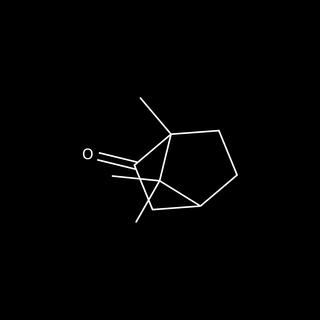
Camphor
PubChem, Camphor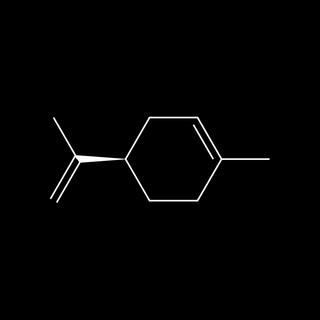
Limonene
PubChem, Limonene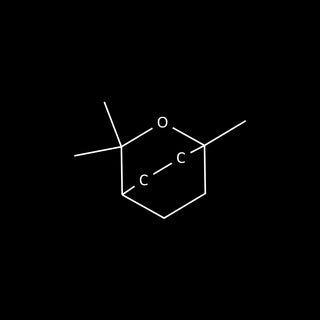
Eucalyptol (1,8-Cineole)
PubChem, Eucalyptol (1,8-Cineole) - Compound classes reported
- Monoterpenoids 37 % · Sesquiterpenoids 20 % · Flavonoids 27 % · Phenylpropanoids (C6-C3) 10 % · of 49 compounds reported, 2 % of them esters · LOTUS
Labelling
- Forms in the EU cosmetic inventory
- Hoary Basil: OCIMUM AMERICANUM LEAF OIL · OCIMUM AMERICANUM LEAF/STEM OIL
- EU allergens reported
- Limonene · Linalool · Eugenol · Pinene · Terpinolene · Beta-Caryophyllene · Camphor
Hoary Basil · See Also
Entries related to Hoary Basil, by their place in the pyramid. “shared” marks a scent word Hoary Basil has too.
Top notes


Heart notes

Rhubafuran
herbal (shared) · aromatic (shared) · floral Aromatic / Same cluster / Synthetic
Methyl Eugenol
spicy · clove · warm Spicy / Natural & Synthetic-
Clove Basil
spicy · herbal (shared) · clove Spicy / Natural


Hoary Basil · Sources
- GBIF Ocimum americanum
- International Plant Names Index (IPNI) Ocimum americanum L.
- BMC Complementary Medicine and Therapies Chemical compositions, antioxidant, antimicrobial, and mosquito larvicidal activity of Ocimum americanum L. and Ocimum basilicum L. leaf essential oils
- PLOS ONE Chemical composition, antioxidant, anti-inflammatory and anti-proliferative activities of essential oils of plants from Burkina Faso
- Molecules Seasonal Variation in Essential Oil Composition and Bioactivity of Three Ocimum Species from Nepal
- IFRA Standards, 51st Amendment
- Wikipedia Ocimum americanum
- Wikipedia Ocimum
Cite as PREMIEREPEAU Glossary, “Hoary Basil”, https://premierepeau.com/

