


Silk Tree Blossom
Keywords: floral · powdery · sweet
Silk Tree Blossom: The Persian silk tree, Albizia julibrissin, is a species of tree in the Fabaceae family, and its showy flowers are fragrant and pink. The tree is native to southwestern and eastern Asia.
- Olfactive family
- Florals · 779 entries of the glossary in this family Subfamily: Powdery florals · 63 entries in this subfamily
- Material
- Fantasy/Concept Flower of Albizia julibrissin
- Pyramid
- Heart · Volatility: Heart Note
- Strength
- N/A — no measured strength for a fantasy accord Not on the graded scale
- Producing countries
- Asia
- Also called
- Pink silk tree, mimosa tree, pink siris, Lankaran acacia
Family, subfamily and cluster: PREMIEREPEAU house classification, version 2026‑11.
Silk Tree Blossom · Facets
Entries of the glossary that carry each facet, of 3,979:
- floral 1,546
- sweet 1,988
- powdery 197
- warm 1,108
- fresh 1,387
- creamy 401
Editorial note We own no rights to this material, its name or its trademark. This entry is independent editorial journalism, published under freedom of expression.
Silk Tree Blossom · Scent
The flowers are fragrant.
Evolution over time
Silk Tree Blossom: scent over time.
- Immediately
N/A — no documented evolution for a fantasy accord
- After a few hours
N/A
Silk Tree Blossom · In Perfumery
Mimosa is among the absolutes in demand, an absolute being produced by solvent extraction.
Pyramid
Silk Tree Blossom: Heart. Entries of the glossary stored at each place of the pyramid, of 4,006 (42 store no place):
- Top 718
- Top · Heart 497
- Heart 1,641
- Heart · Base 514
- Base 594
Role in the formula
Silk Tree Blossom: roles in the formula. Entries of the glossary that share each role, of 4,006:
- N/A — no documented formula role 361
Silk Tree Blossom · Extraction & Chemistry
The scent of the silk tree flower can in principle be captured by solvent extraction, which gives an absolute, or by steam distillation, which gives an essential oil. Both methods apply high heat and are lengthy, so the result may differ considerably from the scent of the living flower. The volatiles of the living flower have instead been analysed by solid-phase microextraction, which uses no solvent and needs no pretreatment.
Available as
Silk Tree Blossom: available as.
- synthetic accord
- fantasy note
- Appearance
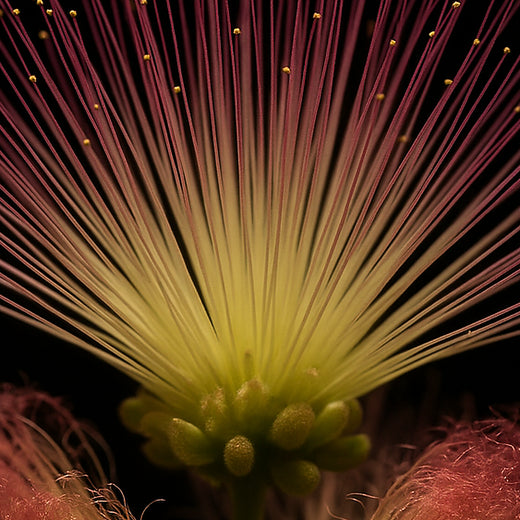
- Pink, puff-ball shaped, feathery and silky flowers
Silk Tree Blossom · Did You Know?
The leaves of the tree slowly close during the night and during periods of rain. In Japan its common names nemunoki, nemurinoki and nenenoki all mean “sleeping tree”.
Silk Tree Blossom · In Depth
Each flower has a small calyx and corolla, except the central ones, and a dense tuft of conspicuous stamens 2–3 cm long, white or pink with a white base. The flowers bloom throughout the summer in dense inflorescences, which resemble starbursts of pink silky threads. They have been observed to attract bees, butterflies and hummingbirds.
The Tree
Albizia julibrissin is a small deciduous tree with a broad crown of level or arching branches, growing to 5–16 m (16–52 ft) tall. The leaves are large and frond-like, divided into 6–12 pairs of pinnae, each with 20–30 pairs of leaflets. Its fruit is a flat brown pod 10–20 cm (4–8 in) long that contains several seeds.
Original habitats of the tree include regions from Iran (Persia) and the Republic of Azerbaijan to China and Korea. The native range also includes Japan, Nepal and Taiwan, and the tree has been introduced to Greece and the United States.
Varieties and Forms
The typical variety is Albizia julibrissin var. julibrissin, while var. mollis differs in having densely hairy shoots. The flower colour varies from white in the form alba to rich red-tipped flowers. The form rosea, the pink silk tree, is a smaller tree of 5–7 m with always pink flowers, native to Korea and northern China, and it survives temperatures down to at least −25 °C.
Names
The specific epithet julibrissin is a corruption of the Persian word gul-i abrisham, which means “silk flower”. It is also called Lankaran acacia or bastard tamarind, though it is not too closely related to either genus. In the United States the species is called Chinese silk tree, silk tree or mimosa, which is misleading. Several species of Acacia, notably Acacia baileyana and Acacia dealbata, are also called mimosa, especially in floristry.
Uses of the Tree
The tree is widely planted as an ornamental plant in parks and gardens. The flowers provide nectar and pollen for bees. Silk tree wood may be used to make furniture. The dried stem bark is used medicinally in China to prepare tonics and sedatives. The flowers are also used to make teas, and in Chinese medicine the plant is considered an antidepressant. In Japan the name nemunoki is a kigo, a seasonal word of haiku, representing summer.
Spread
The tree has become an invasive species in the United States. There it has spread from southern New York, New Jersey and Connecticut west to Missouri and Illinois, and south to Florida and Texas.
Explore all seven extraits in the Discovery Set.
Silk Tree Blossom · History
The tree was introduced to Europe in the mid-18th century by the Italian nobleman Filippo degli Albizzi, and the name of the genus Albizia is given after him. It was introduced to the US as an ornamental in the 1700s.
Silk Tree Blossom · Technical Sheet
Identity
- Botanical
- Albizia julibrissin
- Taxonomy
- Fabales order › Fabaceae family › Albizia genus · GBIF
- Botanical records
- Albizia julibrissin: POWO, Albizia julibrissin · IPNI, Albizia julibrissin · GBIF, Albizia julibrissin · Wikidata, Albizia julibrissin · Wikipedia, Albizia julibrissin · IUCN Least concern (LC), Albizia julibrissin
- IPNI
- Albizia julibrissin Durazz., Mag. Tosc. 3(4): 13 (1772) — Antonio Durazzini (1740–1810)
- Type
- Accord
- Category
- Flowers
In Nature
- Native range
- Caucasus · Western Asia · China · Eastern Asia · Indian Subcontinent · Indo-China · POWO
- Introduced to
- 49 regions · Northern America 26 · Europe 8 · Temperate Asia 8 · Tropical Asia 3 · Africa 2 · Southern America 2
- Flowering
- peak in June–July · north of the equator · iNaturalist
- Recorded altitude
- 0–750 m · median 100 m · 2,858 records with an altitude · GBIF
- Wild or cultivated
- 88 native · 180 introduced · 76 cultivated among 38,650 records (the rest carry no such mark) · GBIF
- Recorded in
- 89 of 512 squares of the world grid; a brighter dot holds more records · GBIF
- Also from this genus
- Albizia: Albizia
- Also from this botanical family
- Fabaceae: Acacia · Amburana Bark · Amburana Wood · Ashoka Flower · Astragalus · Black Locust · 49 more entries
In Print
- Timeline
- first described 1772 · earliest aroma paper in Europe PMC, 2021
- In English books
- most mentioned in the 1990s · Google Books Ngram
Classification
- Cluster
- Powdery florals · 32 entries in this cluster
- Chemical class
- Reconstructed accord
Chemical data
- Formula
- N/A — complex natural mixture (Albizia julibrissin extract)
- Most reported compounds
- p-Coumaroylagmatine (4 papers; one: Tetrahedron 2000, p-Coumaroylagmatine) · Luteolin (2 papers; one: Chem Pharm Bull (Tokyo) 2012, Luteolin) · Quercitrin (2 papers; one: Chem Pharm Bull (Tokyo) 2012, Quercitrin) · LOTUS
- INCI names (CosIng)
- ALBIZIA JULIBRISSIN BARK EXTRACT (FRAGRANCE, SKIN CONDITIONING)ALBIZIA JULIBRISSIN FLOWER EXTRACT (SKIN CONDITIONING)ALBIZIA JULIBRISSIN LEAF EXTRACT (SKIN CONDITIONING – MISCELLANEOUS)ALBIZIA JULIBRISSIN SEED EXTRACT (SKIN CONDITIONING)
- Compound classes reported
- Monoterpenoids 1 % · Flavonoids 26 % · Triterpenoids 26 % · of 84 compounds reported, 23 % of them esters · LOTUS
Physical properties
- Flash point
- N/A — no single substance to measure
- Specific gravity
- N/A — no single substance to measure
- Refractive index
- N/A — no single substance to measure
Performance and rules
- IFRA status
- No IFRA Standard for the material itself (51st Amendment)
Silk Tree Blossom · See Also
Entries related to Silk Tree Blossom, by their place in the pyramid. “shared” marks a scent word Silk Tree Blossom has too.
Heart notes

Floral Notes
floral (shared) · fresh (shared) · rich Florals / Same cluster / Fantasy/Concept
Weeping Cherry Blossom
floral (shared) · powdery (shared) · sweet (shared) Florals / Same cluster / Fantasy/Concept
Nerium Oleander
floral (shared) · powdery (shared) · sweet (shared) Florals / Same cluster / Fantasy/Concept-
Mimosa Absolute
floral (shared) · powdery (shared) Florals / Heart · Base / Same cluster / Natural 
Heliotropin (Piperonal)
floral (shared) · powdery (shared) · sweet (shared) Florals / Same subfamily / Synthetic
Acacia
floral (shared) · sweet (shared) · warm (shared) Florals / Heart · Base / Same subfamily / Natural
Lily
floral (shared) · green · waxy Florals / Synthetic
Jasmine
floral (shared) Florals / Natural
Rose
floral (shared) · honeyed · waxy Florals / Natural
Black Locust
floral (shared) · sweet (shared) · fresh (shared) Florals / Natural
Cassie Absolute
floral (shared) · spicy · herbal Florals / Heart · Base / Natural


Base notes

T-Shirt accord
fresh (shared) · musky · powdery (shared) Amber & musk / Same cluster / Fantasy/Concept
Iris
powdery (shared) · earthy · violet Florals / Same subfamily / Natural-
Saman
coumarinic · hay-like · floral (shared) Green / Natural


Other entries · Place in the pyramid not stored

Carnation
floral (shared) · spicy · clove Florals / Natural

Silk Tree Blossom · Sources
Read the science
- J Plant Physiol (2021) Five TPSs are responsible for volatile terpenoid biosynthesis in Albizia julibrissin
- GBIF Albizia julibrissin
- International Plant Names Index (IPNI) Albizia julibrissin Durazz.
- University of Georgia Extension Invasive Species Alert: Silk Tree or Mimosa (Albizai julibrissin)
- IFRA Standards, 51st Amendment
- Google Patents Patent KR101064067B1
- Wikipedia Albizia julibrissin
- Wikipedia Absolute (perfumery)
- World Agroforestry Albizia julibrissin, Agroforestree species profile
Cite as PREMIEREPEAU Glossary, “Silk Tree Blossom”, https://premierepeau.com/

