


Sodium Silicate
Keywords: inorganic silicate · industrial chemical
Sodium silicate is a generic name for chemical compounds such as sodium metasilicate (Na₂SiO₃), sodium orthosilicate and sodium pyrosilicate. It is also the common name for a mixture of such compounds, chiefly the metasilicate, called waterglass, water glass or liquid glass.
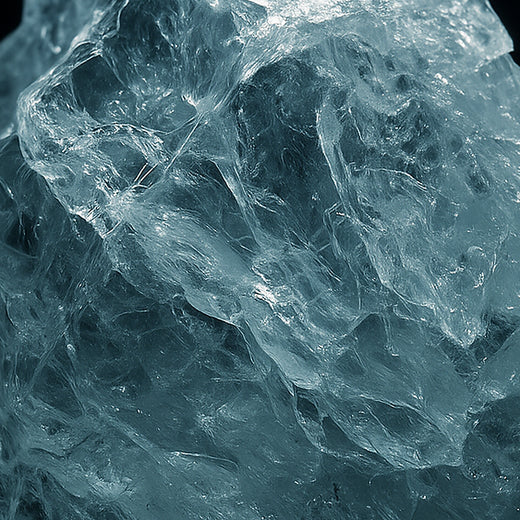
- Olfactive family
- Amber & musk · 136 entries of the glossary in this family Subfamily: Clean musks · 26 entries in this subfamily
- Material
- Synthetic Manufactured from silica (sand) and sodium carbonate
- Pyramid
- Base · Volatility: Base Note
- Strength
- Medium Step 3 of 5 · shared by 1,473 of 2,156 graded entries Graded entries at each step, from 1 to 5: 4, 119, 1,473, 498, 39. 23 more sit between two steps.
- Also called
- water glass, liquid glass, waterglass, soluble glass, sodium metasilicate, disodium metasilicate
Family, subfamily and cluster: PREMIEREPEAU house classification, version 2026‑11.
Sodium Silicate · Facets
Entries of the glossary that carry each facet, of 3,979:
- mineral 72
- odorless 6
Sodium Silicate · Scent
Sodium silicate has no scent of its own. Its granules are described as white and odorless, and a producer’s safety data sheet for the solution gives the odour as odourless, with a musty note in brackets.
Evolution over time
Sodium Silicate: scent over time.
- Immediately
Odorless.
- After a few hours
Odorless.
- After a few days
Odorless, with a musty note recorded in one safety data sheet.
Sodium Silicate · In Perfumery
The listed cosmetic uses of sodium silicate are as an anticorrosive agent and a buffering agent.
Pyramid
Sodium Silicate: Base. Entries of the glossary stored at each place of the pyramid, of 4,006 (42 store no place):
- Top 718
- Top · Heart 497
- Heart 1,641
- Heart · Base 514
- Base 594
Role in the formula
Sodium Silicate: roles in the formula. Entries of the glossary that share each role, of 4,006:
- Signature note 897
- Freshness 720
- Fixative 340
Sodium Silicate · Where It Is Made
- Producing countries
- China, Germany, United States
Sodium Silicate · Extraction & Chemistry
Fusing silica (sand) with sodium carbonate at 1400 °C produces sodium metasilicate. Solutions of sodium silicates can be produced by treating a mixture of silica, usually as quartz sand, caustic soda and water with hot steam in a reactor.
- Appearance
- Colorless glassy or crystalline solids, or white powders
Sodium Silicate · Did You Know?
Eggs immersed in a sodium silicate solution and left to dry keep a permanent air-tight coating. Research from 1945 and 1948 found, however, that this method is ineffective at preserving the quality of albumen, the egg white, at room temperature and changes the odor and flavor of eggs.
Sodium Silicate · In Depth
Chemistry
Except for the most silicon-rich ones, sodium silicates are readily soluble in water, producing alkaline solutions. Grades with a SiO₂:Na₂O weight ratio below 2.85:1 are termed alkaline, and those with a higher ratio are described as neutral. Sodium metasilicate, Na₂SiO₃, is one of the sodium silicates. Their solutions are variable mixtures of water, silicate anions and sodium cations in dynamic equilibrium.
In the anhydrous solid, the metasilicate anion is polymeric, consisting of corner-shared SiO₄ tetrahedra. The pH of a 1% aqueous solution of sodium metasilicate is about 13. Sodium metasilicate is strongly irritating to the skin, eyes and respiratory tract. The commercial product, available in water solution or in solid form, is often greenish or blue owing to the presence of iron-containing impurities. Commercial forms include dustless white granules, amorphous lumps, spray-dried powder and aqueous solution.
Production
In 1990, 4 million tons of alkali metal silicates were produced. The anhydrous metasilicate can be prepared by fusing silicon dioxide with sodium oxide in a 1:1 molar ratio. Sodium silicate may be produced as part of hydrogen production by dissolving ferrosilicon in an aqueous sodium hydroxide solution.
Uses
The main applications of sodium silicates are in detergents, paper industry (as a deinking agent), water treatment, and construction materials. Sodium silicate is used in the formulation of cements, coatings, passive fire protection, textile and lumber processing, the manufacture of refractory ceramics, as adhesives, and in the production of silica gel. The largest application of sodium silicate solutions is a cement for producing cardboard.
Sodium silicate is used as a binder of the sand when doing sand casting of all common metals. A major use of sodium metasilicate is as a builder in soaps and detergents, a material that enhances or maintains the cleaning efficiency of the surfactant, principally by inactivating water hardness. Sodium metasilicate is also used extensively as an anti-corrosion agent in boiler-water feed. Sodium silicate solutions can also serve as a spin-on adhesive layer to bond glass to glass, a low-temperature technique compared with fusion bonding.
Explore all seven extraits in the Discovery Set.
Related: Cashmeran · Leather · Tonka Bean · Ambergris · Ambroxan · Aldron
Sodium Silicate · History
The adhesive properties of sodium silicate were noted as early as the 1850s. Waterglass has been used as an egg preservative, primarily when refrigeration is not available.
Sodium Silicate · Technical Sheet
Molecular weight
122.063 g/mol Heavier than 3 of the 261 other entries at the same place of the pyramid that store a weight.
2,515 entries store a molecular weight. By place in the pyramid: Top 537, Top · Heart 403, Heart 861, Heart · Base 452, Base 262.
Identity
- Botanical
- N/A – inorganic compound
- Type
- Ingredient
- Category
- Accords and curiosities
Classification
- Cluster
- Clean musks · 25 entries in this cluster
- Chemical class
- Silicon oxide, sodium compound
Chemical data
- Formula
- Na2O3Si
- Structure
- Sodium Silicate:
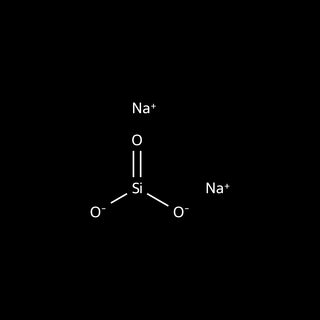 PubChem
- CAS
- 1344-09-8
- PubChem CID
- 23266, compound record on PubChem
- InChIKey
- NTHWMYGWWRZVTN-UHFFFAOYSA-N
- Wikidata · Wikipedia
- Sodium Silicate: Q425397, item on Wikidata · Wikipedia, English article
Physical properties
- Melting point
- 1089 °C
- Flash point
- 32.00 °F. TCC (0.00 °C.) (est)
- Specific gravity
- 1.39000 at 25.00 °C.
- Refractive index
- 1.520 (glass)
Performance and rules
- Available as
- standard form
- IFRA status
- No IFRA Standard for the material itself (51st Amendment)
Sodium Silicate · See Also
Entries related to Sodium Silicate, by their place in the pyramid.
Top notes

Snow
fresh · cold · earthy Amber & musk / Same cluster / Fantasy/Concept

Base notes

Cashmeran
musky · woody · spicy Amber & musk / Synthetic / 206.32 g/mol
Leather
animalic · smoky · dry Amber & musk / Fantasy/Concept
Ambergris
animalic · marine · amber Amber & musk / Natural & Synthetic
Ambroxan
woody · amber · musky Amber & musk / Semi-synthetic / 236.39 g/mol
Aldron
animalic · woody · amber Amber & musk / Synthetic / 248.4 g/mol
Tonka Bean
Gourmand / Natural


Sodium Silicate · Sources
- INCHEM Sodium metasilicate (PIM 500)
- PubChem Sodium Silicate
- IFRA Standards, 51st Amendment
- Penn State Extension How to Safely Handle and Store Eggs from Your Home Flock
- The Good Scents Company Sodium silicate
- Wikipedia Sodium silicate
- Wikipedia Sodium metasilicate
- USDA Agricultural Marketing Service (2025) Sodium Silicate, technical report for the National Organic Program
Cite as PREMIEREPEAU Glossary, “Sodium Silicate”, https://premierepeau.com/
