


Talc
Keywords: powdery · musky
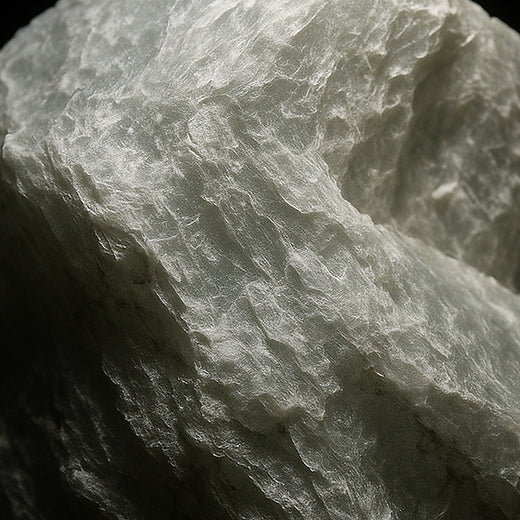
Talc is a clay mineral composed of hydrated magnesium silicate. In perfumery, powdery notes evoke the tactile sensation of fine talcum powder.
- Olfactive family
- Amber & musk · 137 entries of the glossary in this family Subfamily: Powdery florals · 64 entries in this subfamily Cluster: Clean musks · 25 entries in this cluster
- Material
- Natural Olfactory concept reconstructed from powdery musks, iris butter, and heliotropin
- Pyramid
- Base · Volatility: Base Note
- Also called
- talcum, talcum powder
Talc · Facets
Entries of the glossary that carry each facet, of 3,979:
- sweet 1,988
- powdery 197
- dry 159
Editorial note We own no rights to this material, its name or its trademark. This entry is independent editorial journalism, published under freedom of expression.
Talc · Scent
Pure talc is odorless. The scent profile of powdery notes is characterized by a dry, soft, slightly sweet aroma with a floral-musky backbone. It is often described as clean, airy, and subtly sweet.
Evolution over time
Talc: scent over time.
- Immediately
Dry, soft, clean, airy
Scent words: dry - After a few hours
Slightly sweet, floral-musky
Scent words: floral · sweet · musky
Talc · In Perfumery
Heliotropin imparts an almond-vanilla powderiness. Musks such as galaxolide and muscenone are used for their clean, powdery facets.
Pyramid
Talc: Base. Entries of the glossary stored at each place of the pyramid, of 4,000 (36 store no place):
- Top 718
- Top · Heart 497
- Heart 1,641
- Heart · Base 514
- Base 594
Role in the formula
Talc: roles in the formula. Entries of the glossary that share each role, of 4,000:
- Freshness 720
- Powdery effect fewer than 40 entries
Talc · Terroir & Origins
- Producing countries
- Brazil, India, United States, France, Finland, Italy, Russia, Canada, Austria
Talc · Extraction & Chemistry
Talc is mined. Notable economic talc occurrences include the Mount Seabrook talc mine in Western Australia, formed upon a polydeformed, layered ultramafic intrusion.
- Appearance
- White to grayish-white very fine crystalline powder
Talc · Did You Know?
Talc is the softest mineral: the Mohs scale of mineral hardness defines value 1 as the hardness of talc. The France-based Luzenac Group is the world’s largest supplier of mined talc, and its largest mine, at Trimouns in southern France, produces 400,000 tonnes of talc per year.
Talc · In Depth
Composition and structure
The chemical formula of the mineral is Mg₃Si₄O₁₀(OH)₂. The structure of talc is composed of Si₂O₅ sheets with magnesium sandwiched between sheets in octahedral sites. Talc occurs as foliated to fibrous masses, and in an exceptionally rare crystal form. Talc is not soluble in water, and is slightly soluble in dilute mineral acids. Soapstone is a metamorphic rock composed predominantly of talc.
Uses in products
Talc in powdered form, often combined with corn starch, is used as baby powder. The mineral is used as a thickening agent and lubricant. Talc is an ingredient in ceramics, paints, and roofing material. It is a main ingredient in many cosmetics.
Baby powder may contain additional ingredients such as fragrances. Talc is used in many industries, including paper making, plastic, paint and coatings, rubber, food, electric cable, pharmaceuticals, cosmetics, and ceramics.
Risk assessment
A final chemical risk assessment found that talc may be harmful to the lungs if loose powder products, such as baby powder, are breathed in. Talc is not harmful to the environment.
Explore all seven extraits in the Discovery Set.
Related: Ambretone · Ambrette (Musk Mallow) · Exaltolide® · Iris Butter · Clay · Porcelain clay · Porcelain · Satin
Talc · History
The word talc derives from the Persian tālk. Talcum baby powder was pioneered in the early 1890s by Frederick Barnett Kilmer. In 1892, Kilmer prescribed talcum powder to ease skin irritation from medical plasters.
Talc · Technical Sheet
Molecular weight
379.27 g/mol Heavier than 252 of the 261 other entries at the same place of the pyramid that store a weight.
2,515 entries store a molecular weight. By place in the pyramid: Top 537, Top · Heart 403, Heart 861, Heart · Base 452, Base 262.
Identity
- Botanical
- N/A — mineral (hydrated magnesium silicate)
- Type
- Accord
- Category
- Accords and curiosities
Classification
- Chemical class
- Phyllosilicate clay mineral, hydrated magnesium silicate
Chemical data
- Formula
- H2Mg3O12Si4
- CAS
- 14807-96-6
- EC
- 238-877-9
Labelling
- EU cosmetics annexes
- TALC · CosIng, Annex III, entry 59, TALC · restricted Product type, body parts:
“(a) Powdery products intended to be used for children under 3 years of age (b) Other products”
Wording of conditions:“(a) Keep powder away from children’s nose and mouth”
Physical properties
- Melting point
- 1700 to 1800 °F
- Flash point
- 32.00 °F. TCC (0.00 °C.) (est)
- Specific gravity
- 2.58–2.83
- Refractive index
- 1.58
- Vapour pressure
- 0 mmHg at 68 °F
Performance and rules
- Available as
- standard form
- IFRA status
- No IFRA Standard for the material itself (51st Amendment)
Talc · See Also
Entries related to Talc, by their place in the pyramid. “shared” marks a scent word Talc has too.
Heart notes


Base notes

Skin Musk
musky (shared) · warm · powdery (shared) Amber & musk / Same cluster / Fantasy/Concept
Sylkolide
musky (shared) · fruity · floral Amber & musk / Same cluster / Synthetic / 268.39 g/mol
Cashmeran
musky (shared) · woody · spicy Amber & musk / Synthetic / 206.32 g/mol
Ambergris
animalic · marine · amber Amber & musk / Natural & Synthetic
Cashmere
musky (shared) · woody · spicy Amber & musk / Synthetic
Leather
animalic · smoky · dry (shared) Amber & musk / Fantasy/Concept
Ambroxan
woody · amber · musky (shared) Amber & musk / Semi-synthetic / 236.39 g/mol


Talc · Sources
- PubChem Talc
- IFRA Standards, 51st Amendment
- Wikipedia Talc
- Wikipedia Baby powder
- Wikipedia Talcum powder
- Government of Canada Talc
Cite as PREMIEREPEAU Glossary, “Talc”, https://premierepeau.com/
