Bagrem

PrirodnaCVETOVIcvetni · sladak · svež
Srednje notePiramida
—Jačina
—Trajnost
—Poreklo
Uzorak
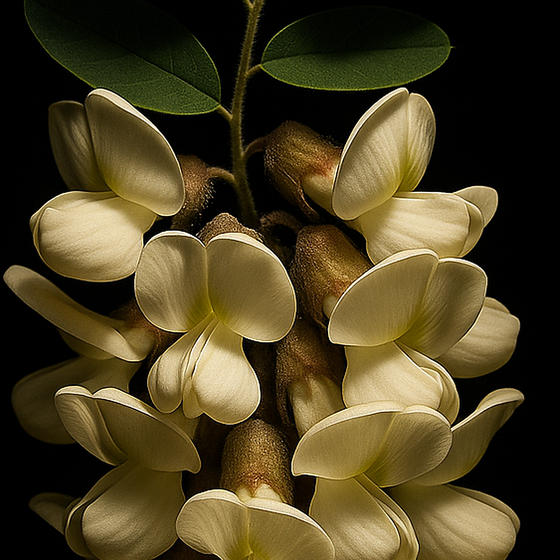
Bagrem kao sirovina za parfeme
Srednje note
Robinia pseudoacacia
Definicija

Black locust (Robinia pseudoacacia) is a medium-sized deciduous tree of the legume family. Its flowers are very fragrant.

DRVENAST CVETNI ZELEN SLADAK TOPAO SVEŽ MEDNI
False acacia, yellow locust
Type
Sirovina
Olfactive family
Cvetni
Source
flowers
Chemical class
Complex natural mixture
Instrumenti
Piramida
GGornje note
SSrednje note
BBazne note

Miris

The flowers are very fragrant, but the solvent extract of the flowers has a peculiar basic odor.

Teroar i poreklo

Detaljno

Black locust is a hardwood tree belonging to the tribe Robinieae of the legume family. Another common name is false acacia.

Origin and Growth

The species is native to a few small areas of the United States, but has been widely planted and naturalized elsewhere, including temperate North America, Eurasia, and Africa. As a nitrogen fixer with rapid juvenile growth, it is widely planted for ornament, for shelterbelts and for land reclamation. When growing in sandy areas the tree can enrich the soil through its nitrogen-fixing nodules, allowing other species to move in. It is typical of young woodlands and disturbed areas where sunlight is plentiful and the soil is dry. The tree is generally 12 to 18 m (40 to 60 ft) tall.

Flowers and Honey

The flowers open in May or June for 7-10 days, after the leaves have developed. The flowers hang in loose racemes typically 10-20 cm (4-8 in) long, and they are cream-white, rarely pink or purple. They are about 2.5 cm (1 in) wide and produce large amounts of nectar. Black locust is a major honey plant in the eastern US, and in many European countries it is the source of acacia honey. Blooming is short and the tree does not consistently produce a honey crop year after year.

Food Uses

In Liguria, Italy, and Romania the flowers are sometimes used to produce a sweet and perfumed jam. The flowers are eaten as beignets after being coated in batter and fried in oil, and they are also eaten in Japan, largely as tempura.

Chemistry

The odor of the flowers indicated the presence of methyl anthranilate, and the flowers were later shown to contain this ester. The extract was found to contain anthranilic acid methyl ester, indole, benzyl alcohol, linalool, α-terpineol, heliotropin and traces of pyridine-like bases. Aldehydes and ketones are also present in the extract, and probably nerol as well. The oil contained 9 per cent ester, computed as methyl anthranilate. Its alcoholic solution had a decided blueish fluorescence. The petals show high concentrations of the monoterpenes (Z)-ocimene and linalool, followed by geranyl nitrile and β-myrcene. The volatiles of Robinia honey are mainly terpenes in high concentrations, including linalool, cis-linalool oxide and hotrienol.

Explore all seven extraits in the Discovery Set.

Zanimljivosti

The wood is considered the most durable wood in North America. Black locust firewood has a higher heat content than any other species that grows widely in the eastern United States, comparable to the heat content of anthracite.

Dobijanje i hemija

Način dobijanja

The flowers are extracted with a readily volatile solvent, which gives a dark brown oil.

Formula
Complex natural mixture (key constituents: linalool; anthranilic acid methyl ester; indole; benzyl alcohol)
CAS
89957-93-7
Botanički naziv
Robinia pseudoacacia
Izgled
Dark brown oil
Sinonimi
False acacia, yellow locust
Status prema standardima IFRA
Pogledajte napomenu

No IFRA Standard for the material itself (51st Amendment)

Fizička svojstva
Tačka ključanja
60 to 150° (5 mm.)

U parfemima

Diluted, the solvent extract of the flowers faithfully reproduced the fragrance of the flowers.

Uloga u formuli
01pojačivač difuzije
02modifikator
03nota potpisa
04sredstvo za podizanje
05sirovina za stapanje
06graditelj volumena
Oblici na tržištu
apsolut

Pogledajte i

7 nota