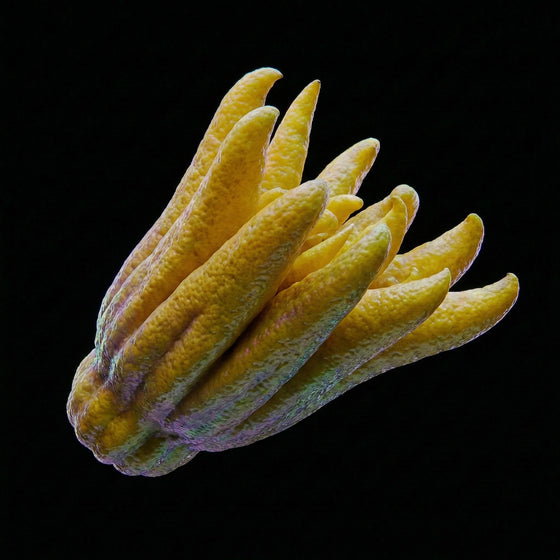
Buddha's hand, Citrus medica var. sarcodactylis, is a citron variety whose fruit is segmented into finger-like sections. The sections resemble those seen on representations of the Buddha. It is called Buddha's hand in many languages, including English, Hebrew, Chinese, Japanese, Korean, Vietnamese, German and French. It belongs to the family Rutaceae, genus Citrus, species Citrus medica.
Its rind is yellow and fragrant, and both rind and pith are edible. The cultivars form a gradient from "open-hand" types with outward-splayed segments to "closed-hand" types, in which the fingers are kept together. There are also half-fingered fruits, in which the basal side is united and the apical side fingered.
Origin and Plant
The origin of this kind of citron is commonly traced back to South or East Asia, probably northeastern India or China, where most domesticated citrus fruits originate. Like any other citron variety, it is a shrub or small tree with long, irregular branches covered in thorns. Its white flowers are tinted purplish from the outside and grow in fragrant clusters. The plant is sensitive to frost, as well as intense heat and drought. It grows best in a temperate climate. Trees can be grown from cuttings taken from branches two to four years old. Genetic analysis of citron cultivars finds two clusters predominantly in China, one of them representing the fingered citrons.
Chemistry
In the fresh fruit, the monoterpene content largely prevails over the sesquiterpene content in both the exocarp and the mesocarp. Limonene (75.8%) and γ-terpinene (16.5%) are the most abundant compounds of the fresh exocarp. In the essential oil, limonene (66.9%) and γ-terpinene (20.0%) are the most abundant compounds. The most abundant compounds of the hydrolate are α-terpineol (44.7%) and terpinen-4-ol (21.6%). The methanol extracts of the exocarp and mesocarp are also rich in furan and coumarin derivatives.
Reported differences in the composition of Buddha's hand essential oils could be attributed to the extraction or isolation method, the conditions of analysis, the geographic origin, the climatic region and genetic variability. The stage of maturity is also a predominant factor. In the mature phases, the quantity of monoterpenic hydrocarbons is higher, while the quantity of sesquiterpene hydrocarbons and oxygenated compounds is reduced.
Cultural and Traditional Uses
The fruit may be given as a religious offering in Buddhist temples. In China, the Buddha's hand is used as a symbol of happiness, longevity, and good fortune. It is also a traditional temple offering and a New Year's gift. According to tradition, Buddha prefers the fingers of the fruit to be in a position where they resemble a closed rather than open hand, as closed hands symbolize the act of prayer.
Whether a Buddha's hand is acceptable for liturgical use as an etrog on Sukkot was addressed in the 19th century by Rabbi Abdallah Somekh and his disciple, Rabbi Yosef Hayyim, both of Baghdad. Somekh was inclined to permit it, whereas Hayyim maintained that one may not use a variety of etrog in the absence of a positive tradition of its having been used.
The fingered citron is cultivated as an ornamental tree in gardens and containers on patios and terraces. The sliced, dried peel of immature fruits is also prescribed as a tonic in traditional medicine. The fruit is eaten as a zest or flavouring in desserts and savory dishes, in alcoholic drinks such as vodka or rice liquor, and candied as a sweet.
This note in PREMIEREPEAU. Gravitas Capitale. Sample all seven extraits in the Discovery Set.