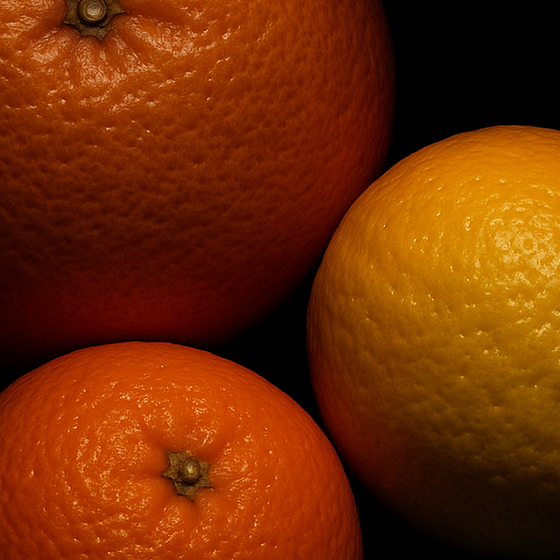
Citrusi

CITRUSNI MIRISIcitrusni · svež · živahan

Sedam parfemaJedan od njih vas posmatra

Gornje notePiramida
—Jačina
—Trajnost
·Poreklo
Uzorak
Citrusi kao sirovina za parfeme
Gornje note
Citrus (family Rutaceae); kumquats and Clymenia species are now generally considered to belong within the genus.
Definicija

Citruses, or citrus essential oils, are usually aromatic compounds found in oil glands in the flowers, leaves and fruit peels of citrus plants, and most are extracted from the fruit peel. Their major component is d-limonene.

CITRUSNI REZAK SVEŽ SLADAK GORAK AROMATIČAN
citrus oils, citrus essential oils
Type
Mirisna porodica
Olfactive family
Citrusni
Source
Oil glands in the peel of citrus fruit
Chemical class
Essential oils rich in monoterpene hydrocarbons (mainly limonene)
Instrumenti
Piramida
GGornje note
SSrednje note
BBazne note
Zemlje proizvođači
Italija (Kalabrija: bergamot; Sicilija: limun, cedrat), Brazil (slatka pomorandža, najveći proizvođač na svetu), SAD (Florida, Kalifornija), Španija (Valensija), Argentina, Kina, Meksiko, Japan (juzu, Koči), Jugoistočna Azija.

Miris

d-Limonene has a citrus, orange, fresh, sweet, peely aroma. The less common l-limonene has a piny, turpentine-like odor and is found in the edible parts of plants such as caraway, dill and bergamot orange. Citral has a strong lemon scent; used to fortify lemon oil, it presents as sharp, lemon, sweet, fresh, juicy, lemon peel, tart and green. Linalool has an odour similar to that of bergamot oil and French lavender, and a typical floral odour free from camphoraceous and terpenic notes.

Detaljno

The plants of the genus Citrus produce citrus fruits such as citrons, mandarins and pomelos. Many important citrus crops, including oranges, lemons, grapefruits and limes, have been developed through extensive hybridization. Three ancestral species of the genus, the mandarin, the pomelo and the citron, are associated with modern cultivars. Citrus essential oils are usually aromatic compounds found in oil glands present in the flowers, leaves and fruit peels.

Explore all seven extraits in the Discovery Set.

Chemistry

Citrus essential oils contain 85-99% volatile and 1-15% non-volatile components. Citrus essential oil is a complex mixture of about 400 volatile and semi-volatile compounds. In all the reported orange species, the volatile constituents contain large amounts of monoterpene hydrocarbons (70-95%). Limonene can be found in quantities ranging from 32% to 98%. Limonene is a cyclic monoterpene, and d-limonene is its (R)-enantiomer, which occurs more commonly in nature in citrus fruit peels. Citral is a collective term for two geometric isomers, geranial and neral, which occur as a mixture. Citral makes up 6-9% of the volatile oil of lime and 2-5% of that of lemon. Limonene and pinene are relatively unstable and decompose when exposed to heat and light, and they are removed from the oil to enhance the life of the products.

Phototoxicity and IFRA

Bergapten (5-methoxypsoralen) appears to be the primary phototoxic compound responsible for Citrus-induced phytophotodermatitis. Various Citrus species contain significant amounts of bergapten, especially bergamot orange, micrantha and certain varieties of lime and bitter orange. In several patch test studies, some sources of bergamot oil applied directly to the skin of guinea pigs had a concentration-dependent phototoxic effect, increasing redness after exposure to ultraviolet light. This property is shared by many other citrus fruits and other members of Rutaceae. The IFRA Standard on citrus oils is set because of their phototoxic effects. It recommends restrictions for several furocoumarin-containing oils, among them expressed bergamot, expressed bitter orange, expressed grapefruit, cold-pressed lemon and expressed lime oils. Petitgrain mandarin oil and cold-pressed tangerine oil contain small amounts of phototoxic furocoumarins, with typical levels of 50 ppm; these levels are not high enough to require special restrictions if used alone.

Classification

In Michael Edwards's fragrance wheel, citrus is a subfamily of the Fresh family, with bergamot and citrus oils given as examples.

Zanimljivosti

A single vial of Farina's aqua mirabilis cost half the annual salary of a civil servant. Eau de Cologne was once believed to protect against bubonic plague: by drinking the cologne, the citrus oil scent would exude through the pores, repelling fleas.

Dobijanje i hemija

Način dobijanja

Citrus essential oils are released when oil sacs are crushed during juice extraction or under pressure during cold pressing of the peel waste. Cold pressing yields a watery emulsion, which is centrifuged to recover the essential oils. Distillation is another way to extract the oils, but oils obtained by distillation have been observed to deteriorate easily and develop off-odor because of the instability of terpene hydrocarbons such as d-limonene. Supercritical fluid extraction with carbon dioxide is an emerging technique that can be done at ambient temperatures in the absence of harmful organic solvents. In peel oils of Valencia orange, Ponkan and Eureka lemon, oil yields ranged from 0.37 to 0.62%, and hydrodistillation gave higher yields than cold pressing for all three species. The extraction method has an obvious effect on the proportion of terpenes and oxygenated compounds in the oils, especially for Eureka lemon oils. One hundred bergamot oranges yield about 3 ounces (85 g) of bergamot oil.

Botanički naziv
Citrus (family Rutaceae); kumquats and Clymenia species are now generally considered to belong within the genus.
Sinonimi
citrus oils, citrus essential oils
Fizička svojstva
Nota
Complex mixture of about 400 volatile and semi-volatile compounds.

U parfemima

Bergamot extracts have been used as an aromatic ingredient in food, tea, snus, perfumes and cosmetics. An essence extracted from the aromatic skin of bergamot flavours Earl Grey and Lady Grey teas and confectionery. Citral has a strong lemon scent and is used as an aroma compound in perfumery, where it fortifies lemon oil. d-Limonene is used as a flavoring agent in food manufacturing. The characteristic flavor of citrus oils is mainly due to linalool, citral and linalyl acetate. Many countries in the Asia-Pacific region have a high demand for citrus essential oils because of their use in various food and beverages, cosmetic preparations and therapeutics. In a base of dilute ethanol (70-90%), eau de cologne contains a mixture of citrus oils, including oils of lemon, orange, tangerine, clementine, bergamot, lime, grapefruit, blood orange and bitter orange. A cologne is usually refreshingly light, unisex, with a citrus-based head note.

Uloga u formuli
01gornja nota
02sredstvo za podizanje
03modifikator
04sidro svežine
Oblici na tržištu
eterično ulje dobijeno hladnim ceđenjem destilovano ulje ulje FCF (bez bergaptena) CO₂ ekstrakt konkret

Pogledajte i

5 nota