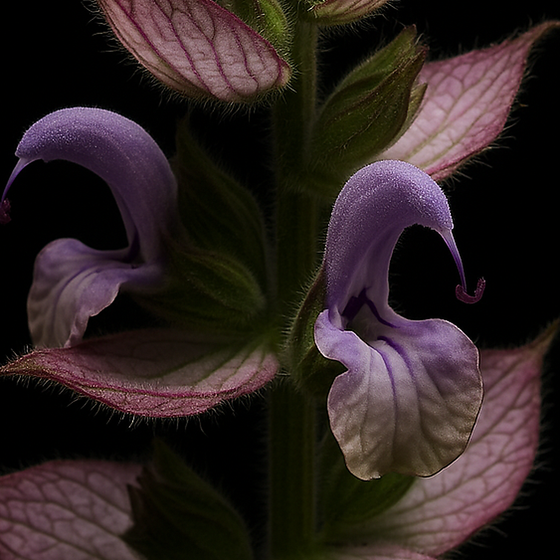
Muskatna žalfija

PrirodnaZELENE NOTE, BILJE I FUŽERIaromatičan · zelen · cvetni
Srednje notePiramida
—Jačina
—Trajnost
3Poreklo
Uzorak
Muskatna žalfija kao sirovina za parfeme
Srednje note
Salvia sclarea
Definicija

Clary sage is Salvia sclarea, a biennial herbaceous plant of the genus Salvia that is grown for its essential oil.

Herbacé
93
Vert
82
Frais
76
Aromatique
52
Boisé
31
Terreux
24
clary
Type
Sirovina
Olfactive family
Aromatični
Source
inflorescences and shoot tips
Instrumenti
Piramida
GGornje note
SSrednje note
BBazne note
Zemlje proizvođači
Francuska Kina Sjedinjene Američke Države

Miris

The aroma of the essential oil is described as fresh, herbal, tea, weedy, dry, sage and spicy. The absolute is described as ambery, herbaceous, camphor, floral and musky. The profile of the absolute is both bright and earthy. Typically aromatic, the absolute offers a subtle fruity undertone.

Teroar i prerada

Detaljno

The plant

Clary sage (Salvia sclarea) is a biennial herbaceous plant of the genus Salvia, in the family Lamiaceae. It is native to the northern Mediterranean Basin and to some areas in north Africa and Central Asia. The plant has long been cultivated as an herb and is currently grown for its essential oil. The word clary derives from Middle English clarie, from Anglo-Norman sclaree, from Late or Medieval Latin sclarēia, meaning clear. The plant reaches 3 to 4 ft (0.91 to 1.22 m) in height, with thick, square stems covered in hairs. The flowers are held in large colorful bracts that range in color from pale mauve to lilac or white-to-pink. The upper leaf surface is rugose and covered with glandular hairs.

Composition of the oil

The main components of the essential oil are 45 to 75% linalyl acetate and 9 to 25% linalool. Other constituents include germacrene D (up to 5%), β-caryophyllene (up to 2.5%) and α-terpineol (up to 4.5%). Geraniol, nerol and their acetates are each present at up to 2.5%.

Sclareol and ambroxide

Sclareol is a fragrant chemical compound found in Salvia sclarea. It is classified as a bicyclic diterpene alcohol, with the formula C₂₀H₃₆O₂ and a molar mass of 308.506 g/mol. Its CAS number is 515-03-7. Sclareol is mainly produced in the glandular trichomes of sage flower calyces. It is an amber-colored solid with a sweet, herbaceous, balsamic scent. Sclareol melts at 95.6 to 98.7 °C.

Sclareol is the most common starting material for manufacturing ambroxide, which is used as a fixative in commercial perfumes. Sclareol has been used extensively to prepare Ambrox because it is available commercially at a reasonable price as an extract of Salvia sclarea. The industrial route has three steps: oxidative degradation of the sclareol side chain to sclareolide, reduction of sclareolide to ambradiol, and cyclodehydration of ambradiol. Stoll completed the first synthesis of Ambrox by reducing sclareolide with LiAlH₄ and cyclizing the resulting diol with acid. A newer patented method that starts from homofarnesol was stated to need 100 times less agricultural surface than the traditional method from clary sage. Ambroxide has a scent with woody, musky and slightly salty nuances.

Production and history

In the United States, the oil is mostly produced on a large scale in and around Bertie County in northeastern North Carolina. Clary sage oil is also used in aromatherapy. The medicinal uses of the plant are described as far back as the 4th century BCE, in the writings of Theophrastus, and in the 1st-century CE writings of Dioscorides and Pliny the Elder.

—

Related: Basil · Basil Oil · Myrtle · Oregano · Rosemary · Rosemary Oil · Sage · Thyme

Dobijanje i hemija

Način dobijanja

Steam distillation of 100 kg of inflorescences and shoot tips gives about 800 grams of colorless essential oil. Depending on soil, altitude, climate, weather and variety, between 3.0 and 8.5 t of inflorescences can be harvested per hectare. For Ukraine, an average of 3.5 to 4.0 t/ha is known. The oil yield is usually between 15 and 23 kg per hectare. Optimal yields are reached when 50% of the nutlets in the fruits of the main stem have turned brown. A primary extraction with a volatile solvent on fresh or dry biomass yields a concrete or resinoid, and the absolute is obtained through a second purification step. Sclareol is extracted by steam distillation of fresh flowers, then purified by further extraction using an organic solvent.

Formula
Complex natural mixture (key constituents: linalyl acetate; linalool; sclareol C₂₀H₃₆O₂)
CAS
8016-63-5
Botanički naziv
Salvia sclarea
Izgled
Colorless essential oil
Sinonimi
clary
Status prema standardima IFRA
Pogledajte napomenu

No IFRA Standard for the material itself (51st Amendment)

Fizička svojstva
Tačka paljenja
100 °C / 212 °F (absolute)

U parfemima

The distilled essential oil is used in perfumes, most often as a supporting note. It is also used as a muscatel-like flavoring for vermouths, wines and liqueurs. Sclareol, found in clary sage, is used as a fragrance in perfume manufacturing and as a flavoring agent. Clary sage is not currently featured in any PREMIEREPEAU fragrance, though its derivative ambroxide appears across the amber and musky families of contemporary compositions.

Uloga u formuli
01modifikator
02sirovina za stapanje
Oblici na tržištu
eterično ulje apsolut CO2 ekstrakt

Pogledajte i

8 nota