Composition
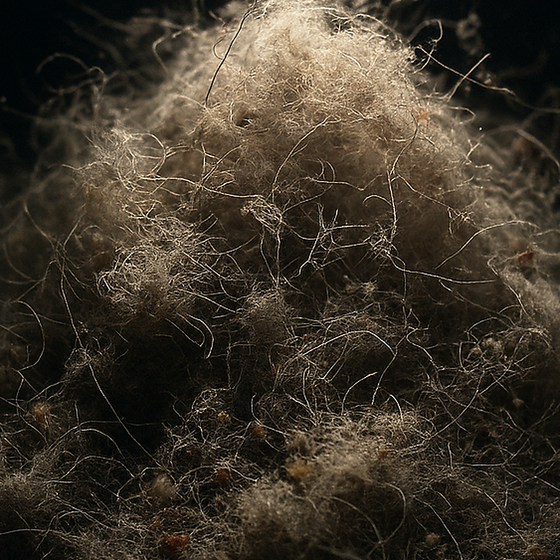
In dust, the remainder is composed of small amounts of plant pollen, human hairs, animal fur, textile fibers, paper fibers, minerals from outdoor soil, burnt meteorite particles, and many other materials which may be found in the local environment. Dust bunnies are small clumps of dust that form under furniture and in corners that are not cleaned regularly. They are made of hair, lint, flakes of dead skin, spider webs, dust and sometimes light rubbish and debris, held together by static electricity and felt-like entanglement. Dust mites are microscopic arachnids whose primary food is dead human skin cells, but they do not live on living people. It could take between twenty minutes and two hours for dust to settle back out of the air.
Sources and concentration
On Earth, dust generally consists of particles in the atmosphere that come from various sources such as soil lifted by wind, volcanic eruptions and pollution. Outdoors, the concentration of total suspended dust can vary between 0.01 and 10,000 mg/m³ across residential, industrial and commercial areas, highways, dirt roads, quarries and sand storms.
Skin oil and ozone
The single most abundant ozone-reactive constituent of skin lipids is squalene, at 10 to 12% of the surface lipids. Ozone reacts with human skin lipids to produce acetone, 6-methyl-5-hepten-2-one, geranyl acetone and 4-oxo-pentanal.
Wind and dust storms
Saltation likely accounts for 50-70% of deflation, suspension for 30-40% and surface creep for 5-25%. Dust storms are wind storms that have entrained enough dust to reduce visibility to less than 1 kilometer. Wind transports minerals from the Sahara to the Amazon basin, and Saharan dust forms red clay soils in southern Europe.
Cosmic dust
Thousands of tons of cosmic dust are estimated to reach Earth's surface every year. A major fraction of the dust in space is stardust, made of refractory minerals such as silicates, graphite and amorphous carbon.
The earthy smell of soil
Geosmin is the molecule released by moist soil or by soil that is freshly ploughed. It is a bicyclic alcohol with the formula C₁₂H₂₂O, formed by microorganisms such as Streptomyces. Its name comes from the Ancient Greek words for earth and smell. Geosmin accounts for the earthy taste of beetroots. Humans notice it in water at between 4 and 10 ng/L. Acid destroys geosmin, which is why fish that carry it are often eaten with lemon.
Explore all seven extraits in the Discovery Set.
—
Related: Alder · Alpha Humulene · Amaranth · Amberever · Amburana Bark · Antillone · Apple Tree