


Geranil-acetat
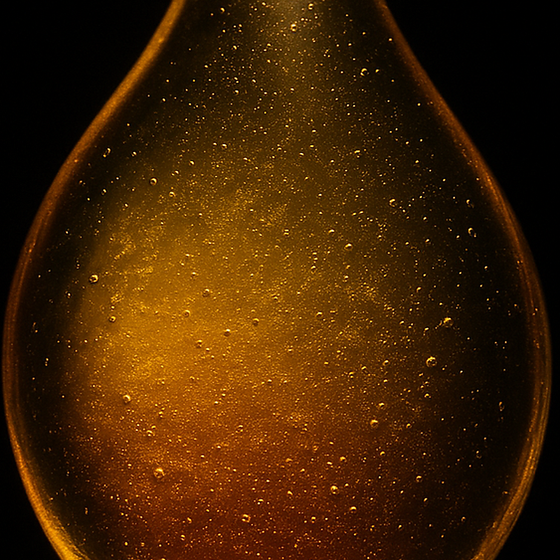
Ripe pear skin over a bed of crushed rose petals. Geranyl acetate is the softer, fruitier sibling of geraniol — where geraniol is a rose in full sun, this ester wraps it in waxy sweetness and a faint green coolness.
- Type
- Sirovina
- Olfactive family
- Cvetni
- Source
- flower
- Chemical class
- ester (terpenoid)
Miris
Detaljno
Zanimljivosti
In 1869, Ferdinand Tiemann at the University of Berlin acetylated geraniol isolated from palmarosa oil, producing geranyl acetate and confirming its structural identity. The same Tiemann later synthesised vanillin (1874) and ionone (1893) — three molecules that between them underpin half of modern perfumery.
Dobijanje i hemija
Način dobijanja
Industrial production: Fischer esterification of geraniol with acetic acid or acetic anhydride, acid-catalysed, yielding geranyl acetate at high purity (90–100% assay, typically containing 4–6% residual geraniol and 1–2% neryl acetate as the cis-isomer). Also obtainable by fractional distillation of palmarosa, citronella, or lemongrass essential oils in which it naturally occurs. Enzymatic synthesis via lipase-catalysed transesterification in supercritical CO₂ or n-hexane has been demonstrated at laboratory scale (Candida antarctica lipase, ~85% yield after 72 hours). Available commercially in multiple grades: natural (ex palmarosa), synthetic, and FCC food-grade.
- Formula
- C12H20O2
- CAS
- 105-87-3
- Botanički naziv
- N/A — synthetic ester (also found in Cymbopogon, Pelargonium, and Eucalyptus oils)
- Izgled
- Colorless to pale yellow clear liquid with sweet fruity-floral odor
- Trajnost
- 24 hour(s) at 100.00 %
- Sinonimi
- GERANYL ACETATE (E)-3,7-DIMETHYL-2,6-OCTADIEN-1-YL ACETATE
Not subject to an IFRA Standard (51st Amendment)
- Tačka ključanja
- 240.00 to 245.00 °C. @ 760.00 mm Hg
- Tačka paljenja
- 219.00 °F. TCC ( 104.00 °C. )
- Relativna gustina
- 0.91090 to 0.91290 @ 25.00 °C.
- Indeks prelamanja
- 1.45300 to 1.46900 @ 20.00 °C.
U parfemima
Top-to-heart modifier and blending ester. Geranyl acetate functions primarily as a fruity-floral bridge: it smooths the junction between citrus openings and floral hearts without adding density. Indispensable in rose accords, where it provides the fruity dimension that separates a flat reconstruction from a convincing one — standard rose bases pair it with citronellol (green-rosy), phenylethyl alcohol (honeyed), rose oxide (metallic-green), and damascones (jammy richness). Beyond rose, it lifts lavender reconstructions, softens neroli accords, and adds transparency to white-floral bouquets. IFRA-unrestricted as of the 51st Amendment, though classified as a fragrance allergen under EU Regulation 2023/1545, requiring label declaration above 0.001% in leave-on products. The Good Scents Company recommends up to 12% in the fragrance concentrate; this is not an IFRA limit.
Pogledajte i
7 nota