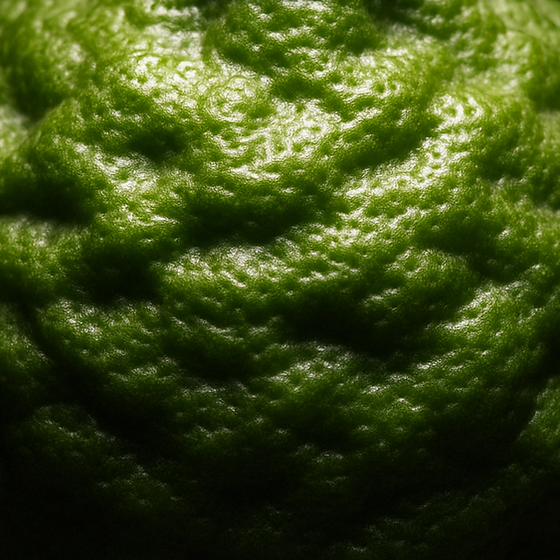
Kafir limeta

PrirodnaCITRUSNI MIRISIcitrusni · svež · zelen
Gornje notePiramida
—Jačina
—Trajnost
2Poreklo
Uzorak
Kafir limeta kao sirovina za parfeme
Gornje note
Citrus hystrix
Definicija

Kaffir lime, also called makrut lime, is Citrus hystrix, a thorny shrub or small tree native to tropical Southeast Asia. The leaf oil, petitgrain combava, has a fresh leafy, sweet rosy odor.

CITRUSNI ZELEN BILJNI SVEŽ TROPSKI
makrut lime, Thai lime, combava, petitgrain combava, limau purut, jêruk purut
Type
Sirovina
Olfactive family
Citrusni
Source
leaves (petitgrain combava); twigs; fruit peel (peel oil — different product)
Chemical class
complex natural (essential oil)
Instrumenti
Piramida
GGornje note
SSrednje note
BBazne note
—Jačina
Snažan
Snažan
Zemlje proizvođači
Malezija Tajland

Miris

The leaf oil has a fresh leafy, sweet rosy odor, somewhat reminiscent of the odor of Guinea lemon petitgrain oil and eucalyptus citriodora oil. The aroma is also described as powerful, fresh, green and lemon-lime. The odour type is described as citrus, fresh, leafy, sweet, lemon, petitgrain, eucalyptus and yuzu, and a further description gives fresh, lemon and citrusy. The plant's rind and crushed leaves emit an intense citrus fragrance.

Teroar i oblici

Detaljno

Makrut lime (Citrus hystrix) is native to tropical Southeast Asia. Its fruit and leaves are used in Southeast Asian cuisine, and its essential oil is used in perfumery. In perfumery, the relevant material is petitgrain combava (CAS 91771-50-5), the essential oil obtained from the leaves of the combava, Citrus hystrix. The fruit peel contains a different essential oil, comparable to lime fruit peel oil, whose main components are limonene and β-pinene.

The Plant

C. hystrix is a thorny shrub or small tree, 2 to 11 metres tall, with aromatic and distinctively shaped double leaves. The hourglass-shaped leaves comprise the leaf blade plus a flattened, leaf-like stalk. The fruit is rough and green and ripens to yellow, and it is approximately 4 cm wide. The flowers can have four to five white petals and are fragrant. The fruits have thick skins and taste very acidic and slightly bitter. Both the peel and the pulp contain significant quantities of furanocoumarins.

Names

The plant is called kaffir lime, Thai lime or makrut lime. In Javanese and Malay its names, jêruk purut and limau purut, both mean wart-lime, after the bumpy texture of the fruit. In Réunion Island it is called combava. In South Africa it is usually referred to as Thai lime. Some authors have favored the name makrut lime as more neutral. The most likely origin of the name kaffir lime is the Kaffirs, an ethnic group in Sri Lanka partly descended from enslaved Bantu. In the Philippines the fruit is called kabuyaw or kulubot, and in Vietnam chúc or chanh Thái.

Chemistry and Distinction

The compound responsible for the characteristic aroma of the leaf oil is (S)-citronellal. It makes up to 80 percent of the leaf oil. Citronellal is a monoterpenoid aldehyde with the formula C₁₀H₁₈O and a molar mass of 154.25 g/mol. Citronellal boils at 201 to 207 °C. Steam-distilled leaf oil contained 83.88% citronellal, against 69.88% in the oil of a leaf-twig mixture and 46.47% in twig oil. Leaves store more citronellal than twigs. The leaves are the most promising source of citronellal for industrial applications. Minor components of the leaf oil include citronellol (10 percent), nerol and limonene. Across leaf, twig and mixture oils, minor constituents included linalool (5.24-8.91%), isopulegol (0.47-2.95%), β-citronellol (2.03-12.22%) and citronellyl acetate (4.28-6.48%). A fractional distillation study of an oil from twigs and leaves found at least 20 compounds, five of them main components: β-citronellal (46.40%), L-linalool (13.11%), β-citronellol (11.03%), citronellyl acetate (6.76%) and sabinene (5.91%). In a comparison of four Citrus leaf oils from Malaysia, GC-MS tentatively identified 46 compounds in the C. hystrix oil, and sabinene (3.0%) and citronellol acetate (2.8%) were found only in that oil.

Citronellal is also a main isolate in distilled oils from Cymbopogon plants other than culinary lemongrass, from lemon-scented gum and from lemon-scented teatree. Citronellal has insect repellent properties.

Labelling

Under Commission Regulation (EU) 2023/1545, citronellol and limonene must be indicated in the list of ingredients of a cosmetic product when their concentration exceeds 0.001% in leave-on products or 0.01% in rinse-off products.

Dobijanje i hemija

Način dobijanja

The oil is obtained by steam distillation of the leaves, of the twigs, or of a leaf-twig mixture. The oil from a leaf-twig mixture was yellow and aromatic, with a yield of 0.60%. Large-scale commercial production of the oil remains a challenge because conventional methods give a low yield. Microwave-assisted extraction of kaffir lime leaves has been chosen as an alternative to conventional industrial methods, and a study of it found its best yield of 23.54% at a particle size of 400 μm, an extraction time of 14.95 minutes and 14.07% ethanol. Fractional distillation of the oil under reduced pressure gave a highest β-citronellal level of 84.86%, in fraction 7, at the optimum pressure of 5 mbar.

Formula
Complex natural mixture (key constituents: citronellal C₁₀H₁₈O; citronellol; limonene)
CAS
91771-50-5
Botanički naziv
Citrus hystrix
Izgled
Pale yellow to greenish yellow mobile liquid
Jačina mirisa
Snažan
Sinonimi
makrut lime, Thai lime, combava, petitgrain combava, limau purut, jêruk purut
Status prema standardima IFRA
Pogledajte napomenu

No IFRA Standard for the material itself (51st Amendment)

Fizička svojstva
Indeks prelamanja
1.439 (oil from a leaf-twig mixture)

U parfemima

Citronellal, the dominant compound of the oil, has extensive applications in the fragrance and pharmaceutical industries. The cosmetic use of petitgrain combava oil is as a perfuming agent, and its category is fragrance agents. Petitgrain oils in general are used in perfumery and aromatherapy as fresh-scented essential oils. Recommended usage levels for petitgrain combava oil are up to 1.0000 % in the fragrance concentrate. The IFRA critical effect given for the oil is sensitization. Petitgrain bergamot oil, petitgrain lime oil, sweet petitgrain oil and lime oil fractions are among the materials named as potential blenders for the oil. No flavor use is recommended.

Uloga u formuli
01nota potpisa
02sredstvo za podizanje
03graditelj volumena
04svežina
Oblici na tržištu
eterično ulje

Pogledajte i

7 nota