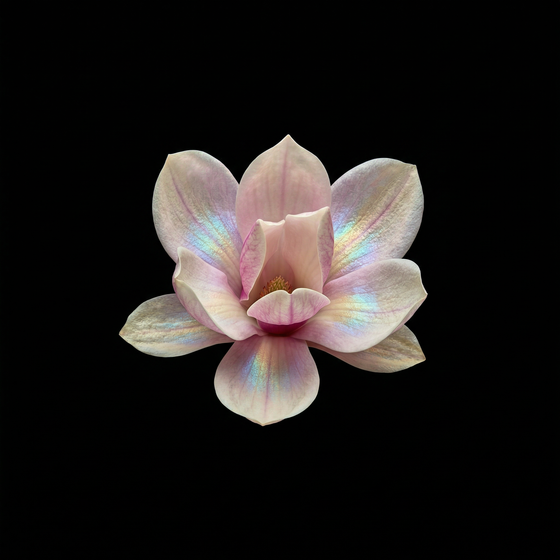
Magnolia is a large genus of about 210 to 340 flowering plant species in the family Magnoliaceae. Magnolias are evergreen or deciduous trees or shrubs with large, fragrant, bowl- or star-shaped flowers. Taxonomists debate merging related genera such as Michelia with Magnolia. The natural range of the genus is split between a main centre in Asia and a secondary centre in South America, Central America, the West Indies and eastern North America. The flowers have numerous spirally arranged reproductive parts, and the cone-like fruits that form in autumn open to reveal seeds.
The Magnoliaceae consist of two genera, Magnolia and Liriodendron, the tulip trees. Unlike most flowering plants, whose flower parts are in rings, the Magnoliaceae have their stamens and pistils in spirals on a conical receptacle. Their flower parts are not clearly divided into sepals and petals, and the poorly differentiated parts that fill both positions are called tepals. The family has about 300 species and ranges across subtropical eastern North America, Central America, tropical South America, southern and eastern India, Indochina, China, Japan and Korea. The fruit is an aggregate of follicles, and, except in Liriodendron, the seeds have a fleshy coat that ranges in colour from red to orange.
Magnolia champaca is a large evergreen tree in the family Magnoliaceae. It was previously classified as Michelia champaca. Its strongly fragrant flowers come in shades from cream to yellow-orange and bloom from June to September. The tree is native to the Indomalayan realm, which consists of South Asia, Southeast Asia-Indochina, and southern China. In its native range the tree grows to 50 metres or taller, with a trunk up to 1.9 metres in diameter and a narrow umbelliform crown. The species name champaca comes from the Sanskrit word campaka. It grows in tropical and subtropical moist broadleaf forests at elevations of 200 to 1,600 metres. The fragrant flowers attract butterflies and hummingbirds, and the aril-covered seeds are highly attractive to birds. The wood is finely textured, dark brown and olive in colour, and is used in furniture making, construction and cabinetry. The species is cultivated by specialty plant nurseries as an ornamental tree, as a dense screening hedge and for its fragrant flowers.
Magnolia × alba, also known as the white champaca, white sandalwood or white jade orchid tree, is a hybrid flowering plant that is commonly cultivated in Southeast Asia and tropical regions of East Asia. Its exact origin is uncertain, but it is considered a hybrid of Magnolia champaca and Magnolia montana. In China the flowers are used to prepare yulan tea. In Indonesia the pleasantly fragrant flower is arranged with Jasminum sambac in garlands, especially worn by brides at traditional wedding ceremonies. The current name of the white champaca derives from its Indonesian name, Cempaka Putih or Bunga Kantil. The tree matures to 30 metres with evergreen leaves, and its flowers have 12 tepals. In Taiwan the flowers are picked from the trees before they open and strung in bunches on wire to be sold at the roadside, and they stay fragrant for several days. In Thailand the flowers are worn as traditional wedding garlands by the bride and groom. In traditional Chinese medicine the flowers are used to move qi and relieve cough.
Magnolia grandiflora, the southern magnolia, is native to the Southeastern United States coastal plain, from Virginia to central Florida, and west to East Texas. Its flowers are white and measure up to 30 cm across. The tree reaches 27.5 m in height, with large, dark-green leaves up to 20 cm long. Each bloom has six to 12 waxy petals and emerges from the tips of twigs on mature trees in late spring. It is the state tree of Mississippi and the state flower of Louisiana. In the United States the lumber of southern magnolia, sweetbay and cucumbertree is sold simply as magnolia and used for furniture, boxes, pallets, venetian blinds, sashes, doors and veneer. More than 150 cultivars of southern magnolia have been named, although only 30 to 40 of them still exist.
In South Asia, especially India, champaca flowers are primarily used in worship ceremonies. They are also worn in the hair by girls and women as a beauty ornament and a natural perfume. Flowers are floated in bowls of water to scent the room.
Magnolia champaca contains the aporphine alkaloid ushinsunine. Magnolia × alba contains ushinsunine as well, together with norushinsunine, a noraporphine alkaloid.
This note in PREMIEREPEAU. Nuit Élastique. Sample all seven extraits in the Discovery Set.