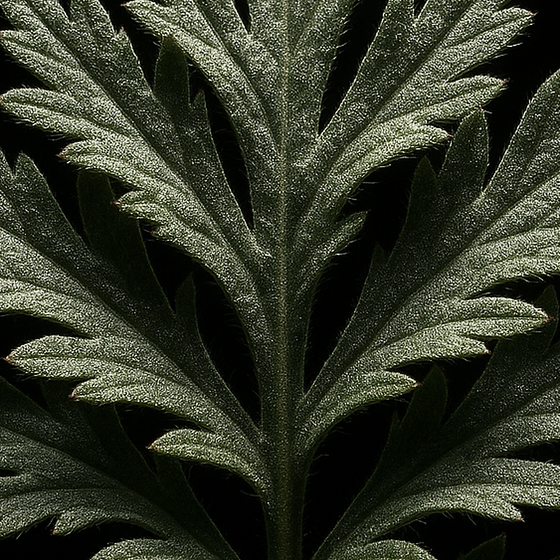
Crni pelen

PrirodnaZELENE NOTE, BILJE I FUŽERIzelen · aromatičan · kamforni
Srednje notePiramida
3/5Jačina
—Trajnost
7Poreklo
Uzorak
Crni pelen kao sirovina za parfeme
Srednje note
Artemisia vulgaris
Definicija

Mugwort is Artemisia vulgaris, a plant whose steam-distilled oil has a herbaceous, camphorous, sage-like scent.

Herbacé
91
Vert
75
Frais
71
Aromatique
47
Boisé
57
Terreux
20
Common mugwort, felon herb, chrysanthemum weed, wild wormwood, old Uncle Henry, sailor's tobacco, naughty man, old man
Type
Sirovina
Olfactive family
Aromatični
Chemical class
complex natural (essential oil)
Instrumenti
Piramida
GGornje note
SSrednje note
BBazne note
3/5Jačina
Srednja
jačina mirisa
Zemlje proizvođači
Francuska Maroko Nemačka Mađarska Indija Kina Japan

Miris

The scent of mugwort essential oil is herbaceous, camphorous and sage-like. Mugwort oil has an herbal odor. The aroma of alpha and beta thujones, which occur in mugwort, is described as thujonic.

Teroar i prerada

Detaljno

Botany

Artemisia vulgaris is a species in the family Asteraceae, and Artemisia vulgaris L. is its accepted name. It is native to temperate Europe, Asia, North Africa, and Alaska, and is naturalized in North America. It is a common plant of low-nitrogen soils, such as waste places, roadsides and uncultivated areas. The stems are purple-looking and angular, and the pinnate leaves are dark green on the upper surface. The leaves have dense, whitish, tomentose hairs on the underside. The yellow or reddish-looking flower heads appear from July to September. The plant spreads mainly through rhizomes and rarely reproduces from seeds in temperate regions.

Chemistry

Alpha and beta thujones are found in mugwort, among other plants. Examples of the plant's phytochemicals include camphene, camphor and sabinene. Across Artemisia essential oils in general, 1,8-cineole, beta-pinene, thujone, artemisia ketone, camphor, caryophyllene, camphene and germacrene D are the major components. In a review of Artemisia oils, the composition of the oil of the same species varied between investigations with geographical origin. In a sample from Erie, Pennsylvania, the leaf oil of A. vulgaris held germacrene D (25%), caryophyllene (20%), alpha-zingiberene (15%) and borneol (11%). The bud oil of the same sample held 1,8-cineole (32%), camphor (16%), borneol (9%) and caryophyllene (5%). In a Serbian sample, the oil of A. vulgaris was dominated by sesquiterpene hydrocarbons (51.91%). Its main constituents included gurjunene (10.41%), cis-chrysanthenyl acetate (7.17%) and γ-humulene (6.67%). Oxygenated sesquiterpenes made up 11.11% of that oil and oxygenated monoterpenes 7.17%. Two Lithuanian oils of the species contained trans-thujone at 8.9% and 10.9%. Mugwort is sometimes called wormwood, but wormwood, Artemisia absinthium, is a separate species of Artemisia. In a comparison of oils from Serbia, trans-thujone (18.9%) was found in the oil of A. absinthium but was not detected in the oil of A. vulgaris.

Uses

Before hops came into beer-making, A. vulgaris was commonly used in England as the flavouring agent. Dried mugwort flowers were added to malt liquor, and the malt liquor was added to the beer. Mugwort has also been one of the traditional flavouring and bittering agents of gruit ales, a type of unhopped, fermented grain beverage. In Germany mugwort is used in cooking as an aromatic herb. The dried leaves can be smoked or made into a tea, to promote lucid dreaming.

Handling

Contact with the plant is thought to cause dermatitis.

Explore all seven extraits in the Discovery Set.

—

Related: Alpha Pinene · Angelica · Angelica Root · Angelica Root Oil · Artemisia · Barrenwort · Beachheather · Behini Tree

Zanimljivosti

In an item from Gotland found in the Uppsala landmålsarkiv and dated to 1875, mugwort requests to be called Luna before it will provide healing powers. The verse says that if you call it Mugwort it will cure neither wife nor cow, but if you call it Luna it will cure both cow and wife. The Ukrainian name for mugwort, chornóbyl', means "black stalk", and the Ukrainian city of Chernobyl gets its name from the plant.

Dobijanje i hemija

Način dobijanja

The essential oil of Artemisia vulgaris is obtained by steam distillation.

Formula
Complex natural mixture (key constituents: 1,8-cineole; camphor; germacrene D; thujone C₁₀H₁₆O)
CAS
68991-20-8
Botanički naziv
Artemisia vulgaris
Izgled
Yellow to green liquid
Jačina mirisa
srednji
Sinonimi
Common mugwort, felon herb, chrysanthemum weed, wild wormwood, old Uncle Henry, sailor's tobacco, naughty man, old man
Status prema standardima IFRA
Pogledajte napomenu

No IFRA Standard for the material itself (51st Amendment)

Fizička svojstva
Tačka paljenja
131 °F (55 °C) TCC
Relativna gustina
0.91700 to 0.93500 @ 25 °C
Indeks prelamanja
1.46000 to 1.47200 @ 20 °C

U parfemima

Armoise oil, the trade name for the oil of Artemisia vulgaris, is recommended at up to 0.5% in the fragrance concentrate and is not recommended for flavour use.

Uloga u formuli
01modifikator
02nota potpisa
03sirovina za stapanje
04svežina
Oblici na tržištu
eterično ulje

Pogledajte i

6 nota