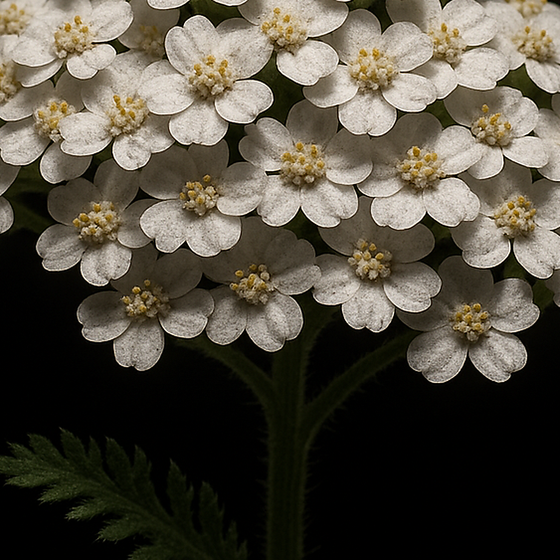
Yarrow (Achillea millefolium) is an erect, herbaceous perennial plant of the Asteraceae family. Its stems, one to several per plant, are 0.2 to 1 metre (8 to 40 inches) high. Its leaves are 5 to 20 centimetres long, fernlike, and divided bipinnately or tripinnately. The ray and disk flowers are white to pink, and the inflorescence is a flat-topped cluster. Yarrow is native to temperate regions of the Northern Hemisphere, being found in Europe, Asia, and North America. The specific epithet millefolium, Latin for 'thousand-leaves', comes from the featherlike leaves, which are minutely divided. There are generally 3 to 8 ray flowers, each about 3 millimetres long. The tiny disk flowers number 10 to 40, and the plant blooms from March to October. The plant grows from sea level to 3,500 m (11,500 ft) in elevation. It has been introduced as feed for livestock in New Zealand and Australia. In the wide sense, Achillea millefolium is an aggregate of 12 species, and naturally occurring hybrids add to the number of its representatives.
The essential oil of yarrow is a mixture of monoterpenes and sesquiterpenes. Variations in the oil may be caused by ecotype, chemotype, phenophase, altitude and environmental parameters such as temperature and sunlight. In oil from Estonia, 66 components were identified. The major ones were beta-pinene (14.9-29.2%), sabinene (2.9-17.6%) and 1,8-cineole (6.9-18.3%), with chamazulene at 0.1-13.3%. Monoterpenes represented 41-61% of the total oil from Estonia. Reported concentrations in yarrow include β-thujone at 0.4-55.3%, germacrene D at 2-20.6% and camphor at 0.6-25.5%.
The dark blue essential oil of yarrow contains chemicals called proazulenes. Chamazulene and δ-cadinol are chemical compounds found in A. millefolium. Chamazulene is a blue-violet derivative of azulene. In chamomile, the colorless sesquiterpene matricin, also called proazulene, can be converted to chamazulene by steam distillation. As a rule, only the tetraploid plants contain prochamazulene, while most other karyotypes are azulene-free. The oil from octaploid plants is characterized by about 80% oxygenated monoterpenes. An oil from Mount Golija (Achillea collina), classed as a tetraploid chamazulene chemotype, had β-pinene (22.52%), chamazulene (19.42%) and E-caryophyllene (14.92%) as its main constituents. An oil of A. pannonica from Radan, an octaploid population, contained no azulene and was dominated by 1,8-cineole (40.40%) and camphor (11.10%). Achillea collina is one of the yarrow species that provide the characteristic blue, chamazulene-containing essential oil, and its chamazulene content varies on a large scale.
Chamazulene has the molecular formula C₁₄H₁₆ and is also found in chamomile and wormwood. Pure chamazulene is a blue oil with a molar mass of 184.282 g/mol, and it boils at 161 °C at a pressure of 12 mmHg. Yarrow also contains isovaleric acid, salicylic acid, asparagine, sterols and flavonoids. Its phenolic acids include gallic, chlorogenic, vanillic and caffeic acids, and its flavonoids include quercetin, luteolin, kaempferol, apigenin and rutin. The oil of hexaploid plants comprises about 50% mono- and sesquiterpene hydrocarbons. The presence of chamazulene increases the antibacterial activity of the oil, whereas its antioxidant effects are related to other substances such as camphor and borneol.
The use of yarrow herb is sometimes restricted because allergic contact dermatitis may occur. Guaianolide peroxides and sesquiterpene lactones, together with the azulenes in the oil of tetraploid plants, are believed to cause itching and inflammatory skin changes with vesicles. Yarrow and the highly poisonous hemlock appear superficially similar, especially in their umbel-style inflorescences.
Explore all seven extraits in the Discovery Set.
—
Related: Alpha Pinene · Angelica · Angelica Root · Angelica Root Oil · Artemisia · Barrenwort · Beachheather · Behini Tree