The plant
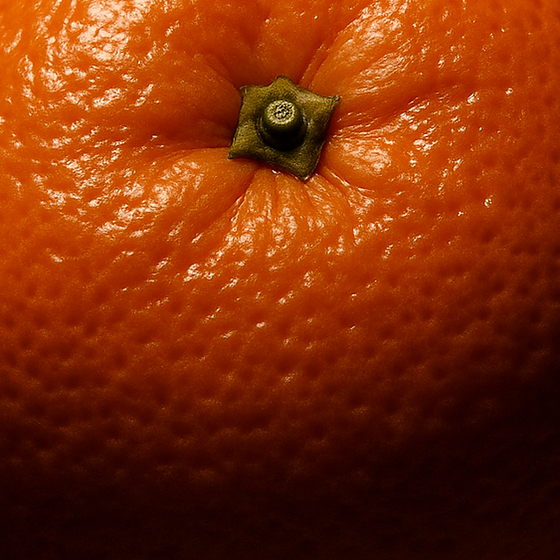
The clementine, Citrus × clementina, is a tangor: a hybrid of a willowleaf mandarin orange (C. × deliciosa) and a sweet orange (C. × sinensis). Genomic analysis shows that it arose from a cross of a sweet orange with the Mediterranean willowleaf mandarin. The fruit is typically juicy and sweet, with less acid than oranges. Clementines can be separated into 7 to 14 segments. The exterior is a deep orange colour with a smooth, glossy appearance, and the fruit tends to be easy to peel.
The mandarin parent
The mandarin is small and oblate, unlike the roughly spherical sweet orange, which is itself a mandarin-pomelo hybrid. The ancestral mandarin was bitter, and most commercial mandarin strains derive from hybridization with the pomelo, which gives them sweet fruit. Hybrid mandarins fall on a continuum of increasing pomelo contribution that runs through clementines, sweet and sour oranges, and grapefruit.
Composition of the oil
Clementine oils contain mostly limonene, together with myrcene, linalool, α-pinene and many complex aromatic compounds. In the Spanish type of the essential oil, limonene is the major component at 90.0 to 97.0%, with myrcene at 1.0 to 2.5%. Sabinene accounts for 0.3 to 1.5%, decanal for 0.1 to 0.4% and linalool for 0.1 to 0.6%. α-Pinene accounts for 0.3 to 0.9%.
In a population of hybrids between clementine and sweet orange, the peel oils were dominated by monoterpenes, at 97.18 to 99.96% of the total composition. Aliphatic aldehydes such as octanal, decanal and dodecanal are known to play a major role in orange aroma. Aliphatic compounds in that population make up 0 to 2.3% of the oil.
Physical specification
The Spanish type of the essential oil is specified with an optical rotation of +90° to +98° at 20 °C and a maximum acid value of 0.2.
Quality standard
A published international quality standard specifies the characteristics of the Spanish type of clementine essential oil to facilitate consistent assessment and trade. Clementine essential oil has a published quality standard that defines its physical properties and a normative gas chromatographic profile. The standard also covers sampling and guidance on packaging and labelling, and gives informational data such as a mean flash point. The standard is intended to ensure reproducible identity and quality evaluation of Spanish-type clementine oil. Because the chromatographic profile is normative, the proportions reported must fall within the specified ranges.
Genetics of the aroma
A genetic map of a cross between clementine and a sweet blood orange has 710 SNP markers spread over nine linkage groups, one for each citrus chromosome. Twenty quantitative trait loci explain between 20.5 and 55.0% of the variance of the major aromatic compounds and of the peel oil yield. The loci for monoterpenes and aliphatic aldehydes lie mostly on linkage groups 5 and 8, and two loci on these groups together explain 49.2% of the variance in oil yield. Thirty compounds were found only in the hybrid offspring and in neither parent. The sensory descriptors 'orange' and 'clementine' could not be correlated with the number of volatile compounds.
Varieties and production
Nules, a mutation of the Fina variety, is the most widely planted clementine in Spain. Fina, a Spanish cultivar, was originally grown on a bitter orange rootstock that gave it superb flavour, and is now grown on a broader range of rootstocks, which affects its flavour profile. Clementine del Golfo di Taranto is a practically seedless Italian cultivar with protected geographical indication status from the European Union. Its fruit has a sweet flavour and an intense aroma. Clementine di Calabria is another Italian variety with that status. In 2016, Spain produced 7.9 million tonnes, Turkey 1.3 and Morocco 1.1 of clementines, tangerines, mandarins and satsumas counted together.
Health note
Clementine phytochemicals may interact with drugs in a manner similar to those of grapefruit, though a 2019 follow-up study called this into question.