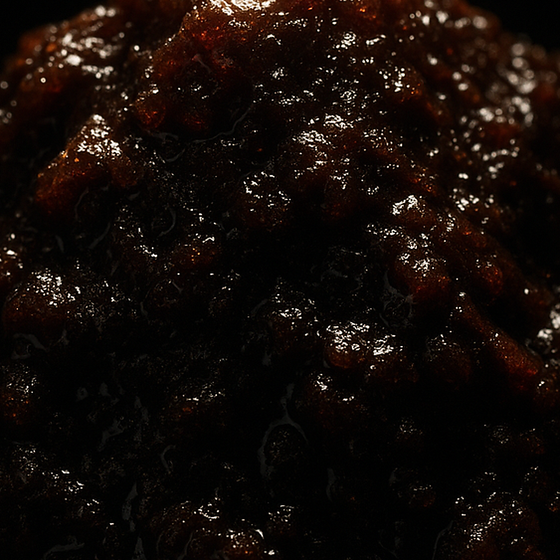
The absolute
Cocoa absolute is the absolute of the seed of Theobroma cacao. It is stored in a cool, dry place in tightly sealed containers, protected from heat and light.
Botanical origin and the fruit
The flowers are small, 1 to 2 cm across, with a pink calyx, and are pollinated by tiny biting midges of the genus Forcipomyia. The fruit, called a cacao pod, is ovoid, 15 to 30 cm long and 8 to 10 cm wide, and ripens from yellow to orange. At harvest the pods are opened, the seeds are kept, and the empty pods are discarded. Before fermentation the seeds are fairly soft and range from pale lavender to dark brownish purple.
The seed
The pod of the cacao tree contains 20 to 60 seeds, usually called "beans", embedded in a white pulp. Each seed contains a significant amount of fat (40-50%) as cocoa butter.
Fermentation and roasting
The seeds are placed where they can ferment. Heat builds up in fermentation, and the beans lose most of their purplish hue and become mostly brown. The beans are roasted, cracked and deshelled, giving pieces called nibs. The nibs are ground into a thick paste known as chocolate liquor or cocoa paste. The time and temperature of the roast affect the result: a low roast produces a more acid, aromatic flavour, while a high roast gives a more intense, bitter flavour lacking complex flavour notes. The optimal time for cocoa bean roasting is 15-45 minutes, at temperatures of 130 to 150 °C.
From beans to chocolate
To produce 1 kilogram of chocolate, around 300 to 600 cocoa beans are processed. The liquor is turned into chocolate by adding cocoa butter, sugar and sometimes vanilla and lecithin. Cocoa powder and cocoa butter can also be separated with a hydraulic press or by the Broma process. Treating cocoa with an alkali gives Dutch process cocoa, whose flavour differs from that of untreated cocoa. Roasting can be done on the whole bean or on the nib, which changes the final flavour. Roasting with superheated steam gives the same bean quality as oven roasting in a shorter time.
Aroma chemistry
More than 600 flavour compounds of cocoa beans and cocoa products have been identified. Among the flavour compounds formed in the Maillard reaction during roasting, pyrazines are the main class of heterocyclic volatiles and key components of cocoa flavour and aroma. About 80 pyrazine compounds contribute to the overall cocoa flavour. The main active compounds in cocoa flavour are 2-methylpyrazine, 2,5-dimethylpyrazine, 2,3-dimethylpyrazine, 2,3,5-trimethylpyrazine and 2,3,5,6-tetramethylpyrazine. Longer and hotter roasting increases the alkylpyrazines and lowers the total polyphenol content. Tetramethylpyrazine, also called ligustrazine, is found in fermented cocoa beans. Its CAS number is 1124-11-4 and its formula is C₈H₁₂N₂.
More on pyrazines
In a study of cocoa powder, the sample roasted at 140 °C for 40 minutes had the highest ratio of tetramethylpyrazine to trimethylpyrazine and the lowest polyphenol content. Tetramethylpyrazine is an alkylpyrazine and, when purified, a colourless solid that melts at 84 to 86 °C.
Theobromine and other constituents
Theobromine is the principal alkaloid of Theobroma cacao. Cocoa beans naturally contain approximately 1% theobromine. The beans also contain between 0.1% and 0.7% caffeine. Theobromine has the CAS number 83-67-0 and the formula C₇H₈N₄O₂. Cocoa contains various phytochemicals, such as flavanols, procyanidins and other flavonoids.
Theobromine in cocoa products
Theobromine is a white solid that melts at 351 °C. It is slightly soluble in water, at 330 mg/L, and has a bitter taste. It is a purine alkaloid derived from xanthosine, and it is the precursor to caffeine. Cocoa butter holds only trace amounts of it, and dark chocolate usually holds more than milk chocolate. Cocoa powder contains on average 2060 mg per 100 g.
Cultivar groups
Chocolate makers recognise three main cultivar groups of cacao beans: Forastero, Criollo and Trinitario. Criollo beans are arguably less bitter and more aromatic than any other bean, and only 10% of chocolate is made from them. Beans of the Forastero group are used to make 80% of chocolate. Forastero trees are significantly hardier and more disease-resistant than Criollo trees, resulting in cheaper cacao beans.
Production
In 2023, world production of cocoa beans was 5.6 million tonnes, led by Ivory Coast with 42.5% of the total. Other major producers were Ghana (11.7%) and Indonesia (11.5%).
Explore all seven extraits in the Discovery Set.
—
Related: Cacao Butter · Chocolate