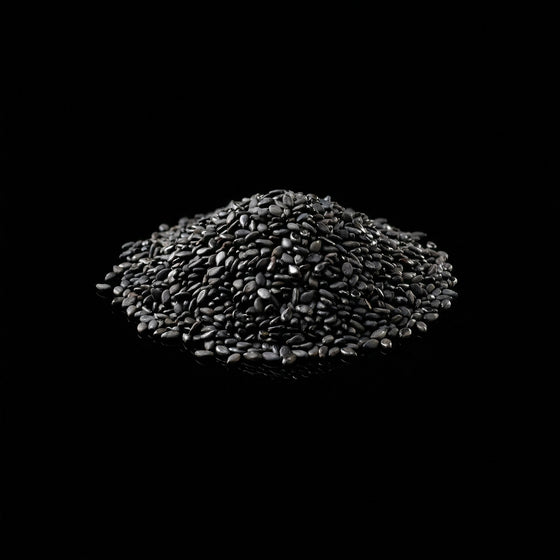
The seed
Sesame (Sesamum indicum) is a plant in the genus Sesamum, also called benne. It is cultivated for its edible seeds, which grow in pods. The seeds are classified by coat color into white, brown and black. The black and darker-colored sesame seeds are mostly produced in China and Southeast Asia. The white and other lighter-colored seeds are common in Europe, the Americas, West Asia and the Indian subcontinent. Sesame has one of the highest oil contents of any seed. With a rich, nutty flavor, it is a common ingredient in cuisines around the world.
Roasting and its volatile compounds
The Maillard reaction is a chemical reaction between amino acids and reducing sugars that creates melanoidins, the compounds that give browned food its distinctive flavor. It typically proceeds rapidly from around 140 to 165 °C. At higher temperatures, caramelization and then pyrolysis, the final breakdown leading to burning and acrid flavors, become more pronounced.
Analysis of sesame oil by GC and GC/MS identified 26 pyrazines, 11 pyridines, 9 thiazoles, 6 furans, 8 pyrroles and 5 phenols among its volatile flavor compounds. The total amount of flavor compounds increased with roasting temperature. Pyrazines such as methylpyrazine, 2,5-dimethylpyrazine, 2,6-dimethylpyrazine, trimethylpyrazine and 2-ethyl-3,5-dimethylpyrazine are the major components among the volatile flavors, and they rise more than any other component above 170 °C. Most of these compounds are assumed to develop by thermochemical reactions of sesame components during roasting above 170 °C. The large increase in phenols above 210 °C seemed to result from the production of guaiacol.
With deeper roasting, monoalkylpyrazines decreased in relative amount while di- and trialkylpyrazines increased. In deep-roasted sesame oil, guaiacol increased from 32 to 321 ppb and 2-furanmethanethiol from 6 to 40 ppb. The total volatiles recovered were 9726 ppb from deep-roasted oil and 2014 ppb from light-roasted oil.
Lignans of the black coat
Black-seeded accessions had the highest total lignan content, while white-seeded accessions averaged lower levels. The major oil-soluble lignans in sesame are sesamin, sesamolin and sesamol. Sesamol was the least abundant of the three, and black seeds contained more of it than white or brown seeds. Statistical analysis suggested that the black variety contains more linoleic acid than brown or white accessions.
Sesamol is a natural organic compound that is a component of sesame seeds and sesame oil. It is a white crystalline solid and a derivative of phenol. Sesame oil is the least prone, among cooking oils with high smoke points, to turn rancid when kept in the open, which is due to natural antioxidants such as sesamol.
In roasted black and white seeds, sesamolin decreased markedly at 180 °C and was undetectable at 250 °C. Sesamol rose with roasting temperature regardless of seed color: the higher the temperature, the higher the concentration. The disappearance of sesamolin may be explained by heat converting it to sesamol, sesaminol dimer and other lignans. In black seeds, the effect of the roasting temperatures on sesamol concentration was lower than in white seeds.
Sesame oil
Sesame oil is an edible vegetable oil derived from sesame seeds. Commercial sesame oil varies in color from light to deep reddish-yellow depending on the color of the seed processed and the method of milling. Sesame oil is rich in oleic and linoleic acids, which together account for 85% of the total fatty acids. In 2023, world production of sesame oil was 1.2 million tonnes, led by India and Myanmar together with 34% of the total.
Cultivation and production
S. indicum, the cultivated type, originated in India. It tolerates drought conditions well, growing where other crops fail. In 2024, world production of sesame seeds was 6.7 million tonnes, led by India, Myanmar and Sudan, which together accounted for 33% of the total. Japan is the world's largest sesame importer.
Related Notes
This note in PREMIEREPEAU. Doppel Dancers. Sample all seven extraits in the Discovery Set.