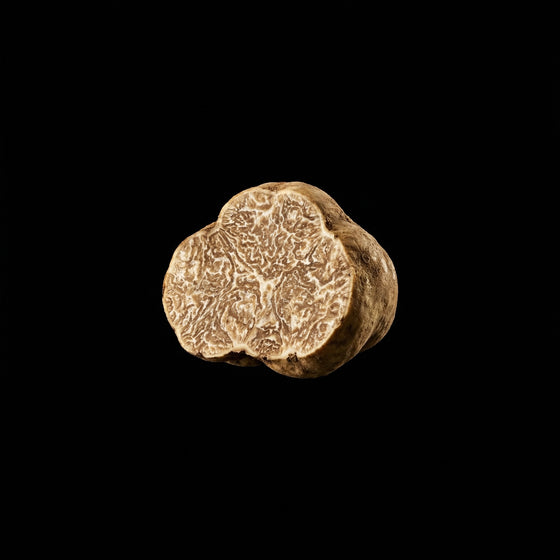
It has no distinct cap and lacks a stipe, and its ecology is mycorrhizal. It is also found in other parts of Southern Europe and in Thailand. It fruits in autumn and can reach 12 centimetres in diameter and 500 grams, though it is usually much smaller.
Its main areas are the Langhe and Montferrat in the Piedmont region of northern Italy, and it is most famous around the cities of Alba and Asti. Acqualagna, in the northern Marche near Urbino, is another centre of production and trade. It also grows in Molise, Abruzzo and the hills around San Miniato in Tuscany. Outside Italy it has been found in Croatia (Istria and the Motovun forest), Switzerland, south-east France, Hungary, Serbia, Slovenia, Greece and Thailand. In a review of 231 reported sites in southeast Europe, 75% lie outside Piedmont, the most famous harvest region. Of those sites, 25% are in Piedmont, 52% are elsewhere on the Apennine Peninsula and 22% are in Serbia, Croatia, Hungary, Romania, Bulgaria, Slovenia, Greece and Switzerland. The species occurs in natural habitats roughly between western Switzerland and eastern Bulgaria, and one site in northern Thailand at about 18° N is probably the southernmost limit of its distribution.
Habitat
The soils where it grows have an average pH of about 7.7, ranging from neutral to alkaline. In the Balkans and Pannonia, the soils contain 20% clay or more. At least 26 potential host species from 12 genera were reported at its sites, with Populus alba and Quercus cerris making up 23.5% of the plant species. Less commonly it is associated with five other host species, each from a different genus: Abies alba, Alnus cordata, Fagus sylvatica, Pyrus pyraster and Ulmus minor. Soil pH at its sites runs from 6.4 to 8.7, whereas the Périgord truffle is restricted to alkaline environments. The soils were often formed during past flood or landslide events and have high macroporosity. All sites have mean winter temperatures above 0.4 °C and summer precipitation totals of about 50 mm. They range from about 37° N in Sicily to about 47° N in Hungary, and from sea level in the north to about 1000 m in the south.
Chemistry of the Smell
Bis(methylthio)methane is also named 2,4-dithiapentane. Thiophene derivatives appear to be produced by bacterial symbionts living in the truffle body. Of these, the most abundant is 3-methyl-4-5 dihydrothiophene, which contributes to the aroma of the white truffle. Ethylene is produced by the mycelia of white truffles and affects the root architecture of the host tree. Studies in 1990 showed that dimethyl sulfide is the compound that both truffle pigs and dogs actively recognise.
The Androstenol Question
Older literature held that androstenol, the natural sex hormone of the male pig, which is also found in truffles, made sows seek out truffles. This has been shown to be incorrect. In replication experiments, pigs ignored androstenol while eagerly trying to eat inorganic objects coated with dimethyl sulfide.
Market and Fraud
The white truffle is the most expensive species of the genus Tuber, and the price of fresh specimens can reach up to about 7000 euros per kilogramme. In Italy alone, the estimated total income from white truffles exceeds 400 million euros per year. In 2001 they sold for between $2,200 and $4,800 per kilogram. In Alba, the market is busiest in October and November, when the truffle fair takes place. In November 1999, the largest truffle in the world at the time, weighing 1.31 kg, was found near Buje in Croatia. In 2021 a white truffle from Piedmont weighing 830 g was sold at auction for €103,000. Because of its high price, and because it is not the only white-coloured truffle, fraud is frequent. Cheaper Tuber borchii are sold as T. magnatum. Tuber oligospermum, which grows well in Tunisia's dry sand and has no culinary value in Italy, is also sold as T. magnatum. On the Asti market in 2012, more than 90% of the truffles did not come from Alba, and about 75% of the white truffles supposedly from Piedmont came from other Italian regions. Isotopic analysis is the most reliable way to detect fraud or mislabelling. In some cases, the scent is enhanced with a petroleum-based essence such as bis(methylthio)methane, which is harmful to human health.
At PREMIEREPEAU
ALBÂTRE SÉPIA places white truffle at the centre of a mineral-gourmand structure, set against metallic ink, violet, and dry double vanilla. The truffle accord here is not decorative — it is the structural foundation.
This note in PREMIEREPEAU. Albâtre Sépia. Sample all seven extraits in the Discovery Set.