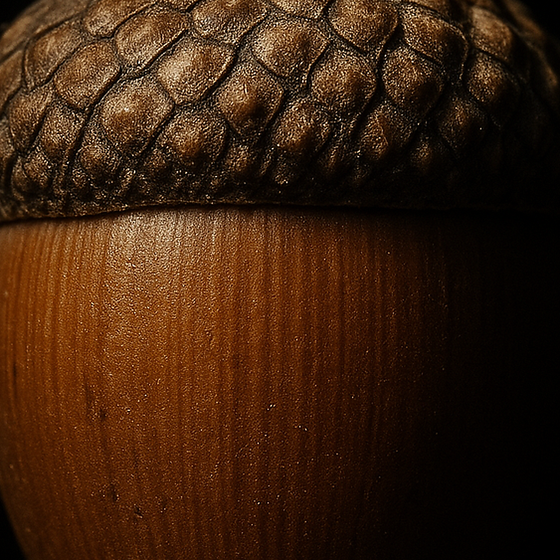
Жолудь

АкордФРУКТИ, ОВОЧІ Й ГОРІХИземлистий · горіховий · деревний
Базові нотиПіраміда
3/5Сила
72годСтійкість
2Походження
Зразок
Жолудь як парфумерна сировина
Базові ноти
Quercus (genus)
Фантазійний/концептуальний
Визначення

Dry oak leaves gathered into a fist. A woody-herbal molecule — 1-ethynylcyclohexyl acetate — that smells of hay bales, immortelle, and the tannin-dusted floor of an autumn forest. Not the nut itself, but the air around the tree.

ДЕРЕВНИЙ ЗЕЛЕНИЙ ЗЕМЛИСТИЙ СОЛОДКИЙ ТЕПЛИЙ СВІЖИЙ ГОРІХОВИЙ
OAK NUT
Type
Складник
Olfactive family
Землисті й деревні
Source
synthetic molecule (acorn acetate)
Chemical class
tertiary propargylic ester
Інструменти
Піраміда
ВВерхні ноти
СНоти серця
ББазові ноти
3/5Сила
Середня
інтенсивність запаху
Стійкість на блотері
72годин · 3 днів
1 год6 год24 год3 дн.7 дн.400 год
за 100 %
Країни-виробники
Європа Північна Америка

Запах

Dry, herbal, woody. The first impression is of oak leaves gathered from the ground after the first frost — papery, faintly tannin-bitter, with a hay-sweet undertone. An immortelle-like honeyed warmth threads through the middle, but without the curry-spice quality of actual Helichrysum italicum. Compared to oakmoss, acorn acetate is cleaner and less damp. Compared to coumarin, it is less powdery, more vegetal. The overall character is autumnal and specific: forest flo or, not flower shop.

Докладно

Acorn acetate (1-ethynylcyclohexyl acetate, CAS 5240-32-4) is a synthetic aroma chemical — a tertiary propargylic ester with molecular formula C₁₀H₁₄O₂, molecular weight 166.22 g/mol. It is the primary molecule used in perfumery to carries the scent of acorns and oak forest flo or. No natural essential oil or absolute of acorns exists for perfumery use. The molecule itself is colourless, liquid at room temperature, with a boiling point of 201–202°C and moderate vapour pressure (0.303 mmHg at 25°C).

Explore all seven extraits in the Discovery Set.

Scent Character

TGSC describes the odour as ‘natural acorn, dry oak leaves, hay, woody, immortelle, herbal.’ The profile is particular: drier and more tannic thanvetiver, less smoky than guaiac wood, with a pronounced hay-like sweetness similar to of immortelle. The herbal dimension sits between dried thyme and crushed walnut shell. There is nothing fruity about it. The scent reads as autumnal, papery, and faintly bitter — closer to dried leaves than to the nut itself.

Synthesis

Industrial production follows a two-step sequence: acetylene is added to cyclohexanone under basic conditions (typically KOH in liquid ammonia or DMSO) to yield 1-ethynylcyclohexanol (CAS 78-27-3), which is then acetylated with acetic anhydride or acetyl chloride to give the final ester. The chemistry is straightforward — a Reppe-type ethynylation followed by standard esterification. The starting materials are inexpensive bulk chemicals, making acorn acetate an affordable ingredient.

Relationship to Real Acorns

Actual acorns (Quercus spp.) do not contain 1-ethynylcyclohexyl acetate. GC-MS analysis of roasted Quercus humboldtii acorns (Warsi to et al., 2019) identified furfural, 5-methylfurfural, furfuryl alcohol, and 3-hydroxy-2-butanone as the dominant volatiles — compounds associated with caramel, grain, and roasted-nut aromas. The connection between the molecule and its trade name is suggestive rather than chemical: acorn acetate smells like the idea of acorns in an autumn woodland, not like the nut’s actual headspace.

Related Notes

See also: Oak, Hay, Immortelle, Vetiver.

Цікавий факт

Acorn acetate contains no chemical found in actual acorns. GC-MS analysis of roasted Quercus humboldtii acorns identified furfural, 5-methylfurfural, and furfuryl alcohol as dominant volatiles — none of which are structurally related to 1-ethynylcyclohexyl acetate. The trade name is a perfumer’s metaphor: the molecule carries the atmosphere of an oak forest in autumn, not the chemistry of the nut itself.

Отримання й хімія

Спосіб отримання

Fully synthetic. No natural acorn essential oil or absolute exists for perfumery use. Industrial synthesis proceeds in two steps: (1) ethynylation of cyclohexanone with acetylene under basic conditions (KOH, liquid ammonia or DMSO) to yield 1-ethynylcyclohexanol (CAS 78-27-3); (2) acetylation of the tertiary alcohol with acetic anhydride to give 1-ethynylcyclohexyl acetate. Starting materials are inexpensive bulk chemicals. The product is a colourless, clear liquid.

Формула
C₁₀H₁₄O₂ (acorn acetate, MW 166.22)
CAS
5240-32-4 (acorn acetate — the synthetic molecule used to recreate acorn notes)
Ботанічна назва
Quercus (genus)
Зовнішній вигляд
pale yellow clear liquid (acorn accord)
Сила запаху
Середня
Стійкість
72 hours at 100%
Синоніми
OAK NUT
Статус IFRA
Обмежено

Permitted with restriction. IFRA recommends a maximum of 10% in the fragrance concentrate. RIFM safety assessment published 2019 (Food and Chemical Toxicology, PubMed 31356913).

Фізичні властивості
Температура кипіння
201.00 to 202.00 °C. @ 760.00 mm Hg (est)
Температура спалаху
179.00 °F. TCC ( 81.67 °C. )
Відносна густина
1.00100 to 1.00900 @ 25.00 °C.
Показник заломлення
1.46300 to 1.46800 @ 20.00 °C.

У парфумерії

Acorn acetate (1-ethynylcyclohexyl acetate) functions as a heart-to-base modifier in woody, herbal, and chypre-adjacent compositions. Its primary contribution is a dry, natural-smelling oakleaf-hay character that grounds green and woody accords without adding smoke or resin. At low doses (0.5–2%), it introduces an autumnal, herbal dryness — useful in fougere bases, hay accords, and masculine woody ambers. At higher concentrations, it becomes a recognisable signature: the dry-oak character that Christopher Sheldrake reportedly deployed in compositions built around forest and wood themes. The molecule pairs effectively with oakmoss (or its synthetic replacements like evernyl), coumarin, vetiver, and patchouli. It can also bridge herbal top notes — thyme, clary sage — into woody-ambery bases. IFRA recommends a maximum of 10% in the fragrance concentrate. Substantivity is moderate: TGSC reports 72 hours at 100% concentration, placing it firmly in the heart-to-base range. Odor strength is medium.

Роль у формулі
01модифікатор
02сполучний компонент
03формувач об’єму
Форми випуску
синтетичний акорд фантазійна нота

Див. також

5 ноти