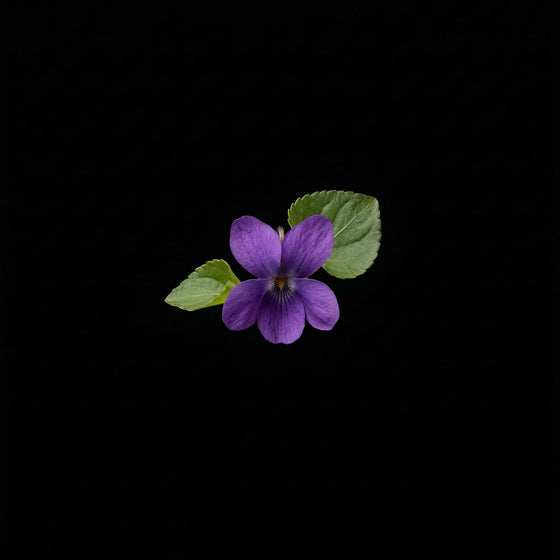
Фіалка

Натуральний і синтетичнийКВІТИквітковий · фіалка
Ноти серцяПіраміда
—Сила
—Стійкість
1Походження
Зразок
Фіалка як парфумерна сировина
Ноти серця
Viola odorata
Визначення

Violet is a flower scent whose characteristic note is the combination of alpha-ionone and beta-ionone, which perfumery and flavouring use with other components to recreate it. The scent of violet flowers is distinctive, with only a few other flowers having a remotely similar odor.

КВІТКОВИЙ СОЛОДКИЙ ФІАЛКОВИЙ
Sweet violet, wood violet, English violet, common violet, florist's violet, garden violet
Type
Складник
Olfactive family
Квіткові
Source
Viola odorata flowers and leaves; ionones are also synthesised
Chemical class
apocarotenoids (C13-norisoprenoids)
Інструменти
Піраміда
ВВерхні ноти
СНоти серця
ББазові ноти
Країни-виробники
Франція (Туретт-сюр-Лу)

Запах

Violet flower absolute has a sweet floral violet odour. Its odour type is floral. Ionone is the compound responsible for the violet scent.

Теруар і походження

Докладно

Viola odorata is a species of flowering plant in the family Violaceae. The plant is native to Eurasia, and its leaves and flowers have been used to make fragrances. The flowers are normally either dark violet or white and are scented.

Viola odorata is native to Europe south of Scandinavia, northwest Africa (Morocco, Algeria and Tunisia), Macaronesia, the Caucasus, Western Asia and Kazakhstan. It has been introduced to the Americas, Scandinavia, southern and eastern Asia, Australia and New Zealand. The species grows near the edges of forests and in clearings. The plant contains the alkaloid violin, about 30 cyclotides and triterpenoids, mostly as constituents of the essential oil. The leaves and flowers are edible, and real violet flower extract is available for culinary uses, especially in European countries. The flowers are also used in confectionery, and one family business crystallises violets by coating them in sugar and drying them in an oven.

The ionones, whose name comes from the Greek ion for violet, are a series of closely related chemical substances that belong to the rose ketones, a group that also includes damascones and damascenones. Ionones are aroma compounds found in a variety of essential oils, including rose oil. Beta-ionone is a significant contributor to the aroma of roses despite its relatively low concentration. The ionones are derived from the degradation of carotenoids. Ionones are classified as apocarotenoids, specifically C13-norisoprenoids, formed by oxidative cleavage of larger carotenoid molecules. The carotenes alpha-carotene, beta-carotene and gamma-carotene, and the xanthophyll beta-cryptoxanthin, can all be metabolized to beta-ionone. A recombinant carotenoid cleavage enzyme from Osmanthus fragrans flowers cleaved carotenes to produce alpha-ionone and beta-ionone in in vitro assays.

In flowers, the formation of ionones is mediated by carotenoid dioxygenases.

Alpha-isomethyl ionone, also known as alpha-cetone, is an isomer of methyl ionone. It is made synthetically and also occurs naturally, for example in Brewer's yeasts. It would be classified as a norsesquiterpenoid, having 14 carbon atoms. It boils at 93 °C at 3.1 mmHg, and its solubility in water is 0.064 g/L.

Irones are a group of chemical compounds related to the ionones. Orris root is the root of Iris germanica and Iris pallida. After preparation the scent of orris is reminiscent of the smell of violets. One ton of iris root produces two kilos of essential oil, also called orris root butter, which is the most expensive substance used in the fragrance industry.

Tourrettans first grew the Parma violet, and the Victoria variety then gradually became the main flower grown in the village. The Tourrettes violet grows from October to March on small terraced plots. Its cultivation has always been based on manual labour. Harvesting is done daily during the winter, and growers often call on seasonal workers to harvest the violets by hand. Horticulturists use the flowers to make bouquets, which are sold between Christmas and Valentine's Day, and each bouquet is made up of around 25 flowers surrounded by a corona of leaves. Tourrettes remains the only area in France where violet production is the main, if not the only, activity of horticulturalists.

This note in PREMIEREPEAU. Albâtre Sépia. Sample all seven extraits in the Discovery Set.

Цікавий факт

A single-nucleotide polymorphism in the OR5A1 receptor causes very significant differences in the odor perception of beta-ionone, both in sensitivity and also in subjective quality. People who are homozygous AA are about 100 times less sensitive to beta-ionone and at higher concentrations perceive a pungent sour or vinegar odor instead.

Отримання й хімія

Спосіб отримання

Ionone can be synthesised from citral and acetone with calcium oxide as a basic heterogeneous catalyst, by an aldol condensation followed by a rearrangement reaction. The aldol condensation product eliminates water to form pseudoionone. Acid catalysis then opens a double bond to form a carbocation, which rearranges with ring closure. The synthesis of alpha-isomethyl ionone involves a cross-aldol condensation of citral with methyl ethyl ketone. A high temperature and strong alkali are used. At Tourrettes-sur-Loup, violet leaves are mown between the beginning of May and the end of July and delivered the same day to Grasse, where they are processed into perfumes.

CAS
8024-08-6
Ботанічна назва
Viola odorata
Зовнішній вигляд
Violet flower absolute: greenish olive viscous liquid.
Синоніми
Sweet violet, wood violet, English violet, common violet, florist's violet, garden violet
Статус IFRA
Див. примітку

No IFRA Standard for the material itself (51st Amendment)

Фізичні властивості
Температура кипіння
126 to 128 °C at 12 mmHg (beta-ionone)
Температура плавлення
-49 °C (beta-ionone)

У парфумерії

Beta-ionone is an important fragrance chemical used in perfumery. Alpha-isomethyl ionone is often used in the flavouring and cosmetic industries, for example in aftershave lotions, bath products, hair care products, moisturizers, perfumes, shampoos and skin care products. It is used in perfume fragrances such as amber, chypre, violet, mimosa, reseda, iris, orris and cyclamen. It is used as well in berries, woody notes, ylang-ylang, leather, orange, nut, pistachio, muscatel and tobacco fragrances. The percentage of alpha-isomethyl ionone used in perfumes ranges approximately from 0.1% to 11.9%, with an average of 1.1%. It is usually used in conjunction with hydroxycitronellal, woody notes, copaiba, N-methyl ionone, ionone or vetiver. Violet leaf absolute remains in use in modern perfumery. Viola odorata is grown for its scent and taste properties, which are used in perfumery and confectionery respectively.

Роль у формулі
01квіткова нота
02нота фіалки
Форми випуску
абсолют синтетична речовина

Див. також

8 ноти