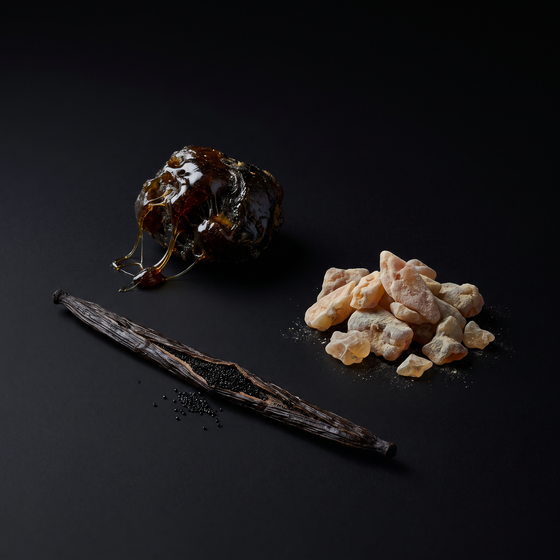
Амбровий акорд

АкордМУСКУС, АМБРОВИЙ АКОРД, ТВАРИННІ ЗАПАХИтеплий · смолистий · солодкий
Базові нотиПіраміда
—Сила
—Стійкість
—Походження
Зразок
Амбровий акорд як парфумерна сировина
Зазвичай базові ноти
Визначення

Amber is a perfumery scent made to emulate the golden warmth of fossil amber and now largely derived from labdanum. The scent called amber is loosely described as warm, musky, rich and honey-like, and also somewhat earthy.

ТЕПЛИЙ СМОЛИСТИЙ БАЛЬЗАМІЧНИЙ СОЛОДКИЙ ВАНІЛЬНИЙ МЕДОВИЙ
Type
Акорд
Olfactive family
Амброві
Source
Accord (combinations of materials such as labdanum, benzoin and vanilla)
Chemical class
Accord (blend), not a single substance
Інструменти
Піраміда
ВВерхні ноти
СНоти серця
ББазові ноти

Запах

Warm, sweet and powdery, with resinous and balsamic depth and a faint spice.

Докладно

Modern products such as perfume do not normally use actual amber, because fossilized amber produces very little scent.

The amber accord

The scent of amber was originally derived from emulating the scent of ambergris and/or the plant resin labdanum. Since sperm whales are endangered, the scent of amber is now largely derived from labdanum. Benzoin is usually part of the recipe, and vanilla and cloves are sometimes used to enhance the aroma.

Fossil amber

Fossil amber is fossilized tree resin. Because it originates as a soft, sticky tree resin, amber sometimes contains animal and plant material as inclusions. Amber can range from a whitish color through a pale lemon yellow, to brown and almost black. Amber is used in jewelry and as a healing agent in folk medicine. There are over 150 types of amber, and five classes of amber are defined on the basis of their chemical constituents. Heating amber under the right conditions yields oil of amber, which was once combined carefully with nitric acid to make an artificial musk with a peculiar musky odor. Baltic amber is amber from the Baltic region, home of its largest known deposits. More than 90% of the world's amber comes from Kaliningrad Oblast of Russia. Because Baltic amber contains 3-8% succinic acid, it is also termed succinite. Although all Dominican amber is fluorescent, the rarest Dominican amber is blue amber.

Ambergris

Ambergris is a solid, waxy, flammable substance of a dull grey or blackish colour produced in the digestive system of sperm whales. Freshly produced ambergris has a marine, fecal odour. It acquires a sweet, earthy scent as it ages. Perfume makers have highly valued ambergris as a fixative that allows the scent to last much longer, although synthetic ambroxide has mostly replaced it. Ambergris and amber may have become confused because both were found washed up on beaches.

Ambroxide

Ambroxide is a naturally occurring terpenoid and one of the key constituents responsible for the odor of ambergris. Breakdown of the relatively scentless ambrein through oxidation produces ambroxide and ambrinol, the main odour components of ambergris. Ambroxide has a scent with woody, musky and slightly salty nuances. Ambroxide is now produced synthetically and used extensively in the perfume industry. Ambroxide has the formula C₁₆H₂₈O and the CAS number 6790-58-5, and a second number, 3738-00-9, applies to unspecified stereochemistry. Small amounts of ambroxide, under 0.01 ppm, are used as a flavoring in food.

Labdanum

Labdanum is a sticky brown resin obtained from the shrubs Cistus ladanifer, the gum rockrose of the western Mediterranean, and Cistus creticus, the pink rockrose of the eastern Mediterranean. Labdanum is the main ingredient used when making the scent of amber in perfumery, as well as chypre fragrances. Labdanum is much valued in perfumery because of its resemblance to ambergris.

Benzoin

Benzoin is a balsamic resin obtained from the bark of several species of trees in the genus Styrax. Benzoin resin is a common ingredient in incense-making and perfumery because of its sweet vanilla-like aroma and fixative properties.

Amber as a fragrance family

In the 2010 version of that wheel the family is named Amber, and it was previously called Oriental.

Amber in PREMIEREPEAU perfumes

Four PREMIEREPEAU perfumes list amber among their materials. Doppel Dancers, composed by Claire Liégent, lists amber and woody amber. Albâtre Sépia, composed by Florian Gallo, lists amber alongside ambroxan. Gravitas Capitale, composed by Grégoire Balleydier, lists amber and ambroxan. Rose Monotone, composed by Claire Liégent, also lists amber and ambroxan.

Цікавий факт

Ambergris is less dense than water and floats, whereas amber is denser and floats only in concentrated saline. In ancient times, labdanum was collected by combing the beards and thighs of goats and sheep that had grazed on the cistus shrubs.

Отримання й хімія

Спосіб отримання

The raw labdanum resin is usually extracted by boiling the leaves and twigs, and an absolute is also obtained by solvent extraction. Ambroxide is synthesized from sclareol, a component of the essential oil of clary sage. Sclareol is oxidatively degraded to a lactone, which is hydrogenated to the corresponding diol, and the resulting compound is dehydrated to form ambroxide. A newer patented method uses homofarnesol as the raw material.

Статус IFRA
Див. примітку

No IFRA Standard for the material itself (51st Amendment)

Фізичні властивості
Нота
Amber in perfumery is an accord, not a single ingredient, and it is distinct from fossil amber and from ambergris.

У парфумерії

In perfumery, scents referred to as amber are often created and patented. Benzoin, which is usually part of the recipe, is used as a fixative, slowing the dispersion of essential oils and other fragrance materials into the air. Ambroxide is used in perfumery for creating ambergris notes and as a fixative. The most prominent use of ambroxide is in fine fragrance, where it serves simultaneously as a base note and a fixative. Four PREMIEREPEAU perfumes list amber among their materials: Doppel Dancers, Albâtre Sépia, Gravitas Capitale and Rose Monotone.

Форми випуску
акорд

Див. також

8 ноти