Лабданум

НатуральнийСМОЛИ Й БАЛЬЗАМИбальзамічний · теплий · амбровий

Сім ароматівОдин із них дивиться на вас

Базові нотиПіраміда
—Сила
—Стійкість
1Походження
Зразок
Лабданум як парфумерна сировина
Базові ноти
Cistus ladanifer
Визначення

Labdanum is a sticky brown resin obtained from the shrubs Cistus ladanifer and Cistus creticus, species of rock rose. Its odour is variously described as amber, sweet, woody, powdery, fruity, animalic, ambergris, dry musk, or leathery.

Résineux
98
Balsamique
80
Animalique
65
Cuiré
60
Chaleureux
55
Fumé
25
ladanum, ladan, ladanon
Type
Складник
Olfactive family
Смолисті
Source
resin (gum)
Chemical class
complex mixture of terpenoid and phenolic compounds
Інструменти
Піраміда
ВВерхні ноти
СНоти серця
ББазові ноти
Стійкість на блотері
Very long-lasting; tenacious
Країни-виробники
Іспанія

Запах

A commercial labdanum extract is described as ambery, woody, resinous, balsamic and leathery. The fragrance of the absolute is more refined than that of the raw resin. The odour is very rich, complex and tenacious. Absolutes offer hints of floral notes on top and deep, warm, long-lasting dry-down notes. Labdanum profiles are usually more intense and longer-lasting than other profiles of the Cistus family, with a leathery dry-down and animalic notes. One absolute has a subtle resinous, aromatic and artemisia-like top note, intertwined with a warm and structured leathery, woody and ambery scent.

Сорти й витримка

Докладно

Labdanum is obtained from two Mediterranean shrubs: Cistus ladanifer, the gum rockrose of the western Mediterranean, and Cistus creticus, the pink rockrose of the eastern Mediterranean. The leaves of Cistus ladanifer yield a fragrant oleoresin known as labdanum. To protect itself from the sun and heat, the shrub produces a gum that envelops its twigs and leaves. Cistus ladanifer is an evergreen shrub 1 to 2.5 m tall and wide, native to the western Mediterranean region. Its flowers have five papery white petals, usually with a red to maroon spot at the base. In Spanish it is called jara pringosa, meaning sticky shrub. Labdanum is produced today mainly for the perfume industry. It was historically used in herbal medicine and is still used in the preparation of some perfumes and vermouths.

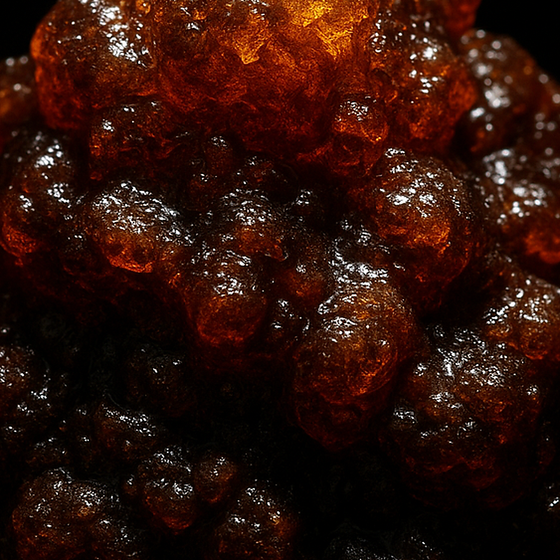
The raw gum is a black or sometimes dark brown, fragrant mass containing up to 20% or more of water. It is plastic but not pourable, and becomes brittle with age. The absolute is dark amber-green and very thick at room temperature.

Explore all seven extraits in the Discovery Set.

Harvest

Manual pruning of the branches begins in July, when they are full of resin, and only the shoots of the year are harvested. Once cut, the branches are gathered in bundles of 25 kg and taken to the processing plant. If it rains too much during the harvesting period, the plant's resin is washed away. If it does not rain and the air is too dry, the plant suffers water stress, loses some leaves and produces less resin. The plant needs about three years to grow enough before its branches can be cut. Wild cistus is picked by hand in summer and early autumn, on wheat fields that are left fallow for two to three years and that wild cistus repopulates naturally.

Chemistry

The resin is a complex mixture of terpenoid and phenolic compounds, represented mainly by labdane-type diterpenes and methylated flavonoids. Labdanolic acid is a major compound in labdanum resin. Labdanolic acid has the molecular formula C₂₀H₃₆O₃ and a molecular weight of 324.5. A methanolic labdanum absolute represented about 70% of the resin, and its diterpenoid and flavonoid fractions about 75% and 15% of the absolute. Flavonoids account for between 14 and 28% of the resin in plants harvested in summer, and between 6 and 16% in plants harvested in winter.

Labdanolic acid does not absorb UV radiation, so classical HPLC methods with UV detectors cannot detect it. Labdanum absolute has a spectrophotometric sun protection factor near 5, mainly because of its flavonoids, whose own factor is 13.

Цікавий факт

Percy Newberry, a specialist on ancient Egypt, speculated that the false beard worn by Osiris and pharaohs may have originally represented a labdanum-laden goat's beard. He also argued that the sceptre of Osiris, usually interpreted as either a flail or a flabellum, was more likely an instrument for collecting labdanum, similar to one used in nineteenth-century Crete.

Отримання й хімія

Спосіб отримання

The raw resin is usually extracted by boiling the leaves and twigs. Industrially and traditionally, the resin is usually extracted from the plant material with alkaline water followed by acid neutralization, but it may also be extracted with just boiling water, at lower yields. To obtain labdanum gum, the leafy branches are first immersed in hot alkaline water. The collected twigs are soaked in an alkaline solution, rinsed and filtered to extract the resin, which is then separated from the water and dried before being extracted with solvent to obtain the absolute. A primary extraction with a volatile solvent on fresh or dry biomass yields a concrete or resinoid. An absolute is also obtained by solvent extraction. Waxes are removed by dissolving labdanum in warm methanol, cooling it to negative temperatures and separating the precipitated waxes by centrifugation. An essential oil is produced by steam distillation.

Формула
Complex natural mixture (key constituents: labdanolic acid C₂₀H₃₆O₃; labdane-type diterpenes; methylated flavonoids)
CAS
8016-26-0
Ботанічна назва
Cistus ladanifer
Зовнішній вигляд
Black or sometimes dark brown, fragrant mass
Стійкість
Very long-lasting; tenacious
Синоніми
ladanum, ladan, ladanon
Статус IFRA
Див. примітку

No IFRA Standard for the material itself (51st Amendment)

Фізичні властивості
Температура спалаху
100 °C / 212 °F

У парфумерії

Labdanum is much valued in perfumery because of its resemblance to ambergris, which has been banned from use in many countries because it originates from the sperm whale, an endangered species. Labdanum is the main ingredient used when making the scent of amber in perfumery, as well as chypre fragrances. The oleoresin from the leaves of Cistus ladanifer is used in perfumes, especially as a fixative. A clear Spanish labdanum absolute adds roundness and body to chypre and oriental accords. Both Cistus branches and labdanum gum are used in perfumery. The clear absolute blends with woody and ambery ingredients, and its leathery facets are often combined with certain florals to bring out an ambery side.

Роль у формулі
01модифікатор
02сполучний компонент
03формувач об’єму
04тваринний модифікатор
05фіксатор
Форми випуску
ефірна олія абсолют

Див. також

6 ноти