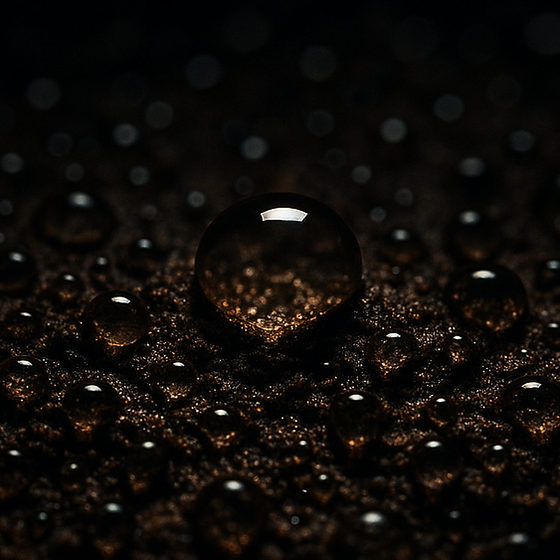
Australian researchers Isabel Joy Bear and Richard Grenfell Thomas introduced the term petrichor in a 1964 paper in Nature. Thomas coined it for what had previously been known as argillaceous odour. The name was proposed for an odour regarded as an ichor, or tenuous essence, derived from rock or stone. The name does not imply that petrichor is necessarily a fixed chemical entity; it denotes an integral odour, variable within a certain easily recognizable range.
Bear and Thomas used the term for an odour released from rock or soil materials after dry conditions, when they are exposed to moisture. The smell is associated with oils that accumulate in rocks and soil during dry periods and are released by moisture. Bear and Thomas described the scent as deriving from chemical compounds that plants exude during dry periods and that clay-based soils and rocks then absorb. The rain itself provides no scent; the impact of the drops on rocks and soil splashes an oily, bacteria-made substance into the air.
Aerosol generation after a drop strikes porous media is a three-step process of bubble formation, bubble growth and bubble bursting. The bubbles then shoot upward and burst from the drop in a fizz of aerosols. The researchers suspect that in natural environments these aerosols may carry aromatic elements, along with bacteria and viruses stored in soil. The team ran roughly 600 experiments on 28 types of surfaces, 12 engineered materials and 16 soil samples. In these experiments more aerosols were produced in light and moderate rain, while far fewer were released during heavy rain. Slower-moving raindrops might produce more aerosols, which is offered as an explanation of why petrichor is more commonly detected after light rains. Alongside plants, bacteria of the genus Streptomyces have in part been implicated in producing the chemicals found in these aerosols. Further research suggests that humans can detect imminent rain by the presence of ozone immediately before it, coming from a combination of various soil components and lightning.
Geosmin is a contributor to the strong scent known as petrichor that occurs when rain falls after a spell of dry weather. Geosmin is also responsible for the earthy taste of beetroots. Geosmin is a bicyclic alcohol and a derivative of decalin. Its name comes from the Greek for earth odour. Its odor detection threshold in water ranges from 0.006 to 0.01 micrograms per liter. The human olfactory system is extremely sensitive to geosmin. In a study of 50 subjects, the mean odor detection threshold was 9.5 ng/L for naturally occurring (-)-geosmin and 78 ng/L for (+)-geosmin.
Geosmin is produced by a number of microorganisms, including most Streptomyces and several species of cyanobacteria, myxobacteria and fungi. Among cyanobacteria, the main genera shown to produce geosmin include Anabaena, Phormidium and Planktothrix. Geosmin biosynthesis begins in farnesyl diphosphate, a key building block in sterol and sesquiterpene biosynthesis. In Streptomyces coelicolor the enzyme germacradienol/geosmin synthase is bifunctional: one domain converts farnesyl diphosphate to germacradienol, and a second completes the conversion to geosmin. In the conversion of germacradienol to geosmin, the three-carbon side chain is released as acetone. Under acidic conditions, geosmin decomposes into odorless substances.
Geosmin and 2-methylisoborneol have been shown to attract springtails, which are believed to feed on and spread the spores of Streptomyces. Geosmin and 2-methylisoborneol are the major biological causes of muddy odor and flavor in drinking water worldwide and in farmed fish. A human odorant receptor for geosmin, OR11A1, has been identified, and its function is conserved in orthologs across six mammalian species. It has been proposed that the extreme sensitivity to geosmin evolved in humans or their ancestors to aid in the search for scarce water, but this is not conclusive.
Aerosol Release by Raindrops
Before this work, windblown dust and sea salt from sea spray were considered the chief mechanisms of environmental aerosol dispersion. As a raindrop hits a surface it starts to flatten, and tiny bubbles rise from the surface and through the droplet before bursting out into the air. The amount of aerosol released can be predicted from the velocity of the raindrop and the permeability of the surface. Aerosol generation is greatest when the ratio of the Weber and Péclet numbers is balanced, at around 1, which means that the raindrops are neither too fast nor too slow and the surface is neither too wet nor too dry. In heavy rain the impact speed leaves too little time for bubbles to form inside the droplet. Moderate or light rain on sandy or clay soils produces many aerosols, because sandy clay has medium wetting properties. In experiments with a dye, the aerosols released from raindrops were found to contain the dye, which suggests that such aerosols may also carry other contaminants, such as soil-based viruses and bacteria.
Geosmin: Sources and Chemistry
Geosmin is a secondary metabolite of blue-green algae, filamentous bacteria of the class Actinomyces, other prokaryotes and various eukaryotes. In beetroots geosmin is produced by the plant itself and not by environmental or endophytic microbes. Some vascular plants, such as cactus flowers and red beet, are also producers of geosmin. Geosmin has also been found to repel the nematode Caenorhabditis elegans and to reduce its contact with Streptomyces. Not every blue-green alga produces geosmin: the geosmin synthase gene geoA is present in cyanobacterial species that produce it and absent from the others. Amplifying this gene from water samples by real-time PCR may make it possible to predict taste and odor events caused by cyanobacteria in fresh water. Geosmin is an irregular sesquiterpenoid. The intermediates in its formation include germacrene D, octalin and isolepidozene. Only the (-) isomer of geosmin is formed in this biosynthesis, while the (+) isomer can be prepared in the laboratory. The retro-Prins fragmentation that removes the germacradienol side chain as acetone has no biochemical precedent.
Geosmin in Water, Fish and Food
Cyanobacteria and actinobacteria release geosmin when they die, and bottom-feeding freshwater fish can absorb it. This is a particular problem in parts of the United States, where it gives off-flavours to catfish, carp, mullet and clams. Communities that depend on surface water can periodically have unpleasant-tasting water when a sharp drop in the population of these bacteria releases geosmin into the local supply. Photocatalysts based on titanium dioxide can also destroy geosmin dissolved in water.
Related Notes
Explore all seven extraits in the Discovery Set.