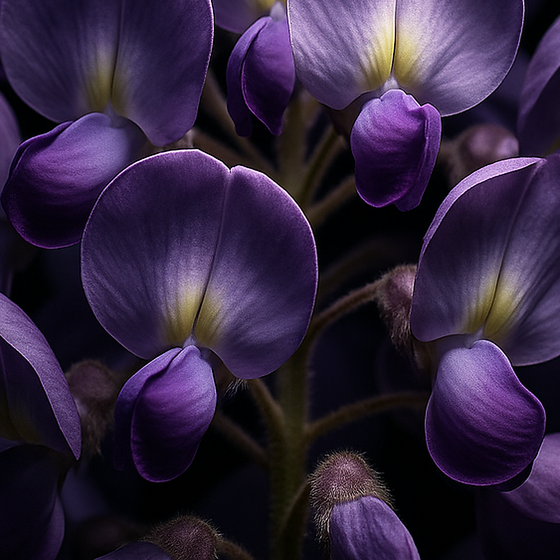
Wisterias climb by twining their stems around any available support, and they can reach 20 m (66 ft) above the ground and spread 10 m (33 ft) sideways. The genus includes four species of woody twining vines that are native to China, Japan, and the Eastern United States. Some species are popular ornamental plants. The drooping flower racemes differ in length from one species to another. Flower colors include white, lilac, purple and pink. Some Asian species flower in spring, just before or as the leaves open, while the American species flower in mid to late summer. The leaves are alternate, 15 to 35 cm long and pinnate, with 9 to 19 leaflets. American wisteria has the shortest racemes, 5-7 cm long.
Explore all seven extraits in the Discovery Set.
Species
Wisteria sinensis, the Chinese wisteria, is native to China. Wisteria floribunda, the Japanese wisteria, is native to Japan. Japanese wisteria twines clockwise when viewed from above, while Chinese wisteria twines counterclockwise. Japanese wisteria has the longest flower racemes of any wisteria, and some cultivars can reach 2 m (7 ft) in length. The flowers of Chinese wisteria are white, violet or blue, on racemes 15-20 cm long that appear before the leaves emerge in spring. Wisteria brachybotrys, the silky wisteria, is native to Japan, and Wisteria frutescens, the American wisteria, grows in the United States from Kentucky to Texas and Florida, and also in Iowa, Michigan and New York. Chinese wisteria is a deciduous vine that grows 20-30 m tall, and its fruit is a flattened, brown, velvety, bean-like pod 5-10 cm long. Japanese wisteria is a woody, deciduous twining climber with about 15-19 oblong leaflets per leaf, and its flowers, in white, pink, violet or blue, open in early to mid spring. Garden hybrids include Wisteria × formosa and Wisteria × valderi.
Cultivars
The Chinese wisteria variety 'Amethyst' has deeper colored reddish violet flowers. The cultivar 'Prolific' bears the classic purple flowers in greater abundance on larger racemes, and it blooms at an earlier age than the traditional cultivar. 'Prolific', 'Amethyst' and 'Jako' have each gained an Award of Garden Merit.
Scent chemistry
Methyl anthranilate occurs naturally in wisteria, as well as in Concord grapes, jasmine, gardenia and several other plants. Its odor is grape-like. At 25 ppm it has a sweet, fruity, Concord grape-like smell with a musty and berry nuance. It is an ester of anthranilic acid with the chemical formula C₈H₉NO₂.
Cultivation
Wisteria, especially Chinese wisteria, is very hardy and fast-growing. It prefers fertile, moist, well-drained soil and thrives in full sun. Plants grown from seed can take decades to bloom. Non-native wisterias are considered invasive species in many parts of the United States, especially the Southeast. It can grow in fairly poor-quality soils. Wisteria can be propagated by hardwood cuttings, softwood cuttings or seed, but gardeners usually grow plants started from rooted cuttings or from grafted cultivars known to flower well. Chinese wisteria is more sensitive to cold than American wisteria and Japanese wisteria, and spring frosts in Zones 5 and 6 can kill its latent flower buds, so that the plant might only bloom sporadically. It is most commonly trained along garden walls, along the exterior of buildings, or over a pergola, and it may also be trained as a freestanding tree.
Toxicity
The seeds of all species contain high levels of the toxin wisterin and are especially poisonous. In many countries, wisterias have poisoned children, causing mild to severe gastroenteritis. All parts of Chinese wisteria contain a glycoside called wisterine, which is toxic if ingested and may cause nausea, vomiting, stomach pains and diarrhea.