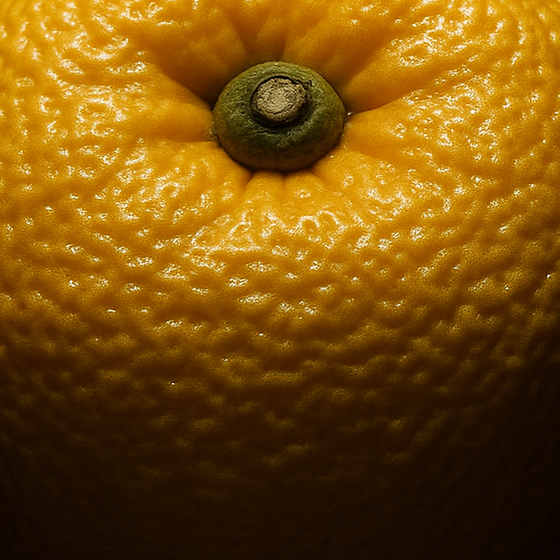
Yuzu (Citrus × junos, from Japanese 柚子 or ユズ) is a citrus fruit and plant in the family Rutaceae of Chinese origin. It is believed to have originated in central China as an F1 hybrid of the mangshanyeju subspecies of mandarin orange and the ichang papeda. The fruit resembles a yellow clementine with uneven skin and can be either yellow or green depending on the degree of ripeness. Yuzu fruits, which are very aromatic, typically range between 5.5 and 7.5 cm in diameter. Yuzu is unusual among citrus plants in being relatively frost-hardy, due to its cold-hardy Ichang papeda ancestry.
Botany and varieties
Yuzu forms an upright shrub or small tree that commonly bears many large thorns. Its leaves have a large leaf-like petiole and are heavily scented. Yuzu closely resembles sudachi, a Japanese citrus from Tokushima Prefecture, but yuzu eventually ripens to an orange colour. Kito is an old Japanese variety, and Komatsu Sadao is one of the most famous varieties for its aroma. The accepted botanical name is Citrus × junos Siebold ex Yu.Tanaka.
Chemistry
Yuzunone, an odor-active volatile identified in yuzu peel oil, has been found to contribute greatly to yuzu's distinctive aroma. In a study of cold-pressed peel oil from five Japanese prefectures, 174 compounds were detected and 67 were identified and quantified. The cold-pressed oils of the five-prefecture study were harvested in early, middle and late November. The oil from Oita and Wakayama had approximately the same profile as that from Kochi, whereas some differences appeared between Kochi and the other origins. In C. junos, limonene is the most abundant compound, at concentrations between 63 and 77%. Most of the characteristic compounds of C. junos have been reported at trace levels, with percentages lower than 0.02%. The ratio of monoterpene to sesquiterpene hydrocarbons in the oil also shows the characteristic citrus aroma profile. The peel oils of the 21 citrus cultivars from Jeju Island, yuzu among them, shared nine components: α-pinene, d-limonene, trans-β-ocimene, γ-terpinene, terpinolene, linalool, β-terpineol, terpinene-4-ol and α-terpineol. Yuzu lactone, (Z)-9-dodecen-12-olide, has been isolated only from C. junos and C. limon. Limonene comprises two isoprene units and has two double bonds, and it serves as a precursor for the biosynthesis of other monoterpenes.
Volatile profile of the fruit
In a headspace analysis of Yuzu Jeune grown in Switzerland, monoterpene hydrocarbons made up 99.08% of the vapor of the juice and 96.58% of the vapor of the peel. Limonene was the most abundant of them, at 78.25% in the juice and 78.40% in the peel, followed by γ-terpinene at 14.43% and 11.43%. Yuzu Jeune also shows a significant amount of β-phellandrene, a proportion above 1% that is unusual in citrus.
Peel oil and its quality
Roughly 300 kilos of grated peel are needed to make 2 kilos of yuzu essential oil. Yuzuol and yuzunone, the latter also found in galbanum, increase the balsamic, sweet and floral character that distinguishes the aroma of yuzu from other citrus fruits.
Storage
Steam-distilled yuzu peel oil changes more rapidly during storage than cold-pressed oil. The storage test followed 44 compounds of the steam-distilled oil at 25°C for up to 12 weeks. In steam-distilled peel oil stored at 25°C, total monoterpene hydrocarbons decreased markedly, with major losses of limonene and γ-terpinene. Bicyclogermacrene, the main sesquiterpene hydrocarbon of the fresh steam-distilled oil, practically disappeared. Alcohols and p-cymene increased notably during that time. (-)-Spathulenol, the main artifact, was formed from bicyclogermacrene. Antioxidants such as α-tocopherol, β-carotene and BHT slowed the formation of oxidation products.
Culinary and other uses
Though rarely eaten as a fruit, yuzu is a common ingredient in Japanese cuisine, where the zest and the juice are used much as lemon is used in other cuisines. Together with sudachi, daidai and similar citrus fruits, it is an integral ingredient of the citrus-based sauce ponzu, and yuzu vinegar is also made. Yuzu is often combined with honey to make yuzu hachimitsu, a syrup used for yuzu tea, and it goes into alcoholic drinks such as the yuzu sour. In Korea, yuja is made into the fruit-punch dessert yuja-hwachae and is also used in salads.
Production
Yuzu has been cultivated mainly in East Asia, though it has also recently been grown in New Zealand, Australia, Spain, Italy, and France. Yuzu's domestic production in Japan is about 27,000 tons (2016). Five popular yuzu production districts in Japan are the prefectures of Kochi, Tokushima, Ehime, Oita and Wakayama.