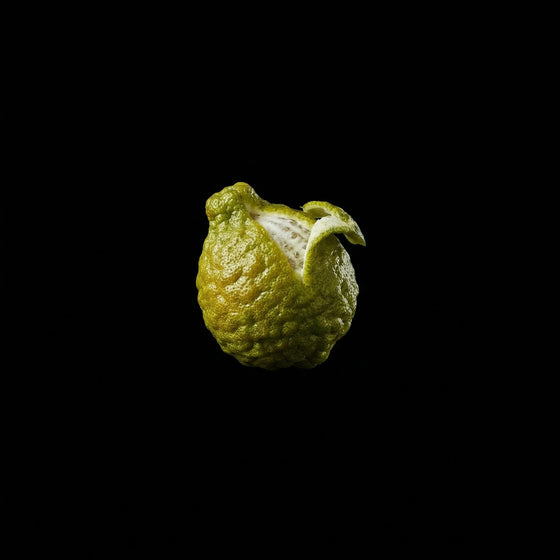
Бергамот

НатуральнийЦИТРУСОВІ ЗАПАХИцитрусовий · ароматичний · гіркий · чайний
Верхні нотиПіраміда
—Сила
—Стійкість
3Походження
Зразок
Бергамот як парфумерна сировина
Верхні ноти
Citrus bergamia
Визначення

Bergamot is an essential oil obtained from the peel of Citrus bergamia, a fragrant citrus fruit. Its scent is described as fresh, zesty and lavender-like.

Agrumé
93
Frais
89
Vert
69
Doux
28
Amer
50
Fruité
24
Bergamot oil, Oil of bergamot, Bergamot peel oil
Type
Складник
Olfactive family
Цитрусові
Source
fruit peel
Chemical class
complex mixture (essential oil)
Інструменти
Піраміда
ВВерхні ноти
СНоти серця
ББазові ноти
Країни-виробники
Italy (Calabria — 90% of world production of bergamot oil) southern France Ivory Coast

Запах

The oil has an extremely rich, sweet and fruity top note, followed by floral and balsamic undertones. Its citrus aroma is described as "citrus, floral, green, spicy, orange peel, ginger". The oil gives fragrances a bright, sparkling citrus facet. Some newer qualities of the oil are made to stress the juicy or green, zesty side of the fruit.

Теруар і варіації

Докладно

Bergamot, Citrus bergamia, is a fragrant citrus fruit the size of an orange, yellow or green in colour depending on ripeness. It is defined as a hybrid of bitter orange and lemon and belongs to the Rutaceae family. The trees have big dark green ovate leaves similar to those of lemon, star-shaped white flowers and round yellow fruits. The fruit turns from green to yellow as it ripens, with a sour, bitter pulp.

Origin and production

The bergamot is a citrus fruit grown mostly in Mediterranean areas. Production is on large scale in the Ionian Sea coastal areas of the province of Reggio di Calabria in Italy. Ninety per cent of the world's production of bergamot oil is sourced from crop to factory in Calabria. Three cultivars are traditionally grown: Feminello, Fantastico and Castagnaro. Bergamot is also grown in southern France and the Ivory Coast for the essential oil, and in Antalya in southern Turkey for its marmalade. Around 1,300 smallholder farmers in Calabria work on the bergamot trees. Harvesting begins with the arrival of cold days at the end of November and usually ends around the end of February. It takes four to five years for a bergamot tree to bear fruit, with each tree producing around 100 kilograms per year, and two trees to produce a single kilogram of essential oil.

Chemistry

Bergamot essential oil consists of a volatile fraction (average 95%) and a non-volatile fraction (5% or residual). It is a complex mixture of many classes of organic substances, particularly in the volatile fraction, including terpenes, esters, alcohols and aldehydes. The non-volatile fraction holds oxygenated heterocyclic compounds such as coumarins and furanocoumarins. The main volatile components are limonene (30–45%), linalyl acetate (22–36%), linalool (3–15%), γ-terpinene (6–10%) and β-pinene (4.5–9%). The (−) enantiomer makes up 99.3 to 99.7% of the linalool and 99.4 to 99.7% of the linalyl acetate. Of the limonene, 97.4 to 98.4% is the (+) enantiomer. Bergapten, found in the non-volatile residue, is present at 1800 to 3800 mg/kg.

Phototoxicity and FCF

Bergamot essential oil contains a significant amount of bergapten, a phototoxic substance that gets its name from the bergamot orange. Bergapten is a linear furanocoumarin derived from psoralen, often found in plants associated with phytophotodermatitis. Bergamot essential oil has a higher concentration of bergapten than any other Citrus-based essential oil. When the oil is applied directly to the skin in a patch test and followed by exposure to ultraviolet light, a concentration-dependent phototoxic effect is observed. If the oil is twice rectified, and therefore bergapten-free, no phototoxic response is observed. The oil also contains a significant amount of bergamottin, one of two furanocoumarins believed to be responsible for a number of grapefruit-drug interactions. IFRA recommends that leave-on skin products be limited to 0.4% bergamot oil. This is more restrictive than for any other Citrus-based essential oil.

Uses

Bergamot essential oil has been used in cosmetics, aromatherapy, and as a flavoring in food and beverages. An essence extracted from the aromatic skin of the fruit flavours Earl Grey and Lady Grey teas, as well as confectionery. The pharmaceutical industry uses it to absorb the unpleasant smells of medicinal products and for its antiseptic and antibacterial properties. Clinical studies of its therapeutic applications focus exclusively on aromatherapy and suggest that its use can help reduce anxiety and stress.

Quality control

Adulteration with cheaper products such as oil of rosewood and bergamot mint has been a problem for consumers. To protect the reputation of their produce, the Italian government introduced tight controls, including testing and certificates of purity. The Experimental Station for Essential Oil and Citrus By-Products in Reggio di Calabria is the quality control body for the essential oil Bergamotto di Reggio Calabria DOP.

Цікавий факт

The leftover peels of bergamot were traditionally made into small souvenir boxes or snuff containers. In Calabria, locals sometimes call bergamot "green gold".

Отримання й хімія

Спосіб отримання

The oil is obtained by cold pressing of the fresh pericarp. The oil is held in the oily sacs of the pericarp. The bergamots are then stored for two to three days to warm them up and soften their skin. In modern methods, the oil is extracted mechanically with machines called peelers, which scrape the outside of the fruit under running water; the resulting emulsion goes to centrifuges that separate the essence from the water. The traditional technique for manually extracting the oil was the sfumatura, or slow-folding process. The rinds of 100 bergamot oranges yield about 3 ounces (85 g) of bergamot oil. Vacuum distillation of bergamot peels gives an oil totally devoid of 5-MOP that is chemically comparable to the cold-pressed oil.

Формула
Complex natural mixture (key constituents: limonene; linalyl acetate; linalool; γ-terpinene; β-pinene; bergapten C₁₂H₈O₄)
CAS
8007-75-8
Ботанічна назва
Citrus bergamia
Зовнішній вигляд
clear liquid, green to greenish yellow
Синоніми
Bergamot oil, Oil of bergamot, Bergamot peel oil
Статус IFRA
Обмежено

Restricted — IFRA Standard « Bergamot oil expressed » (Amendment 49)

Фізичні властивості
Відносна густина
0.875 to 0.883 at 20 °C
Показник заломлення
1.4640 to 1.4690 at 20 °C

У парфумерії

Bergamot oil is one of the most commonly used ingredients in perfumery. Bergamot is a major component of the original Eau de Cologne. From the beginning of the 18th century to the present day, bergamot has been used in all types of perfume to bring freshness and naturalness to the fragrance. It is particularly used in floral top notes to accompany tea and citrus accords. In the heart of woody or ambery compositions it adds freshness. Its ability to fix the aromatic bouquet and to harmonize all of the essences makes it one of the main basic constituents of perfumes. Because of the photo-toxicity induced by 5-MOP, a furocoumarin-free essential oil has been prepared for perfumery and cosmetic uses. Bergamot is the mainstay of the first modern perfume accord, cologne.

Роль у формулі
01модифікатор
02фірмова нота
03компонент піднесення
04сполучний компонент
05свіжість
Форми випуску
олія холодного пресування олія FCF (без бергаптену)

Див. також

8 ноти