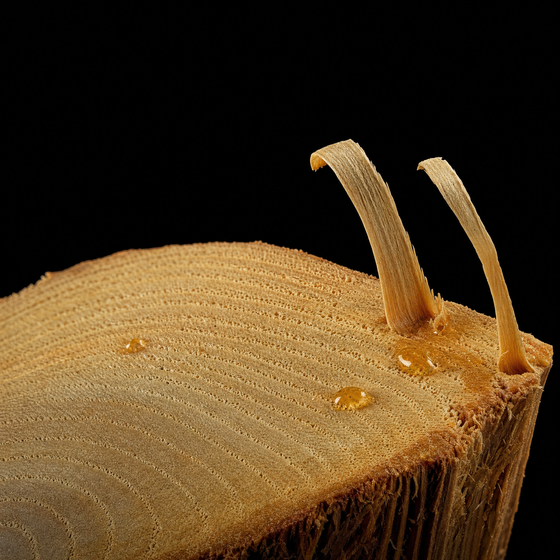
What does sandalwood smell like? Woody-floral. Sandalwood is the fragrant heartwood of trees in the genus Santalum, steam-distilled into an essential oil that perfumers use in fragrance.
The two main oil species are Santalum album and Santalum spicatum, the Australian sandalwood. Related entries cover Indian sandalwood and Mysore sandalwood; this page is the overview.
Where sandalwood comes from
Sandalwood trees are hemiparasites. S. album parasitises the roots of other trees through haustoria, and up to about 300 species can serve as hosts, its own included. The relationship is not obligatory. Sandalwoods grow slowly. The trunk of S. album starts to smell at around ten years and is not ready to harvest until after twenty. For commercially valuable oil, S. album trees are said to need to be at least fifteen years old.
The native range of S. album is given as Indonesia (Java and the Lesser Sunda Islands), the Philippines and Australia (Western Australia and the Northern Territory). Austronesian traders carried it to South India in ancient times, and it has grown there since at least 1300 BCE. In India, harvest and transport are regulated state by state.
The GBIF backbone lists 20 accepted species of Santalum. Not everything sold as sandalwood belongs to the genus: West Indian sandalwood (Amyris balsamifera) is an unrelated tree that traders also accept as sandalwood.
From wood to oil
Sandalwood essential oil is steam-distilled from chips and billets cut from the heartwood. Stump and roots are distilled too. For S. album the sapwood must be removed first. For S. spicatum it does not need to be.
The two main components are sesquiterpene alcohols, α-santalol and β-santalol, both C₁₅H₂₄O (220.35 g/mol). The oil is a natural mixture, so it has no single molecular formula. The CAS number of Santalum album oil is 8006-87-9.
Sandalwood at PREMIEREPEAU
At PREMIEREPEAU, sandalwood is a listed material in three extraits. Insuline Safrine, composed by Claire Liégent, lists it with saffron, clove, cinnamon, bitter almond, vanilla and hazelnut. Doppel Dancers, also by Claire Liégent, lists it with iris, ambrette, musk and amber. Nuit Élastique, by Ugo Charron, lists it with jasmine, rose, cedar, labdanum and benzoin.
This note in PREMIEREPEAU. Insuline Safrine · Doppel Dancers · Nuit Élastique. Sample the extraits in the Discovery Set.
Related notes: Indian Sandalwood · Mysore Sandalwood · Cedarwood · Oud · Ebanol · Sandalore
Sources and notes
[A] Species and range: GBIF, Santalum album L.; GBIF, genus Santalum; Wikidata Q210858; Wikipedia, Sandalwood and Santalum album (native range, host plants, tree age).
[B] Oil, extraction and composition: Wikipedia, Sandalwood oil (steam distillation, sapwood); CAS 8006-87-9 for Santalum album oil from Wikidata Q675299 and PubChem; α-santalol C₁₅H₂₄O, 220.35 g/mol, PubChem CID 11085337.