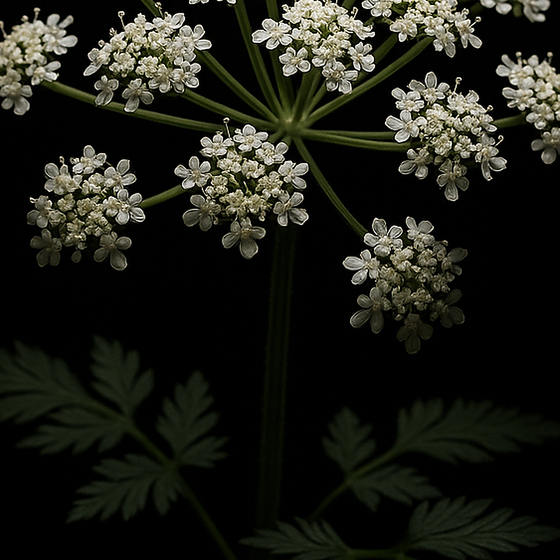
The tree and the name
Tsuga canadensis, also known as eastern hemlock, is a coniferous tree in the pine family, Pinaceae, native to eastern North America. The English name hemlock arose from a perceived similarity between the smell of the crushed foliage of Tsuga and that of the unrelated plant hemlock. Unlike that plant, Tsuga species are not poisonous. Conium maculatum is a highly poisonous weed of the carrot family Apiaceae. Its main toxic alkaloids are coniine and γ-coniceine. It is well known as the poison that killed the philosopher Socrates.
The genus Tsuga comprises eight to ten species, four of them in North America and four to six in eastern Asia. Tsuga canadensis is also called Canadian hemlock and, in French-speaking Canada, pruche du Canada, and it is the state tree of Pennsylvania. Poison hemlock is native to Europe and North Africa, and its distinctive odour is usually considered unpleasant.
Range and habitat
The range of Tsuga canadensis runs from northeastern Minnesota eastward through southern Quebec into Nova Scotia, and south in the Appalachian Mountains to northern Georgia and Alabama. It is found primarily on rocky ridges, ravines, and hillsides with relatively high levels of moisture. The tree is tolerant of shade, moist soil, and slopes. Many eastern hemlocks live for more than 500 years. The oldest recorded specimen, found in Tionesta, Pennsylvania, was at least 554 years old. The tree generally reaches heights of about 31 metres, but exceptional trees have been recorded up to 53 metres. The understory of hemlock forests is characterized as dark, damp, and cool. Declines caused by the invasive hemlock woolly adelgid have led to Tsuga canadensis being rated Near Threatened on the IUCN Red List.
In Canada the tree grows in Ontario and in all provinces to the east except Newfoundland and Labrador. It is generally confined to cool, humid highland climates, with annual precipitation typically between 740 mm and more than 1,270 mm. Hemlocks tolerate heavy shade better than other conifers but are more susceptible to drought. The leaves are flattened and two-ranked, typically 15 to 20 mm long, with a shiny green upper side and a glaucous underside marked by two broad stomatal bands. The leaves stay on the tree for three to four years. The tree grows alongside forest fungi such as Ganoderma tsugae, which is called hemlock varnish shelf. Hemlock is the third-most prevalent tree in Vermont, where it protects stream banks from erosion and gives food and winter shelter to deer.
Composition of the oil
Bornyl acetate makes up 25% to 40% of the oil, alpha-pinene 15% to 40%, camphene 10% to 20%, limonene 3% to 5% and beta-pinene 1% to 5%. One analysed oil contained 33.06% bornyl acetate and 20.16% alpha-pinene. It also contained 12.59% camphene, 4.48% tricyclene and 3.56% limonene. Tricyclene and myrcene are also present. The ester content of the oil, calculated as bornyl acetate, is 37% to 45%.
Bornyl acetate is the acetate ester of the terpenoid borneol. Its formula is C₁₂H₂₀O₂, its molar mass is 196.29 g/mol, and it melts at 27–29 °C and boils at 223–224 °C. It is chiral and also occurs in valerian. The (-) enantiomer is used as a food additive, flavouring agent and odour agent. Needle oils from Pinaceae species contain (-)-bornyl acetate as their main odoriferous component.
Properties and regulation
One volume of the oil dissolves in at least one volume of 90% ethanol, and the solution may become hazy when more than two volumes of ethanol are added. Hemlock oil carries the FEMA number 3034, and the oil of hemlock needles and twigs from Tsuga species is among the substances added to food.
Other uses of the tree
Hemlock wood is used in construction and for railroad ties. Eastern hemlocks are popular as ornamental trees. Wood from hemlocks is important in the timber industry, especially for wood pulp, and many species and numerous cultivars are grown in gardens.
Explore all seven extraits in the Discovery Set.
—
Related: Spruce