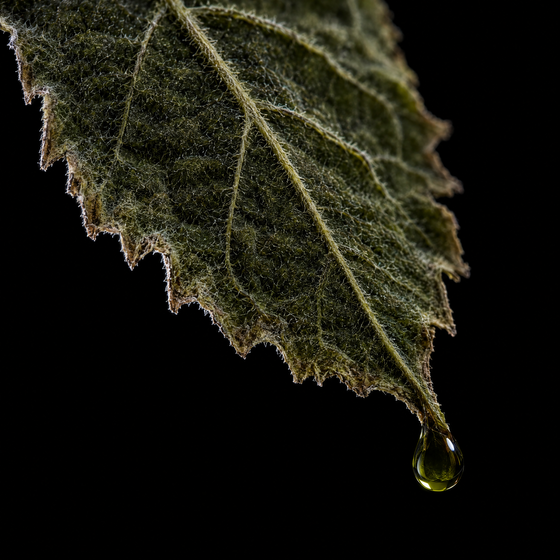
Pogostemon cablin is a species of flowering plant in the family Lamiaceae, commonly called the mint or deadnettle family. It grows as a bushy perennial herb with erect stems reaching up to 75 centimetres in height and bears small, pale pink-white flowers. The leaves accumulate essential oil in glandular trichomes.
Where patchouli comes from
Pogostemon cablin is native to the island region of Southeast Asia, including Sri Lanka, Indonesia, the Malay Peninsula, New Guinea and the Philippines. It is also found in many parts of Nepal and North East India. Patchouli is cultivated on a commercial scale in India, Indonesia, Malaysia, China, Singapore, West Africa and Vietnam. It thrives in hot, humid weather but not extended periods of direct sunlight. The species name cablin comes from cabalam, a local name for the plant in the Philippines. Indonesia supplies approximately 90% of the world market demand for patchouli oil. As of 2023, global demand for patchouli oil is over 1,600 metric tons per year. The most common commercial varieties are native to the islands of Sumatra and Sulawesi in Indonesia.
How the oil is made
The oil is obtained by steam distillation of shade-dried leaves. Steam distillation requires rupturing the cell walls of the plant material by steam scalding, light fermentation or drying. Leaves and twigs may be harvested several times a year. Some of the sesquiterpene hydrocarbons in the oil, such as α-patchoulene and β-patchoulene, are suspected to be artifacts formed from patchoulol by dehydration during steam distillation.
What is in the oil
The main chemical component of patchouli oil is patchoulol, a sesquiterpene alcohol. The oil is rich in sesquiterpenes, mainly patchoulol, a tricyclic sesquiterpene. Commercial patchouli oils are frequently graded in terms of their patchoulol content. The share of patchoulol differs by origin. It was reported at 32% in Vietnam, 57.7% in India and 60.59% in Shipai, China. Elsewhere it averages 20-45% of the oil, and sometimes reaches 72%. Other components include germacrene B, norpatchoulenol and pogostone. In the Philippines, research attributes the distinctive aroma mainly to germacrene B, which is a major sesquiterpene component. A GC-MS analysis of patchouli oil identified up to 30 volatile substances. Pogostemon cablin is divided into two chemotypes, a pogostone type and a patchoulol type, on the basis of chemical differences in the volatile oil. Patchoulol is a white solid that melts at 56 °C in its racemic form and boils at 287-288 °C. It is practically insoluble in water and soluble in ethanol. Patchoulol is obtained industrially from patchouli leaf fermentation.
Other uses
More recently, the scent has also been used in incense, insect repellents, chewing tobacco, many alternative medicines and intimate objects. The oil is also used in scented personal products such as bay rum, and in industrial products such as paper towels, laundry detergents and air fresheners.
Patchouli in PREMIEREPEAU
Patchouli is one of the listed materials of Albâtre Sépia, composed by Florian Gallo. The other listed materials include polywood, wolfwood, ambroxan and cashmeran.