


Ялина
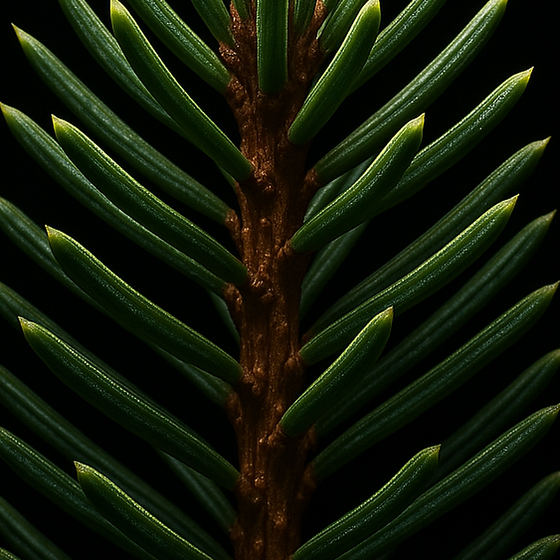
Dark-green, resinous, and deeply forested — spruce smells like the interior of a boreal forest at altitude. More serious than fir, less sharp than pine, with a balsamic depth from bornyl acetate and a faintly bitter, almost medicinal edge.
- Type
- Складник
- Olfactive family
- Деревні
- Source
- needles
- Chemical class
- complex natural (essential oil)
Запах
Теруар і зрілість
Докладно
Отримання й хімія
Спосіб отримання
Steam distillation of needles and twigs. Black spruce (Picea mariana) is harvested primarily in Canadian boreal forests. Norway spruce (Picea abies) is produced in Scandinavia and Central Europe. Oil composition varies significantly with harvest season — summer needles tend toward higher monoterpene content, while winter harvests produce more bornyl acetate. The crude oil is a pale yellow to colorless liquid.
- Формула
- N/A — complex essential oil (key: bornyl acetate C₁₂H₂₀O₂ ~30%, alpha-pinene C₁₀H₁₆)
- CAS
- 8008-80-8
- Ботанічна назва
- Picea abies
- Зовнішній вигляд
- colorless clear liquid
- Сила запаху
- Середня
- Стійкість
- 24 hours at 100.00%
- Синоніми
- SPRUCE WOOD SPRUCE ESSENTIAL OIL
No IFRA Standard for the material itself (51st Amendment)
- Температура спалаху
- 108.00 °F. TCC ( 42.22 °C. )
- Відносна густина
- 0.90000 to 0.91500 @ 25.00 °C.
- Показник заломлення
- 1.46700 to 1.46720 @ 20.00 °C.
У парфумерії
Spruce oil — particularly black spruce (Picea mariana) — functions as a heart-to-base note with strong diffusive qualities. Its high bornyl acetate content (37-46%) provides excellent fixation and a sweet-balsamic warmth that anchors coniferous accords. In fougere structures it reinforces the green-aromatic axis with more depth than fir or pine. In woody-amber compositions it adds a cold, forested dimension. Spruce bridges well with vetiver, cedarwood, labdanum, and incense materials. The oil's dense, resinous character makes it particularly useful in masculine and unisex compositions where a serious, non-decorative coniferous note is required.
Див. також
6 ноти