


Heptanal
Keywords: fatty · fruity · oily
Heptanal is an n-alkanal, a saturated medium-chain fatty aldehyde, with a powerful, oily-fatty, green odour that turns almost fruity in extreme dilution.
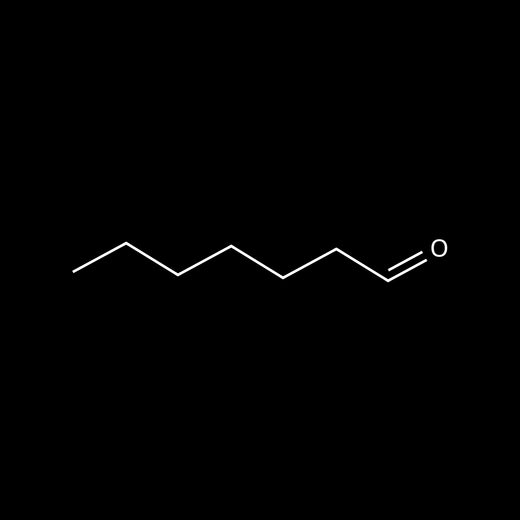
- Olfactive family
- Green · 370 entries of the glossary in this family Subfamily: Green notes · 218 entries in this subfamily Cluster: Green leafy notes · 420 entries in this cluster
- Material
- Synthetic
- Pyramid
- Top · Volatility: Top Note
- Strength
- High Step 4 of 5 · shared by 498 of 2,156 graded entries Graded entries at each step, from 1 to 5: 4, 119, 1,473, 498, 39. 23 more sit between two steps.
- Also called
- Heptyl aldehyde, n-Heptanal, Enanthic aldehyde, Oenanthic aldehyde, Aldehyde C-7
Family, subfamily and cluster: PREMIEREPEAU house classification, version 2026‑11.
Heptanal · Facets
Entries of the glossary that carry each facet, of 3,979:
- fatty 265
- fruity 1,301
- oily 237
- cognac 24
- green 1,442
- nutty 258
Heptanal · Scent
Heptanal smells fatty, oily and green, with a fruity, almost fermented-fruit side in extreme dilution.
Heptanal · In Perfumery
Heptanal is used in perfumery and has a very powerful, diffusive, oily-fatty and green odour.
Pyramid
Heptanal: Top. Entries of the glossary stored at each place of the pyramid, of 4,006 (42 store no place):
- Top 718
- Top · Heart 497
- Heart 1,641
- Heart · Base 514
- Base 594
Heptanal · Extraction & Chemistry
It is obtained by distilling castor oil under reduced pressure, where catalytic dehydration of ricinoleic acid methyl ester yields heptanal as a cleavage product in almost quantitative yield. It is also made by pyrolysis of castor oil, which gives heptanal and undecylenic acids, and by reacting 1-hexene with carbon monoxide and hydrogen over a rhodium catalyst in the oxo process.
- Appearance
- Colourless to slightly yellow, oily liquid
Heptanal · In Depth
Identity
Heptanal carries the CAS number 111-71-7, the molecular formula C₇H₁₄O and a molecular weight of 114.19 g/mol. It is an n-alkanal and a saturated, medium-chain fatty aldehyde, the aldehyde that results from the oxidation of the alcoholic hydroxy group of heptan-1-ol.
Odour
It smells fatty, oily and green, with a fruity, citrus side. The odour is very powerful and diffusive, oily-fatty and rancid, penetrating and pungent at high concentration. In extreme dilution it turns almost fruity, like fermented fruit. At 1 % in dipropylene glycol it smells fresh, aldehydic, fatty, green and herbal, with wine-lee and ozone facets. Its odour strength is high, and smelling it in a 1 % solution or less is recommended. Its substantivity is 12 hours at 100 %.
Occurrence in nature
It is a plant volatile found in various essential oils, fruits and other natural sources. It occurs in Arctium lappa, Aspalathus linearis, Aster scaber, Avena sativa, Bellis perennis, Camellia sinensis, Cannabis sativa, Carica papaya, Castanopsis cuspidata, Centaurea oltensis, Centaurea sessilis and Centella asiatica. It is also an endogenous aldehyde that comes from membrane lipid oxidation.
Production
It is obtained by distilling castor oil under reduced pressure, where catalytic dehydration of ricinoleic acid methyl ester yields heptanal as a cleavage product in almost quantitative yield. It is also made by pyrolysis of castor oil, which gives heptanal and undecylenic acids, and by reacting 1-hexene with carbon monoxide and hydrogen over a rhodium catalyst in the oxo process.
Use in perfumery
It is used in perfumery, and as a starting material for 1-heptanol, ethyl oenanthate and heptanoic acid.
Use in flavours
It is used as a flavouring agent. Its flavour profile is citrus, fat, green and nut, and its taste is green, aldehydic, oily, grassy, clover and cilantro. The Joint FAO/WHO Expert Committee on Food Additives found no safety concern at current levels of intake when it is used as a flavouring agent.
Properties
Its boiling point is 152.8 °C and its melting point is −43.3 °C. Its flash point is 48 °C in a closed cup and it has an estimated logP of 2.442. It has an estimated vapour pressure of 3.854 mmHg at 25 °C. It dissolves in water to 1,250 mg/L at 25 °C, and is miscible with alcohol and ether. It is soluble in 3 volumes of 60% alcohol.
Safety and IFRA
No IFRA Standard covers this material itself, as of the 51st Amendment. Its INCI name is HEPTANAL and its function is perfuming. Its EC number is 203-898-4 and it is registered under REACH. Its hazard statements include H226, flammable liquid and vapour, H315, causes skin irritation, and H319, causes serious eye irritation.
Heptanal · Technical Sheet
Molecular weight
114.19 g/mol Heavier than 301 of the 536 other entries at the same place of the pyramid that store a weight; 5 weigh the same.
2,515 entries store a molecular weight. By place in the pyramid: Top 537, Top · Heart 403, Heart 861, Heart · Base 452, Base 262.
Identity
- Type
- Ingredient
- Category
- Aroma chemicals
Classification
- Chemical class
- Aldehyde
Chemical data
- Formula
- C7H14O
- CAS
- 111-71-7
- Reported in plants
- Avena sativa (2 papers; one: J Chem Ecol 1984, Avena sativa) · Arctium lappa (1 paper; one: Journal of the agricultural chemical society of Japan 1985, Arctium lappa) · Bellis perennis (1 paper; one: Phytochemistry 1995, Bellis perennis) · Camellia sinensis (1 paper; one: Agricultural and Biological Chemistry 1986, Camellia sinensis) · Cannabis sativa (1 paper; one: J Nat Prod 1980, Cannabis sativa) · Centella asiatica (1 paper; one: Journal of essential oil research 1994, Centella asiatica) · LOTUS
- PubChem CID
- 8130, compound record on PubChem
- InChIKey
- FXHGMKSSBGDXIY-UHFFFAOYSA-N
- Wikidata · Wikipedia
- Heptanal: Q425827, item on Wikidata · Wikipedia, English article
Physical properties
- Boiling point
- 152.8 °C
- Melting point
- −43.3 °C
- Flash point
- 48 °C in a closed cup
- Vapour pressure
- 3.854 mmHg at 25 °C (estimated)
- Log P
- 2.442 (estimated)
Performance and rules
- Tenacity
- 12 hours at 100 %
- Odour threshold
- 180 ppt to 30 ppb in air (2 studies) · Abraham et al. 2012
- Available as
- synthetic
- IFRA status
- No IFRA Standard for the material itself (51st Amendment)
Heptanal · See Also
Entries related to Heptanal, by their place in the pyramid. “shared” marks a scent word Heptanal has too.
Top notes

2-Ethylhexanal
fruity (shared) · green (shared) · fatty (shared) Green / Top · Heart / Same cluster / Synthetic / 128.21 g/mol
Caviar
cold · briny · marine Aquatic / Top · Heart / Fantasy/Concept
Octanal
citrus · waxy · aldehydic Citrus / Natural & Synthetic / 128.21 g/mol
Heptanoic Acid
sour · fatty (shared) · fermented Top · Heart / Synthetic / 130.18 g/mol
(3E)-7-Methyl-3-octen-2-one
fruity (shared) · floral · fatty (shared) Fruity / Top · Heart / 140.22 g/mol


Heart notes

Heptanal dimethyl acetal
green (shared) · oily (shared) · fruity (shared) Green / Same cluster / Synthetic / 160.25 g/mol
Decanenitrile
fatty (shared) · musty · nutty (shared) Green / Same cluster / 153.26 g/mol
Heptanal diethyl acetal
green (shared) · herbal · winey Green / Same cluster / 188.31 g/mol
Angel’s Trumpet
floral · warm · spicy Florals / Accord
Heptanal 1,2-glyceryl acetal
earthy · sweet · fungal Earthy / 188.26 g/mol


Heptanal · Sources
- PubChem Heptanal
- ChEBI Heptanal: chemical classification record
- Pyrfume Arctander, Perfume and Flavor Chemicals: odour descriptions (Pyrfume archive)
- The Good Scents Company Information System Heptanal: data sheet
- Pyrfume Good Scents odour data (Pyrfume archive)
- Pyrfume Leffingwell odour data (Pyrfume archive)
- Wikidata (LOTUS natural products data) Heptanal: organisms it is reported in, with the papers
- IFRA Standards, 51st Amendment
- European Commission, CosIng Heptanal: cosmetic ingredient record
- European Chemicals Agency Heptanal: substance record
Cite as PREMIEREPEAU Glossary, “Heptanal”, https://premierepeau.com/

