


Star Magnolia
Keywords: floral · creamy · fresh
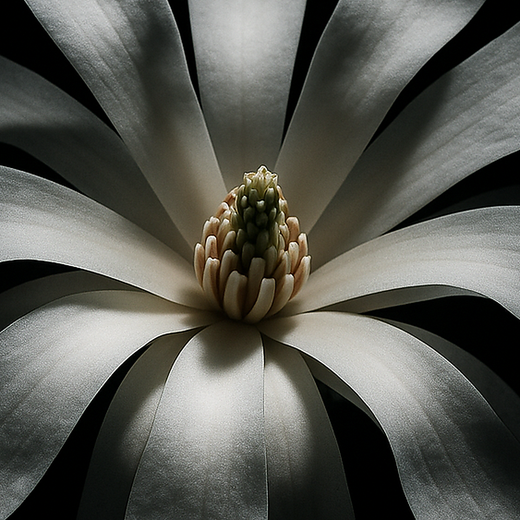
Star magnolia is Magnolia stellata, a slow-growing deciduous shrub or small tree native to Japan. Its flowers are slightly fragrant.
- Olfactive family
- Florals · 779 entries of the glossary in this family Subfamily: Green florals · 143 entries in this subfamily Cluster: Magnolia-like fresh florals · 7 entries in this cluster
- Material
- Fantasy/Concept Flowers of Magnolia stellata, a deciduous shrub or small tree
- Pyramid
- Heart · Volatility: Heart Note
- Strength
- N/A — no measured strength for a fantasy accord Not on the graded scale
- Also called
- Magnolia kobus var. stellata, Yulania stellata, Buergeria stellata
Family, subfamily and cluster: PREMIEREPEAU house classification, version 2026‑11.
Star Magnolia · Facets
Entries of the glossary that carry each facet, of 3,979:
- floral 1,546
- citrus 487
- green 1,442
- sweet 1,988
- fresh 1,387
- creamy 401
- rose 212
- jasmine 57
- spicy 474
Editorial note We own no rights to this material, its name or its trademark. This entry is independent editorial journalism, published under freedom of expression.
Star Magnolia · Scent
The flowers of Magnolia stellata are slightly fragrant. Magnolia as a fragrance type is described as floral, with lily, green, rosewood, herbal, aldehydic, spicy and fruity aspects; supplier descriptions include a mild sweet warm magnolia floral and a sweet floral magnolia gardenia.
Evolution over time
Star Magnolia: scent over time.
- Immediately
N/A — no documented evolution for a fantasy accord
- After a few hours
N/A
Star Magnolia · In Perfumery
A magnolia fragrance, described as a floral rose magnolia scent, can be used in candle and fragrances. One magnolia white oil is described as having crisp, green top notes with jasmine, muguet and ozone, and heart notes of lilac, rose and carnation, completed with orange flower. Another magnolia oil is described as crisp green and fresh ozone top notes, with lily, jasmine and rose at the heart and a delicate spicy base.
Pyramid
Star Magnolia: Heart. Entries of the glossary stored at each place of the pyramid, of 4,006 (42 store no place):
- Top 718
- Top · Heart 497
- Heart 1,641
- Heart · Base 514
- Base 594
Role in the formula
Star Magnolia: roles in the formula. Entries of the glossary that share each role, of 4,006:
- N/A — no documented formula role 361
Star Magnolia · Terroir & Origins
- Producing countries
- Japan
Star Magnolia · Extraction & Chemistry
Flower buds of two Magnolia species have been hydrodistilled in a Clevenger-type apparatus for 8 hours, starting from 1 kg of fresh buds. Leaves of Magnolia champaca give 0.06 to 0.31% of pale yellow, strong-smelling oil by hydrodistillation, measured on fresh weight. The plant material is first extracted with a hydrocarbon solvent such as hexane to give a concrete. The concrete is then extracted with ethanol, and the ethanol extract is chilled and filtered to remove waxes. When the ethanol evaporates, the absolute is left behind.
Available as
Star Magnolia: available as.
- synthetic accord
- fantasy note
- Appearance
- Pale yellow to colorless liquid (headspace/absolute is rarely produced commercially)
Star Magnolia · Did You Know?
There are eight varieties with women’s names in the trade, the “Eight Little Girls”.
Star Magnolia · In Depth
Star magnolia bears large, showy white or pink flowers in early spring, before its leaves open.
Description
The shrub grows 1.5 to 2.5 metres in height and spreads to 4.6 m in width at maturity. The flowers are star-shaped, with at least 12 thin, delicate petal-like tepals, and some cultivars have more than 30. Flower colour varies naturally from white to rich pink. The slightly fragrant flowers are 7 to 10 cm wide and cover the bare plant in late winter or early spring.
Origin and Cultivation
The species may be found growing wild in certain parts of the Ise Bay area of central Honshū, at elevations of 50 to 600 m. It grows by streams and in moist, boggy areas. Its conservation status is Endangered (IUCN 3.1).
The shrub prefers deep, acidic soil. Spring frosts can damage the flowers. It may be propagated by seed, or more easily by rooting cuttings taken after the flower buds have formed. The cultivars ‘Centennial’, ‘Jane Platt’ and ‘Royal Star’ have all gained the Royal Horticultural Society’s Award of Garden Merit.
Relatives and Other Magnolias
Star magnolia is closely related to the Kobushi magnolia (Magnolia kobus). Some authorities consider the star magnolia to be a variety of M. kobus. Magnolia stellata was accepted as a distinct species in the 1998 monograph by Hunt.
Magnolia kobus blooms in early spring, bearing pleasantly fragrant white flowers with hints of pale pink about 10 cm across, produced before the leaves.
Explore all seven extraits in the Discovery Set.
Star Magnolia · History
Magnolia stellata was introduced to the United States in 1862 by Dr. George Robert Hall and has since been widely cultivated in much of North America. It was first introduced to the United Kingdom in 1877 or 1878.
Magnolia × loebneri, a cross of Magnolia kobus and Magnolia stellata, was first made by Max Löebner in Germany in the early 20th century. The hybrid first flowered in 1917. Magnolia × proctoriana, a cross of Magnolia salicifolia and Magnolia stellata, was first obtained in 1925 at the Arnold Arboretum of Harvard University.
Star Magnolia · Technical Sheet
Identity
- Botanical
- Magnolia stellata
- Taxonomy
- Magnoliales order › Magnoliaceae family › Magnolia genus · GBIF
- Botanical records
- Magnolia stellata: POWO, Magnolia stellata · IPNI, Magnolia stellata · GBIF, Magnolia stellata · Wikidata, Magnolia stellata · Wikipedia, Magnolia stellata · IUCN Endangered (EN), Magnolia stellata
- IPNI
- Magnolia stellata (Siebold & Zucc.) Maxim., Bull. Acad. Imp. Sci. Saint-Pétersbourg Sér. 3, 17(4): 418 (1872) — Maximowicz, Carl Johann (Ivanovič) (1827–1891) · ≡ Buergeria stellata Siebold & Zucc. (1845)
- Type
- Accord
- Category
- Flowers
- Note
- Magnolia stellata is primarily an ornamental species from Japan. No standard commercial essential oil or absolute. The scent note in perfumery is typically reconstructed.
In Nature
- Growth form
- Shrub · POWO
- Native range
- Eastern Asia · POWO
- Introduced to
- 2 regions · Northern America 2
- Recorded altitude
- 0–350 m · median 150 m · 144 records with an altitude · GBIF
- Wild or cultivated
- 22 native · 9 introduced · 134 cultivated among 1,534 records (the rest carry no such mark) · GBIF
- Recorded in
- 29 of 512 squares of the world grid; a brighter dot holds more records · GBIF
- Also from this genus
- Magnolia: Champaca · Champaca Absolute · Chinese Magnolia · Magnolia · Magnolia Brooklynensis · Magnolia Flower Oil · Magnolia Leaf · Michelia · 4 more entries
In Print
- In English books
- most mentioned in the 1950s · Google Books Ngram
Classification
- Chemical class
- Reconstructed accord
Chemical data
- Formula
- Key volatiles include linalool (C₁₀H₁₈O), β-elemene (C₁₅H₂₄)
Performance and rules
- IFRA status
- No IFRA Standard for the material itself (51st Amendment)
Star Magnolia · See Also
Entries related to Star Magnolia, by their place in the pyramid. “shared” marks a scent word Star Magnolia has too.
Heart notes

Saucer Magnolia
Magnolia flowers Florals / Same cluster / Fantasy/Concept
Magnolia Leaf
floral (shared) · fresh (shared) · green (shared) Florals / Same cluster / Natural
Magnolan
green (shared) · fresh (shared) · floral (shared) Florals / Heart · Base / Same cluster / Synthetic
Violet Woodsorrel
floral (shared) · fresh (shared) Florals / Same subfamily / Fantasy/Concept
Jasmine
floral (shared) Florals / Natural
Orange Blossom
floral (shared) · honeyed · citrus (shared) Florals / Natural
Violet
floral (shared) · violet Florals / Natural & Synthetic
Rose
floral (shared) · honeyed · waxy Florals / Natural


Other entries · Place in the pyramid not stored

Magnolia Brooklynensis
floral (shared) · green (shared) Florals / Same cluster / Natural
Chinese Magnolia
floral (shared) · citrus (shared) · green (shared) Florals / Same cluster / Natural


Star Magnolia · Sources
- International Plant Names Index (IPNI) Magnolia stellata (Siebold & Zucc.) Maxim.
- Molecules (2021) Profiles of Essential Oils and Correlations with Phenolic Acids and Primary Metabolites in Flower Buds of Magnolia heptapeta and Magnolia denudata var. purpurascens
- Molecules (2022) Volatile Profiling of Magnolia champaca Accessions by Gas Chromatography Mass Spectrometry Coupled with Chemometrics
- IFRA Standards, 51st Amendment
- Perflavory Magnolia fragrance
- Wikipedia Magnolia stellata
- Wikipedia Absolute (perfumery)
- Wikipedia Magnolia kobus
Cite as PREMIEREPEAU Glossary, “Star Magnolia”, https://premierepeau.com/
